Key takeaways
- Tooth pitch versus wall thickness: Keep at least three teeth engaged in the material at all times. Thin-wall brass tube and extruded aluminum channel want 14–18 TPI or finer; anything coarser will hook the wall, deform the profile, and ruin a diffuser seat.
- Variable pitch for mixed stock: A varying tooth spacing such as 5–8 or 14–18 TPI breaks up harmonic vibration. That translates directly to quieter cuts and fewer visible ripples on surfaces you intend to leave bare or clear-coated.
- Set pattern: Wavy set is the safer default for tubing and thin sheet because the groups of teeth share the load. Raker set clears chips more aggressively and belongs on solid bar, plate, and heavier structural work.
- Bimetal over carbon: High-speed steel teeth welded to a spring steel back survive brass, aluminum, mild steel, and stainless without going soft at the tips. For anyone cutting mixed materials in one session, this is not optional.
- Width and radius: Wide blades track straight for long rip cuts on lamp bases and plinths. Narrower stock is what you need for the curved brackets and scalloped shades that make a fixture look designed rather than assembled.
What's inside
Most of the metalwork behind good lighting is small, thin-walled, and unforgiving. A 1/2″ brass stem for a pendant, a run of aluminum LED channel cut to land exactly at a cabinet reveal, a 3/16″ steel backplate for a wall sconce, a slice of walnut destined to become a lamp base. Every one of those cuts eventually sits somewhere a person will look at under raking light, which is the cruelest inspection lamp ever invented. Chatter marks, a rolled burr on a channel end, a stem that reads out of square by half a degree once the shade goes on — the blade caused all of it, and no amount of filing later fully hides it.
This guide looks at band saw blades through that lens: fixture fabrication, diffuser fit, and finish quality rather than pure production throughput. We cover benchtop blades in the common 93″ and 111-1/4″ lengths, portable band saw blades for cutting conduit and threaded rod in place on a ladder, and heavier stock for the thick plate that anchors floor lamps and swing-arm brackets. Tooth pitch, set pattern, and bimetal construction are where the real decisions live, so that’s where we spend our time.
As an Amazon Associate we earn from qualifying purchases.


How to Choose Band Saw Blades (2026)
- Tooth pitch versus wall thickness: Keep at least three teeth engaged in the material at all times. Thin-wall brass tube and extruded aluminum channel want 14–18 TPI or finer; anything coarser will hook the wall, deform the profile, and ruin a diffuser seat.
- Variable pitch for mixed stock: A varying tooth spacing such as 5–8 or 14–18 TPI breaks up harmonic vibration. That translates directly to quieter cuts and fewer visible ripples on surfaces you intend to leave bare or clear-coated.
- Set pattern: Wavy set is the safer default for tubing and thin sheet because the groups of teeth share the load. Raker set clears chips more aggressively and belongs on solid bar, plate, and heavier structural work.
- Bimetal over carbon: High-speed steel teeth welded to a spring steel back survive brass, aluminum, mild steel, and stainless without going soft at the tips. For anyone cutting mixed materials in one session, this is not optional.
- Width and radius: Wide blades track straight for long rip cuts on lamp bases and plinths. Narrower stock is what you need for the curved brackets and scalloped shades that make a fixture look designed rather than assembled.
The Best Band Saw Blades (2026) Reviewed
Lenox Classic Tuff Tooth 93″ x 3/4″, 18 TPI
The 18 TPI wavy-set pattern on a 3/4″ bimetal body is close to ideal for thin brass and aluminum tube, leaving an edge that only needs a light deburr before a socket or coupler goes in. The extra blade width keeps the cut from wandering on longer stems where a visible taper would be obvious once wired up.
FOXBC 44-7/8″ Portable Bandsaw Blades, 14 TPI (5-Pack)
A sensible five-pack for Milwaukee and DeWalt portable saws, replacing the 48-39-0511 and DW3982 patterns. Genuinely useful for trimming EMT, unistrut, and threaded rod at the installation site, where dragging material back to a benchtop machine is not realistic.
Lenox Classic Pro Vari-Raker 111-1/4″ x 1″, 5–8 TPI
Built for solid stock: the 1″ width and raker set chew through steel bar and thick plate for chandelier spiders and heavy mounting brackets without stalling. The variable 5–8 pitch keeps the cut noticeably calmer than a fixed-pitch blade of the same coarseness.
Lenox Diemaster 2 93″ x 3/8″, 14–18 TPI
The 3/8″ width is the sweet spot for curved work, and 14–18 variable TPI handles thin material without tearing. If you build shades, scalloped shrouds, or anything with a radius under a couple of inches, this is the blade that stays on the machine.
Lenox Portable Band Saw Blades 44-7/8″, 14 TPI (5-Pack)
The premium option for portable saws, with a bimetal edge that holds up through conduit, all-thread, and stainless tube far longer than budget alternatives. Worth the difference if your portable saw sees regular use rather than occasional trimming.
Frequently Asked Questions
What TPI should I use for aluminum LED channel?
14–18 TPI or finer. Coarse teeth grab the thin extrusion wall, tear the anodized finish, and distort the diffuser groove, which then refuses to accept the lens cleanly.
Do I need a different blade for wood lamp bases?
Yes. Wood cutting wants low tooth counts, roughly 3–6 TPI, to clear large chips. Running a fine metal blade through hardwood loads the gullets and scorches the surface almost immediately.
What about thick steel plate?
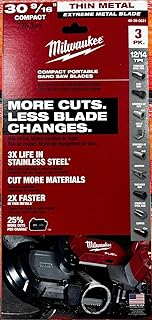
For heavy sections on a compact portable saw, a dedicated blade like the Milwaukee 48-39-0631 in 12/14 TPI is designed for thick metal and clears chips better than a general-purpose pitch.
How do I stop the blade from wandering?
Check tension and guide bearing clearance before blaming the blade. Once those are right, widen the blade for straight cuts and slow your feed pressure rather than forcing the material.
Final Thoughts
For most lighting fabrication, the Lenox Classic Tuff Tooth in 18 TPI covers tube and thin section work with the finish quality that visible fixture parts demand, and the Lenox Diemaster 2 in 3/8″ handles every curve you’ll want to cut. Add the Lenox Classic Pro Vari-Raker when heavier plate and bar enter the picture, and the bench is genuinely covered.