Key takeaways
- Finish and light interaction: Dark wood tones like rustic brown absorb ambient light and ground a room, making them ideal for spaces with abundant overhead or natural illumination. White and mirrored finishes amplify existing light — a serious advantage in bedrooms that rely on a single window or a pair of bedside lamps.
- Built-in lighting features: Integrated LED armoires serve double duty as accent lighting sources. A warm-toned LED strip inside a wardrobe with barn doors can cast a soft, welcoming glow when the doors are open — functioning almost like a low-wattage floor lamp during evening hours.
- Material and visual weight: Solid wood armoires carry a visual heaviness that dominates a room’s sightlines, while steel-framed cabinets read as lighter and more open. Match the material to the density of furniture already in the space; two massive wooden pieces three feet apart will crowd the eye.
- Mirror placement: A mirrored door panel doesn’t just add convenience — it redirects and multiplies light. In a small bedroom, a mirrored armoire positioned opposite a window can visually double the room’s brightness without any wiring.
- Door style and room flow: Sliding barn doors require zero clearance swing space and preserve sightlines when partially open. Traditional hinged doors need a full arc in front of the cabinet, which can interrupt traffic flow and block nearby light fixtures in tighter layouts.
What's inside
Choosing the right armoire closet is less about square footage and more about how a piece of furniture reshapes the entire feel of a room. A tall, light-absorbing wardrobe in a dimly lit bedroom can flatten the space into a cave; a reflective metal cabinet in a sun-drenched spare room can bounce light around like an unintended disco. Buyers routinely grab the first freestanding closet that fits their budget, only to discover it kills the ambience they spent months cultivating.
This guide approaches the 2026 armoire market from that exact tension — storage function versus living-space atmosphere. Every pick below was evaluated not just for hanging capacity and drawer count, but for how its materials, finishes, and built-in lighting interact with a room’s existing palette and light sources. Whether you need a rustic anchor for a warm-lit bedroom or a sleek silhouette that disappears into a minimalist suite, the right match is here.
As an Amazon Associate we earn from qualifying purchases.




🛒 Best Price Today on Amazon
Prime members get fast, free shipping on everything above, plus member-only deals. New members get a 30-day free trial — cancel anytime.
How to Choose an Armoire Closet (2026)
- Finish and light interaction: Dark wood tones like rustic brown absorb ambient light and ground a room, making them ideal for spaces with abundant overhead or natural illumination. White and mirrored finishes amplify existing light — a serious advantage in bedrooms that rely on a single window or a pair of bedside lamps.
- Built-in lighting features: Integrated LED armoires serve double duty as accent lighting sources. A warm-toned LED strip inside a wardrobe with barn doors can cast a soft, welcoming glow when the doors are open — functioning almost like a low-wattage floor lamp during evening hours.
- Material and visual weight: Solid wood armoires carry a visual heaviness that dominates a room’s sightlines, while steel-framed cabinets read as lighter and more open. Match the material to the density of furniture already in the space; two massive wooden pieces three feet apart will crowd the eye.
- Mirror placement: A mirrored door panel doesn’t just add convenience — it redirects and multiplies light. In a small bedroom, a mirrored armoire positioned opposite a window can visually double the room’s brightness without any wiring.
- Door style and room flow: Sliding barn doors require zero clearance swing space and preserve sightlines when partially open. Traditional hinged doors need a full arc in front of the cabinet, which can interrupt traffic flow and block nearby light fixtures in tighter layouts.
The Best Armoire Closet (2026)s Reviewed
Farmhouse 4-Door Barn Door Armoire with LED
This piece stands out because it treats the wardrobe as a lighting fixture. The built-in LED strips paired with sliding barn doors create a layered, gallery-style glow when opened — perfect for bedrooms where the armoire sits across from the bed and serves as a focal point rather than a hidden utility. The rustic brown finish anchors warm-toned rooms without overwhelming them.
VOWNER 71-Inch Armoire with Mirror
The six-door, mirror-fronted design makes this VOWNER unit a light multiplier. In bedrooms with limited natural light, the mirrored panels bounce ambient illumination across the room and create an illusion of depth that no solid-panel armoire can match. Its generous 71-inch height also keeps the reflective surface at eye level, maximizing the spatial effect.
ANCTOR 3-Door Modern Farmhouse Armoire
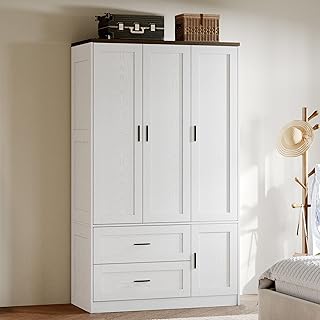
Clean white finishes are a lighting designer’s easiest tool, and the ANCTOR leverages that principle. Soft-close hinges prevent the subtle door-slam that disrupts quiet rooms, while the white surface picks up and diffuses whatever light sources are nearby — bedside sconces, recessed cans, or a single pendant. Ideal for modern farmhouse interiors that prize understated brightness.
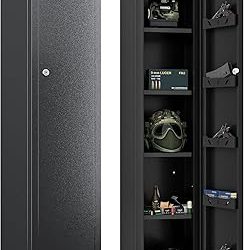
GAIOUS Metal Wardrobe Cabinet (Black)
Steel construction gives this cabinet an industrial edge that reads lighter than its actual mass. The matte black finish absorbs harsh overhead light rather than reflecting it, which is exactly the behavior you want in rooms with bright, cool-toned LED ceiling panels. The GAIOUS turns a potential glare problem into a moody, grounded aesthetic statement.
Metal Armoire with Mirror (71-Inch, Black)
Combining a steel frame with a mirrored door panel solves two lighting problems at once. The metal body adds industrial character and tames overbright environments, while the mirror injects a targeted reflective surface that restores depth and dimensionality. For bedrooms that split the difference between moody and functional, this is the most balanced option in the roundup.
Frequently Asked Questions
Can an armoire replace a built-in closet for lighting purposes?
An armoire will never fully substitute for architectural lighting, but a unit with integrated LEDs — like the Farmhouse Barn Door model — can add a meaningful layer of accent light. Use it as supplementary mood lighting rather than a primary source, and pair it with warm-toned bulbs to keep the atmosphere cohesive.
Do mirrored armoires make small rooms feel larger?
Yes, particularly when positioned to reflect a window or an open doorway. The VOWNER and the metal armoire with mirror both redirect light in ways that visually push walls outward. The key is placement: aim the mirror toward the room’s brightest light source for maximum depth effect.
Are metal armoires harder to light around than wooden ones?
Actually the opposite — matte black metal absorbs stray reflections rather than creating them, giving you more control over how light behaves in the room. Wooden finishes, especially glossy ones, can introduce unintended hot spots. Metal lets you shape the ambience without fighting surface glare.
How do I choose between sliding barn doors and hinged doors?
Consider your room’s light fixtures first. If the armoire sits near a wall-mounted sconce or floor lamp, hinged doors risk swinging into the fixture’s light cone and casting shadows. Sliding barn doors stay flush and preserve an uninterrupted light path, making them the safer choice in tight, deliberately lit spaces.
Final Thoughts
From a lighting-and-ambience standpoint, the Farmhouse 4-Door Barn Door Armoire with LED delivers the most thoughtful interplay between storage and atmosphere, functioning as both wardrobe and ambient light source. For rooms starved of natural light, the VOWNER 71-Inch Armoire with Mirror is the strongest tool for visually expanding space and redirecting illumination. And if your bedroom already runs bright and you need a piece that absorbs rather than amplifies, the GAIOUS Metal Wardrobe Cabinet brings grounded, moody contrast without sacrificing an ounce of storage capacity.