Key takeaways
- Noise level in dBA: Anything at or under 60 dBA lets you work beside a client without shouting; conventional pancakes land near 78–82 dBA, which is roughly the difference between a refrigerator hum and a garbage disposal. If you install in finished homes, treat this as your first filter, not a bonus feature.
- SCFM at 90 PSI: This is the number that determines whether your tool works. Brad and pin nailers sip around 0.3–0.5 SCFM, staplers and framing nailers want more, and any spray gun or sander needs several times that. Match the tool you use most, then leave headroom.
- Tank volume versus recovery: A bigger tank means fewer motor cycles, which matters more for ambience than raw capacity does. A one-gallon tank restarts constantly; four to eight gallons lets you trim a whole wall of shadow-gap detail between cycles.
- Weight and how it travels: Aluminum tanks and wheel kits change what you’re willing to carry upstairs at 7 p.m. Under 30 pounds is genuinely portable for a single lightweight fixture job; 50 pounds wants wheels or a second set of hands.
- Oil-free pump and duty cycle: Oil-free means no crankcase checks and no tipping worries in a client’s dining room. Look for a stated duty cycle around 50 percent or better, and expect ultra-quiet units to run slower RPM pumps that last longer but fill less aggressively.
What's inside
Anyone who designs rooms for a living learns the same lesson twice: the light sells the space, and the noise unsells it. I spend most of my working hours dialing in 2700K glow, hiding drivers behind crown molding, and tacking upholstery on case goods that will sit under a pendant for the next twenty years. All of that means pin nailers, brad nailers, blow guns, and staple crowns, which means a compressor. And the wrong compressor turns a calm, half-finished living room into a jet apron every ninety seconds, which is a real problem when the homeowner is three feet away deciding between linen and bouclé.
This guide looks at air tool compressors the way a lighting and ambience person has to: by decibel level first, then by whether the machine can actually feed a nailer or an HVLP touch-up gun without gasping. I’ve grouped the models that hold up in occupied rooms, on scissor lifts, and in workshops where you also want to hear a conversation. Below you’ll find the picks, then a short buying framework, individual notes on each unit, and answers to the questions that come up most from furniture makers and installers.
As an Amazon Associate we earn from qualifying purchases.




🛒 Best Price Today on Amazon
Prime members get fast, free shipping on everything above, plus member-only deals. New members get a 30-day free trial — cancel anytime.
How to Choose a Air Tool Compressor (2026)
- Noise level in dBA: Anything at or under 60 dBA lets you work beside a client without shouting; conventional pancakes land near 78–82 dBA, which is roughly the difference between a refrigerator hum and a garbage disposal. If you install in finished homes, treat this as your first filter, not a bonus feature.
- SCFM at 90 PSI: This is the number that determines whether your tool works. Brad and pin nailers sip around 0.3–0.5 SCFM, staplers and framing nailers want more, and any spray gun or sander needs several times that. Match the tool you use most, then leave headroom.
- Tank volume versus recovery: A bigger tank means fewer motor cycles, which matters more for ambience than raw capacity does. A one-gallon tank restarts constantly; four to eight gallons lets you trim a whole wall of shadow-gap detail between cycles.
- Weight and how it travels: Aluminum tanks and wheel kits change what you’re willing to carry upstairs at 7 p.m. Under 30 pounds is genuinely portable for a single lightweight fixture job; 50 pounds wants wheels or a second set of hands.
- Oil-free pump and duty cycle: Oil-free means no crankcase checks and no tipping worries in a client’s dining room. Look for a stated duty cycle around 50 percent or better, and expect ultra-quiet units to run slower RPM pumps that last longer but fill less aggressively.
The Best Air Tool Compressor (2026)s Reviewed
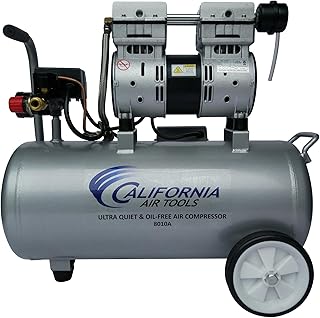
California Air Tools 8010A
At 60 dBA with an 8-gallon aluminum tank and wheels, this is the machine I keep for full-day upholstery and millwork sessions in furnished rooms; the low-RPM pump cycles rarely and never dominates the space. It’s the closest thing to a compressor you can run during a client walkthrough without apologizing.
California Air Tools CAT-1P1060S
A 56 dBA, one-gallon steel-tank unit light enough to carry up a ladder well with a pin nailer in the other hand, ideal for fitting cove lighting valances and small trim returns. The tradeoff is frequent restarts, so keep it to low-consumption tools.
California Air Tools CAT-4610AC
The 4.6-gallon aluminum twin-tank splits the difference cleanly: still ultra-quiet and oil-free, but with enough stored air for continuous brad and staple work on case goods and headboards. If you want one quiet compressor for both shop and site, this is the sensible middle.
DEWALT DWFP55126 Pancake
Six gallons, 165 max PSI, and 2.6 SCFM at 90 PSI make this the strongest performer here for roofing, framing, and anything with a real air appetite. It is loud, so treat it as a workshop or unoccupied-jobsite tool rather than a finished-room companion.
BOSTITCH BTFP02012-WPK
A quieter, lighter take on the 6-gallon pancake at 150 PSI, and the included accessory kit means you’re working the day it arrives. Good value for a home shop where you build the furniture and then light it.
Frequently Asked Questions
Is 60 dBA actually quiet enough to work indoors?
Yes, in practice. Sixty dBA sits at normal conversation level, so you can talk over it and clients rarely comment. The bigger win is that ultra-quiet pumps also vibrate less, so nothing walks across a finished floor.
Can these run a spray gun for finishing furniture?
Small detail and touch-up guns, sometimes. Full HVLP spraying typically needs sustained SCFM well beyond what any of these deliver, so plan on a larger stationary compressor or a turbine system for cabinet-grade finishing.
Do I need 165 PSI?
Only if you’re running framing or roofing nailers, or want more usable air stored in the same tank volume. For pin, brad, and narrow-crown work, 120–150 PSI is plenty.
Oil-free versus oil-lubricated for occasional use?
Oil-free wins for intermittent, mobile work: no maintenance schedule, no orientation limits, and cold starts aren’t a problem. Oil-lubricated pumps still lead on longevity under heavy daily duty.
Final Thoughts
If you work in rooms people are living in, the California Air Tools 8010A is the pick that changes your day, with the CAT-4610AC as the lighter, more portable version of the same idea. When output matters more than atmosphere, the DEWALT DWFP55126 has the muscle for framing and roofing work.