Key takeaways
- True HEPA, not “HEPA-type”: Mold spores run roughly 1 to 20 microns and dust fragments go far smaller, so insist on a genuine H13 or true HEPA element rated to capture 99.97% at 0.3 microns. Marketing hedges like “HEPA-style” mean the media has not been held to that standard.
- Activated carbon for the musty note: Particle filters trap the spore; only carbon adsorbs the microbial VOCs that create that damp-cellar smell. If odor is your complaint, weight the carbon stage heavily.
- Coverage rated at a useful air change rate: Square-footage claims often assume a single hourly air change. For mold and heavy dust, size up so the unit clears your room four to five times an hour, which usually means buying for double your actual floor area.
- Noise you can live with after dark: A purifier that reads 24 to 28 dB on sleep mode disappears into a room. Anything louder becomes the acoustic equivalent of a buzzing driver, and you will switch it off and defeat the purpose.
- Washable pre-filter and honest filter costs: A rinseable mesh pre-stage catches lint, pet fur, and coarse dust so the expensive HEPA layer lasts. Check annual replacement pricing before you commit, since that is the real cost of ownership.
What's inside
Anyone who works with light for a living learns to read a room by its air. Point a warm 2700K spot across a living space and you see everything the naked eye politely ignores: drifting dust catching the beam like fine snow, a low haze that flattens contrast and dulls the saturation you spent hours dialing in, and in damper rooms, that heavy earthen note of mold that no amount of dimming or diffusion can style out. Dust and mold spores are not just a health problem. They are a finish problem, settling into matte lampshades, clouding glass, and softening the crisp edges of every fixture you own.
This guide approaches air purification the way a designer approaches a lighting plan: coverage first, then noise floor, then how the object behaves inside a styled room. Below are the machines that hold up under real conditions in bedrooms, open-plan living areas, basements, and north-facing rooms that never fully dry out. Each has been considered for filtration honesty, room-scale performance, and whether it earns its footprint next to good furniture.
As an Amazon Associate we earn from qualifying purchases.


How to Choose an Air Purifier For Mold And Dust (2026)
- True HEPA, not “HEPA-type”: Mold spores run roughly 1 to 20 microns and dust fragments go far smaller, so insist on a genuine H13 or true HEPA element rated to capture 99.97% at 0.3 microns. Marketing hedges like “HEPA-style” mean the media has not been held to that standard.
- Activated carbon for the musty note: Particle filters trap the spore; only carbon adsorbs the microbial VOCs that create that damp-cellar smell. If odor is your complaint, weight the carbon stage heavily.
- Coverage rated at a useful air change rate: Square-footage claims often assume a single hourly air change. For mold and heavy dust, size up so the unit clears your room four to five times an hour, which usually means buying for double your actual floor area.
- Noise you can live with after dark: A purifier that reads 24 to 28 dB on sleep mode disappears into a room. Anything louder becomes the acoustic equivalent of a buzzing driver, and you will switch it off and defeat the purpose.
- Washable pre-filter and honest filter costs: A rinseable mesh pre-stage catches lint, pet fur, and coarse dust so the expensive HEPA layer lasts. Check annual replacement pricing before you commit, since that is the real cost of ownership.
The Best Air Purifier For Mold And Dust (2026)s Reviewed
LEVOIT Core 300 / Core 300-P
The benchmark compact for bedrooms and studies, pairing an H13 true HEPA element with a genuinely quiet sleep mode that measures around 24 dB, so it vanishes beside a nightstand lamp. AHAM-verified coverage and a cylindrical, low-profile shell make it the easiest unit to specify when you do not want the appliance reading as an appliance.
COWAY Airmega Mighty2 (AP-1512N)
The next generation of the long-trusted AP-1512HH, with IEST-certified HEPA plus active carbon and coverage up to 1,800 square feet, which is why it remains the default recommendation for open-plan rooms with a mold history. The wall-hugging flat body and top-facing controls let it sit tight against a console without disrupting sightlines.
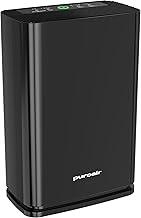
PuroAir 400
Built for genuinely large volumes at up to 2,000 square feet, with a CarbonTech stage that goes noticeably further than thin carbon wraps on musty basement air. The onboard air quality sensor and auto mode mean it ramps only when the room needs it, which keeps the noise floor low during evenings.
Alen 35i
The design-forward option, with a true HEPA Ultimate filter tuned for odors, mold, and smoke across 1,400 square feet, plus app control and real particulate data rather than a vague colored light. Interchangeable front panels let you match cabinetry or upholstery instead of accepting default white plastic.
KNKA APH4000
Strong value at scale, clearing up to 1,695 square feet in an hour with AHAM-verified numbers, a washable pre-filter, an AQI display, and a dedicated pet mode for dander-heavy homes. It comes in white or black, and the black finish is a rare gift in this category for rooms built on darker, moodier palettes.
Frequently Asked Questions
Can an air purifier remove existing mold?
No. A purifier captures airborne spores and reduces musty odors, but it cannot treat colonies growing on drywall, grout, or subfloor. Remediate the source and control humidity below 50%, then let the purifier handle what circulates.
Where should I place the unit?
Give it 12 to 18 inches of clearance and put it near the dust source or the room’s return path, not tucked behind a sofa. Corners and closed cabinets choke intake and cut effective throughput dramatically.
Should it run continuously?
Yes, on auto or low. Continuous low-speed operation maintains cleaner air with less noise and less filter stress than intermittent bursts on high.
Do UV or ionizer add-ons help with mold?
Their real-world contribution is modest at typical airflow rates, and some ionizers generate trace ozone. Prioritize sealed HEPA plus generous carbon and treat extras as optional.
Final Thoughts
For most rooms, the COWAY Airmega Mighty2 is the safest specification, delivering proven filtration and large-room coverage in a body that disappears against a wall. Pair it with a LEVOIT Core 300 in the bedroom for near-silent overnight running, or step up to the Alen 35i when the purifier has to look intentional in a carefully lit space.