Key takeaways
- Match the port, not the hose: A 1/4″ inline trap suits a single gun at the wall; 1/2″ and 3/4″ NPT units keep pressure drop low when you’re feeding a plasma cutter, blast cabinet, or two stations at once.
- Count the stages honestly: Particulate first, coalescing second, desiccant third. Three stages handle spray finishing; four-stage systems add polish for high-gloss lacquer, candy coats, and anything where a single speck reads as a shadow.
- Insist on auto drain: Manual bowls get forgotten mid-project, then dump water into your line at the worst moment. Auto-draining bowls purge on their own, which matters when your attention is on the gun.
- Check the regulator range: 0–240 PSI gives headroom for cutting and blasting; a 0–150 PSI unit is plenty for HVLP and detail guns. Look for a gauge you can actually read under work lighting.
- Metal bowls over plastic: Solvent vapor, heat, and dropped tools all punish polycarbonate. Metal bowls survive shop life and won’t craze into a cloudy guessing game.
What's inside
Anyone who builds mood for a living knows the finish carries the light. A brass sconce with a hand-rubbed lacquer throws a warm, forgiving glow; the same sconce with a hazed, orange-peeled topcoat scatters light like frosted plastic and flattens the whole room. The culprit is almost never the gun or the paint. It’s water — condensate riding your air line, atomizing into the coat, blooming into fisheyes and blush hours after you thought the piece was done. Compressed air heats, then cools, then sheds moisture exactly where you least want it, and on humid finishing days a bare tank drain simply cannot keep up.
This guide looks at air compressor water separators through the eyes of a lighting-and-ambience designer: someone spraying lamp bases and shade frames, plasma-cutting steel diffusers, blasting patina off salvaged fittings, and running a small compressor in a shop that doubles as a staging area. We cover what actually matters in a filter stack, then break down the strongest options for 2026 across port sizes and stage counts.
As an Amazon Associate we earn from qualifying purchases.




How to Choose a/an Air Compressor Water Separator (2026)
- Match the port, not the hose: A 1/4″ inline trap suits a single gun at the wall; 1/2″ and 3/4″ NPT units keep pressure drop low when you’re feeding a plasma cutter, blast cabinet, or two stations at once.
- Count the stages honestly: Particulate first, coalescing second, desiccant third. Three stages handle spray finishing; four-stage systems add polish for high-gloss lacquer, candy coats, and anything where a single speck reads as a shadow.
- Insist on auto drain: Manual bowls get forgotten mid-project, then dump water into your line at the worst moment. Auto-draining bowls purge on their own, which matters when your attention is on the gun.
- Check the regulator range: 0–240 PSI gives headroom for cutting and blasting; a 0–150 PSI unit is plenty for HVLP and detail guns. Look for a gauge you can actually read under work lighting.
- Metal bowls over plastic: Solvent vapor, heat, and dropped tools all punish polycarbonate. Metal bowls survive shop life and won’t craze into a cloudy guessing game.
The Best Air Compressor Water Separator (2026)s Reviewed
3/4″ NPT 4-Stage Industrial Air Drying System
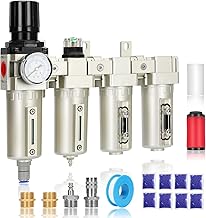
The high-flow choice when you’re sandblasting patina or laying down show-quality clearcoat and cannot afford starvation at the gun. Four stages plus auto drain make it the most complete stack here, and the 3/4″ ports keep a big compressor breathing freely.
1/2″ NPT 3-Stage System with Desiccant Dryer
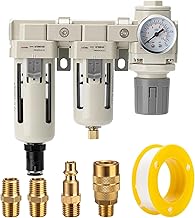
A well-balanced shop workhorse: particulate, coalescing, and desiccant filtration behind a 0–240 PSI regulator with a metal bowl. This is the setup I’d hang on the wall of a mixed-use studio where the same line feeds finishing, cutting, and cleanup.
1/2″ NPT 4-Stage Air Dryer, 141 CFM
Rated flow is the story — 141 CFM means the four-stage filtration isn’t paid for in pressure drop, so plasma cuts stay clean and spray patterns stay consistent. Strong pick for anyone fabricating metal shades and finishing them in the same session.
1/2″ NPT 3-Stage Filter Dryer with Regulator
Leaner than the four-stage units and easier to service, with the same 0–240 PSI regulator and auto drain. If your work leans toward satin and matte finishes where micro-texture is forgiving, this covers you without the extra element to maintain.
LE LEMATEC AI303 1/4″ Inline Filter
The point-of-use insurance policy: a compact moisture trap that lives at the gun or coupler and catches whatever slips past your wall unit. Inexpensive, auto-draining, and genuinely worth running downstream of a larger system.
Frequently Asked Questions
Does my tank drain replace a separator?
No. Draining the tank removes bulk water already collected; a separator removes aerosolized moisture and oil that forms as air cools in the line downstream, which is the part that reaches your finish.
How far from the compressor should I mount it?
Farther is better. Give the air 20–25 feet of line to cool first, ideally with a drip leg, so the separator is condensing moisture rather than fighting hot air.
Do I need three stages for basic painting?
For primer and satin topcoats on lamp bases, a two-stage filter with auto drain is usually sufficient. Gloss and metallic finishes are where the desiccant stage earns its keep.
What about the 3/8″ NPT double-filter units?
The 3/8 NPT air filter dryer with auto and semi-auto drains is a tidy fit for smaller compressors and 0–150 PSI work — good for detail guns and airbrush-scale finishing, less suited to blasting.
Final Thoughts
For a studio that finishes fixtures and cuts metal under one roof, the 3/4″ four-stage system is the safest long-term buy, with the 1/2″ 141 CFM four-stage close behind at a friendlier footprint. Add the LE LEMATEC AI303 at the gun and you’ve built redundancy where the stakes are highest — right before the air meets the finish that carries your light.