Key takeaways
- SCFM at 90 PSI: This is the number that actually drives your tool. A brad or pin nailer wants roughly 0.3–0.5 SCFM, a framing nailer closer to 2, and a HVLP touch-up gun far more. Add your tools’ demands, then add 30% headroom.
- Tank size versus recovery: A larger tank buys you burst capacity; a stronger pump buys you sustained work. Six gallons suits trim and moderate framing. One gallon is fine for occasional indoor pin work where the motor gets time to breathe.
- Noise, measured honestly: Decibels matter when you’re working in an occupied home or a gallery install. Anything near 80 dBA is a shout-over-it machine; low-70s models let you stay in conversation with a client.
- Weight and how it moves: If you carry gear up stairs alongside fixtures and lamp stock, every pound counts. Look at the handle and roll cage before you look at the spec sheet.
- Oil-free pump and cold-start behavior: Oil-free means no crankcase to check and no risk of oil mist reaching a finished surface. Also check that the motor starts under load in a cold garage without tripping a household breaker.
What's inside
Ambience work is quieter than people think. Most of a job is small, repeatable, precise: pin-nailing a mitered frame around a diffusion panel, tacking linen to a stretcher for a wall wash, brad-nailing cove molding that will hide an LED channel, stapling blackout fabric behind a sheer. The tools that do this well are pneumatic, and pneumatic tools are only as good as the air behind them. A compressor that can’t keep up leaves you with half-driven pins, a proud nail head that catches light at exactly the wrong angle, and a finish carpenter’s nightmare on a surface you were planning to graze with a 3000K wash.
This guide looks at compressors through that lens: enough recovery to keep a nailer honest, enough restraint to work in a finished room without shaking the glassware. We cover pancake units for trim and framing, a cordless inflator for the truck, and a small quiet model for delicate indoor work. One note before you shop — searches for “compressor” often surface HVAC parts like the Goodman ZR25K5EPFV800 Copeland Scroll. That’s a sealed refrigerant compressor for air conditioning systems, not an air supply for tools, so skip it here.
As an Amazon Associate we earn from qualifying purchases.



🛒 Best Price Today on Amazon
Prime members get fast, free shipping on everything above, plus member-only deals. New members get a 30-day free trial — cancel anytime.
How to Choose an Air Compressor For Pneumatic Tools (2026)
- SCFM at 90 PSI: This is the number that actually drives your tool. A brad or pin nailer wants roughly 0.3–0.5 SCFM, a framing nailer closer to 2, and a HVLP touch-up gun far more. Add your tools’ demands, then add 30% headroom.
- Tank size versus recovery: A larger tank buys you burst capacity; a stronger pump buys you sustained work. Six gallons suits trim and moderate framing. One gallon is fine for occasional indoor pin work where the motor gets time to breathe.
- Noise, measured honestly: Decibels matter when you’re working in an occupied home or a gallery install. Anything near 80 dBA is a shout-over-it machine; low-70s models let you stay in conversation with a client.
- Weight and how it moves: If you carry gear up stairs alongside fixtures and lamp stock, every pound counts. Look at the handle and roll cage before you look at the spec sheet.
- Oil-free pump and cold-start behavior: Oil-free means no crankcase to check and no risk of oil mist reaching a finished surface. Also check that the motor starts under load in a cold garage without tripping a household breaker.
The Best Air Compressor For Pneumatic Tools (2026)s Reviewed
DEWALT 6 Gallon Pancake (DWFP55126)
The default recommendation for good reason: 165 max PSI and 2.6 SCFM at 90 PSI give it real recovery for finish nailing and light framing, with a high-efficiency motor that starts reliably in cold shops. The oil-free pump means nothing to maintain and nothing to leak onto a fabric-covered panel.
Metabo HPT 6 Gallon Pancake (EC914S)
At 200 PSI and 4 CFM, this is the one to reach for when two people are working — it will feed a framing nailer and a brad gun at the same time without either operator waiting on the tank. The extra pressure also stretches the usable air per fill, which matters on long runs of ceiling trim.
BOSTITCH 6 Gallon Quiet Pancake Kit (BTFP02012-WPK)
The quiet, lightweight pick, and the one I’d bring into a furnished room. It runs noticeably softer than typical pancakes at 150 PSI, and the included accessory kit means you’re taping hose ends instead of hunting for fittings on day one.
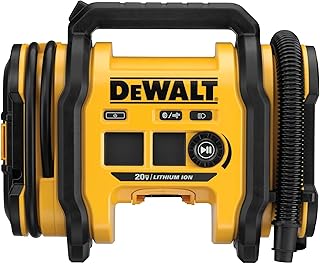
DEWALT 20V MAX Tire Inflator (DCC020IB)
Not a tool compressor, but the piece of kit that keeps a mobile install running: it tops off van tires, cart wheels, and air mattresses on site, with automatic shutoff at a set pressure and an LED for dark loading docks. Runs on the same 20V batteries as the rest of your bag.
SENCO 1-Gallon PC1010
Twenty pounds, half a horsepower, and genuinely mild-mannered — this is the compressor for upholstery staples, pin nails, and mockup work in an occupied space. It won’t sustain a framing nailer, and it isn’t meant to.
Frequently Asked Questions
How much air does a brad nailer really need?
Around 0.3 to 0.5 SCFM at 90 PSI for typical intermittent firing. Any of the six-gallon pancakes here have several times that margin, which is why they barely cycle during trim work.
Can one compressor run two nailers at once?
Yes, if the SCFM rating covers the combined draw. The Metabo HPT EC914S at 4 CFM is the comfortable choice for two-gun crews; a 2.6 SCFM unit will manage two finish nailers but lag with two framers.
Does higher PSI mean a more powerful tool?
No. Most pneumatic tools regulate down to 90–100 PSI regardless of tank pressure. Higher tank pressure simply stores more air in the same volume, so you get longer stretches between motor cycles.
Is a quiet compressor worth the trade-off?
If you work in finished interiors, yes. Quiet models generally use slower-turning motors, which means slightly gentler recovery — an easy compromise when the alternative is asking a client to leave the room.
Final Thoughts
For most people building, trimming, and finishing around light — the DEWALT DWFP55126 is the balanced buy, with the recovery for framing and the manners for finish work. Step up to the Metabo HPT EC914S if two guns run at once, or take the SENCO PC1010 when the job is delicate, indoors, and needs to stay calm.