Key takeaways
- Airflow over pressure claims: Nearly everything advertises 150 PSI, which is not the useful number. CFM is. Anything under 2 CFM will crawl on 33-inch tires; dual-cylinder units in the 7 to 12 CFM range refill a full set in minutes rather than a long, cold half hour.
- Duty cycle and thermal headroom: A 100% duty cycle rating means the pump can run continuously without a cooldown pause. If you air down and up regularly, this matters more than raw speed, because a compressor that overheats mid-tire leaves you standing in the dark waiting.
- Lighting quality, not just presence: Look for a warm or neutral-white work light aimed forward at the valve, ideally with a diffused lens. Bare high-CCT LEDs pointed at your face destroy dark adaptation and make the rest of the trail read as a black wall for several minutes afterward.
- Display legibility in low ambient light: Backlit digital gauges beat analog dials at night by a wide margin. Dual screens let you watch pressure and target simultaneously without leaning in, and auto shut-off means you can look away entirely.
- Power architecture and cable geometry: Battery-platform tools are tidy and quiet; direct-to-battery clamp kits deliver far more airflow. Whichever you pick, check hose and lead length against your longest wheelbase reach, because a taut cable in the dark is a trip hazard across your whole campsite.
What's inside
Trail recovery almost never happens at high noon. It happens in that blue half-hour after sunset, or in full dark with a lockspar of headlamp beams crossing each other, when you’re airing back up on a gravel shoulder and the temperature has dropped fifteen degrees. As someone who designs light for rooms and spaces, I notice this immediately: the compressor you choose is also a light source, a noise source, and a thing that either calms a scene or turns it into a strobing mess. The wrong one hums like a shop vac and floods your retinas with cold blue glare, wrecking the night vision you need to see the valve stem.
This guide looks at portable 12V and cordless inflators for off-road use with two things weighted equally: how fast they move air, and how they behave in low light. That means duty cycle and CFM, yes, but also screen legibility at dusk, whether the work light points where your hands are, glare control, and how much cable clutter you end up dragging across a dark campsite. Below are the units worth your money in 2026.
As an Amazon Associate we earn from qualifying purchases.




How to Choose a/an Air Compressor For Off Roading (2026)
- Airflow over pressure claims: Nearly everything advertises 150 PSI, which is not the useful number. CFM is. Anything under 2 CFM will crawl on 33-inch tires; dual-cylinder units in the 7 to 12 CFM range refill a full set in minutes rather than a long, cold half hour.
- Duty cycle and thermal headroom: A 100% duty cycle rating means the pump can run continuously without a cooldown pause. If you air down and up regularly, this matters more than raw speed, because a compressor that overheats mid-tire leaves you standing in the dark waiting.
- Lighting quality, not just presence: Look for a warm or neutral-white work light aimed forward at the valve, ideally with a diffused lens. Bare high-CCT LEDs pointed at your face destroy dark adaptation and make the rest of the trail read as a black wall for several minutes afterward.
- Display legibility in low ambient light: Backlit digital gauges beat analog dials at night by a wide margin. Dual screens let you watch pressure and target simultaneously without leaning in, and auto shut-off means you can look away entirely.
- Power architecture and cable geometry: Battery-platform tools are tidy and quiet; direct-to-battery clamp kits deliver far more airflow. Whichever you pick, check hose and lead length against your longest wheelbase reach, because a taut cable in the dark is a trip hazard across your whole campsite.
The Best Air Compressor For Off Roading (2026)s Reviewed
DEWALT DCC020IB 20V MAX Tire Inflator
The most civilized option here: quiet enough for a pre-dawn departure, with a genuinely well-aimed LED that lights the valve stem instead of your eyes, and an auto shut-off that lets you set a pressure and walk away. It’s a top-off and trail-repair tool rather than a fast full-refill unit, so treat it as the compressor you keep in the cab, not the one you rely on for four 35s.
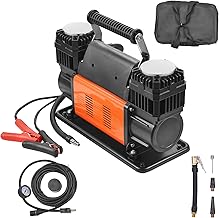
ALL-TOP Dual Cylinder 12V Kit, 12.35 CFM
This is the heavy hitter, and the airflow is what buys back your evening; it clamps straight to the battery and moves enough air that you’re back on pavement before the light fully goes. If your rig runs smaller tires, ALL-TOP’s 7.06 CFM single-cylinder kit uses the same build language for less bulk and less current draw.
VEVOR 10.6 CFM Dual-Cylinder Inflator
Close to the ALL-TOP’s performance for noticeably less money, with a broad adapter set that covers RV tires, air mattresses, and camp inflatables. The gauge is the weak point in low light, so plan on a headlamp or read pressure with a separate digital gauge.
ROCGORLD R8 Dual Digital Screen Inflator
The large twin backlit screens are the standout, readable at arm’s length in near-dark, which is exactly the sort of detail that separates a pleasant roadside stop from a fumbling one. Airflow is modest compared to the clamp-on kits, so this is a commuter-and-light-trail choice.
ETENWOLF VORTEX S6 Cordless Inflator
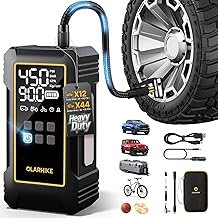
My pick for anyone who values a clean, cordless setup: dual cylinders and a 100% duty cycle in a self-powered body, with a diffused LED backlight that spills usable working light without blinding anyone nearby. The 19200mAh pack also doubles as a camp power source, which is a real advantage on longer trips.
Frequently Asked Questions
How much CFM do I actually need?
For 31 to 33-inch tires, 2 to 3 CFM is workable. Above 33 inches, aim for 7 CFM or more, or accept refill times long enough that you’ll be doing them by flashlight.
Can I run a 12V compressor with the engine off?
Briefly, yes, but high-draw dual-cylinder units can pull enough current to leave you with a soft start. Idle the engine during long refills, or use a cordless unit like the VORTEX S6.
Does the built-in light actually replace a work light?
No. Onboard LEDs are task lights for the valve area. Keep a separate diffused lantern or headlamp for general area lighting, and prefer warm color temperatures so you preserve night vision.
Are these compressors loud?
Battery inflators are moderate; high-CFM dual-cylinder pumps are genuinely loud. If you camp with others, factor that into when and where you air up.
Final Thoughts
For serious airflow on big tires, the ALL-TOP Dual Cylinder 12.35 CFM kit is the one I’d bolt into a build, with the VEVOR 10.6 CFM as the value alternative. If you want the tidiest, quietest, best-lit experience at the end of a long day, the ETENWOLF VORTEX S6 is the smarter buy, and the DEWALT DCC020IB stays in the cab for top-offs.