Key takeaways
- Noise output: Look for compressors rated under 45 dB if you work in a shared living space or run sessions late. Quieter units preserve the ambient calm that lets you focus on fine detail work without auditory fatigue.
- Pressure consistency: A built-in regulator and water trap are non-negotiable. Steady PSI delivery prevents tip spattering and ensures even pigment atomization across broad surfaces and tight corners alike.
- Tank capacity: A 3-liter (or larger) tank acts as a buffer, reducing motor cycling and giving you uninterrupted airflow during extended spraying sessions—critical when layering translucent finishes on furniture or decor.
- Cooling system: Dual-fan or upgraded single-piston designs with active cooling extend runtime and prevent thermal shutdown, which matters when you’re mid-project and can’t afford uneven drying on a wet coat.
- Portability and footprint: Consider where the unit will live. Compact compressors that still deliver 25–48 PSI save bench space in smaller studios while remaining easy to stow between projects.
What's inside
If you’ve ever stood in a freshly finished studio watching a gradient mural dry under track lighting only to notice speckling from inconsistent air pressure, you already understand the real cost of pairing the wrong compressor with your airbrush. Fluctuating PSI, distracting noise, and moisture bleed turn what should be a meditative creative process into a frustrating guessing game—especially when the finish quality on cabinetry, accent walls, or custom furniture details has to hold up under scrutinizing light.
This guide cuts through the clutter. We evaluated six leading airbrush compressors on the factors that matter most to anyone who cares about controlled results in a home studio or workshop: pressure stability, operational volume, thermal management, and moisture control. Below you’ll find our curated picks, a practical buyer’s checklist, and answers to the questions that actually surface when you’re setting up a workspace.
As an Amazon Associate we earn from qualifying purchases.


How to Choose an Air Compressor for Airbrush (2026)
- Noise output: Look for compressors rated under 45 dB if you work in a shared living space or run sessions late. Quieter units preserve the ambient calm that lets you focus on fine detail work without auditory fatigue.
- Pressure consistency: A built-in regulator and water trap are non-negotiable. Steady PSI delivery prevents tip spattering and ensures even pigment atomization across broad surfaces and tight corners alike.
- Tank capacity: A 3-liter (or larger) tank acts as a buffer, reducing motor cycling and giving you uninterrupted airflow during extended spraying sessions—critical when layering translucent finishes on furniture or decor.
- Cooling system: Dual-fan or upgraded single-piston designs with active cooling extend runtime and prevent thermal shutdown, which matters when you’re mid-project and can’t afford uneven drying on a wet coat.
- Portability and footprint: Consider where the unit will live. Compact compressors that still deliver 25–48 PSI save bench space in smaller studios while remaining easy to stow between projects.
The Best Air Compressor for Airbrush (2026) Reviews
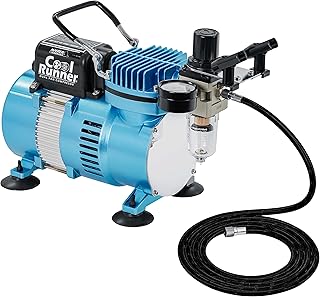
Master Airbrush TC-320 Cool Runner II
The TC-320’s dual-fan architecture keeps surface temperature remarkably low during marathon sessions, translating to rock-steady output without the thermal creep that ruins gradient work. For furniture refinishing and detailed accent pieces, the integrated regulator and water trap deliver dependable moisture-free airflow that holds paint consistency from the first pass to the last.
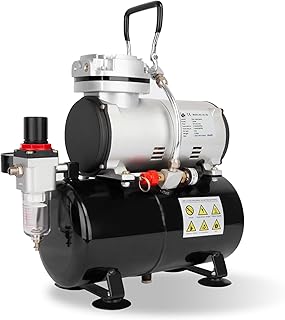
Timbertech AS186 with 3L Tank
Timbertech’s single-piston AS186 pairs a generous 3-liter reservoir with oil-free operation, meaning zero contamination risk when spraying solvent-based lacquers or water-based acrylics in an enclosed workspace. The built-in moisture trap is especially effective in humid environments where condensation can compromise an otherwise flawless clear coat.
Timbertech ABPST08 Upgraded with Cooling Fan
The ABPST08 takes the AS186 formula and adds active fan cooling, extending continuous spray time significantly—a welcome upgrade for anyone tackling multi-coat furniture projects where pausing means re-masking and re-mixing. Pressure delivery stays smooth even at lower PSI settings used for fine line detail on cabinet doors and trim.
Gaahleri Ambition Series GTS-06
The GTS-06 stands out by bundling a well-matched airbrush and compressor with integrated air control, reducing the trial-and-error of pairing components. In a studio setting where predictable, repeatable results matter more than raw power, this all-in-one approach streamlines the workflow from setup to cleanup.
Gocheer Airbrush Kit (48 PSI)
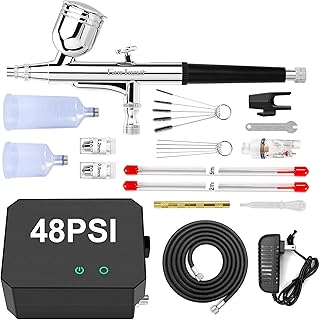
Topping out at 48 PSI gives the Gocheer kit genuine versatility—from broad priming coats on large furniture panels to delicate detail with its interchangeable 0.2mm, 0.3mm, and 0.5mm nozzles. The non-clogging design keeps maintenance minimal, which is a real advantage when you’re working under deadline on client pieces.
Frequently Asked Questions
Can I use these compressors for painting furniture and cabinetry?
Absolutely. Every compressor on this list handles the fine-mist application needed for furniture finishes. Models with 3-liter tanks and regulators—like both Timbertech units—are particularly suited to extended cabinetry work where consistent pressure prevents orange peel texture.
How loud are airbrush compressors in a home studio?
Most modern oil-free units operate between 35 and 47 dB. The ultra-quiet 35 dB models feel comparable to a running refrigerator, making them ideal for apartments or shared spaces where ambient noise is a genuine concern for both the operator and household members.
Do I need an external moisture trap?
All six compressors reviewed include a built-in moisture trap, which is sufficient for most home studio conditions. If you routinely work in high-humidity environments, adding an inline secondary trap is an inexpensive safeguard that protects both your paint finish and your airbrush internals.
What PSI range should I look for?
For airbrushing furniture, decorative pieces, and detail work, a compressor that delivers a stable range between 15 and 40 PSI covers the vast majority of tasks. Higher maximum PSI (48+) offers flexibility for heavier primers or larger spray patterns when tackling bigger surfaces.
Final Thoughts
For most home studio and furniture projects, the Timbertech ABPST08 offers the best balance of sustained output, cooling performance, and noise control. If budget and simplicity are priorities, the Gaahleri GTS-06 delivers reliable all-in-one value, while the Gocheer 48 PSI kit is the standout choice when you need maximum pressure flexibility and nozzle variety in a single package.