Key takeaways
- Tooth Count and Geometry: For fine crosscuts and miters, aim for 80 to 100 teeth with an alternate-top-bevel (ATB) grind. More teeth distribute the chip load, meaning each tooth removes a whisper of material rather than tearing through fibers. The difference between 60 and 100 teeth is immediately visible under raking light across a miter joint.
- Kerf Thickness: Thin-kerf blades (around 0.090″) remove less material per pass, reducing resistance on less powerful saws and preserving stock. Full-kerf blades (0.125″) add rigidity that helps on heavier cuts but demand more motor and generate more waste. For furniture-grade work on a sliding miter saw, thin kerf is usually the smarter trade.
- Carbide Quality and Sharpenability: Micro-grain carbide tips stay sharp dramatically longer than economy alloys and produce a cleaner shear on wood fibers. Premium blades use brazing techniques that hold tips through heat buildup, which matters when you are making dozens of repeated compound cuts for a cabinet or shelving run.
- Arbor Size and Compatibility: Most 12-inch miter saws accept a 1-inch arbor, but verify before purchasing. A blade that does not sit perfectly centered will vibrate, and even micron-level wobble translates to visible scalloping on the cut face that catches light unevenly.
- Application Matching: A 40-tooth ripping blade and a 100-tooth finishing blade solve different problems. If your workflow includes both rip cuts on plywood and delicate miter joints on hardwood trim, a two-blade combo or a multi-pack gives you the right tooth profile for each task without compromise.
What's inside
Anyone who has mounted a fresh board to a miter saw and watched it splinter along the cut line knows the particular frustration of a blade that simply cannot deliver on the promise of “fine finish.” The tear-out eats into hours of sanding, filler work, or worse — a piece that gets scrapped entirely. For home furniture projects where joinery tolerances matter and surface quality is non-negotiable, blade selection is not a minor detail; it is arguably the single highest-leverage decision you make at the tool.
This guide distills six current 12-inch miter saw blades down to the five that earn a genuine recommendation for fine-cut woodworking in 2026. We focused on tooth count, carbide grade, kerf geometry, and — as someone who designs spaces where light plays across every surface — how each blade treats the grain so that the finished piece catches illumination the way the maker intended, rather than scattering it across micro-roughness that cheapens the final look.
As an Amazon Associate we earn from qualifying purchases.



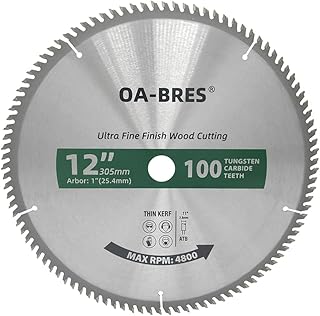

How to Choose a 12 Miter Saw Blade For Fine Cuts (2026)
- Tooth Count and Geometry: For fine crosscuts and miters, aim for 80 to 100 teeth with an alternate-top-bevel (ATB) grind. More teeth distribute the chip load, meaning each tooth removes a whisper of material rather than tearing through fibers. The difference between 60 and 100 teeth is immediately visible under raking light across a miter joint.
- Kerf Thickness: Thin-kerf blades (around 0.090″) remove less material per pass, reducing resistance on less powerful saws and preserving stock. Full-kerf blades (0.125″) add rigidity that helps on heavier cuts but demand more motor and generate more waste. For furniture-grade work on a sliding miter saw, thin kerf is usually the smarter trade.
- Carbide Quality and Sharpenability: Micro-grain carbide tips stay sharp dramatically longer than economy alloys and produce a cleaner shear on wood fibers. Premium blades use brazing techniques that hold tips through heat buildup, which matters when you are making dozens of repeated compound cuts for a cabinet or shelving run.
- Arbor Size and Compatibility: Most 12-inch miter saws accept a 1-inch arbor, but verify before purchasing. A blade that does not sit perfectly centered will vibrate, and even micron-level wobble translates to visible scalloping on the cut face that catches light unevenly.
- Application Matching: A 40-tooth ripping blade and a 100-tooth finishing blade solve different problems. If your workflow includes both rip cuts on plywood and delicate miter joints on hardwood trim, a two-blade combo or a multi-pack gives you the right tooth profile for each task without compromise.
The Best 12 Miter Saw Blade For Fine Cuts (2026) Reviewed
DEWALT DWA112100 12-Inch 100-Tooth
DEWALT’s 100-tooth fine-finish blade shipsrazor-sharp out of the box and holds its edge through long production runs. The ultra-sharp carbide tips leave a surface that practically glows under directional lighting — you can feel the smoothness before you see it. This is the benchmark most woodworkers compare everything else against.
WEN BL1200 12-Inch 100-Tooth Carbide-Tipped
The BL1200 matches the tooth count of premium competitors at a fraction of the price, making it an exceptional value for hobbyists outfitting a first shop. Its ultra-fine finish rivals blades costing three times as much on both softwood and closed-grain hardwoods, and the thin kerf keeps cuts cool so resin-heavy species do not gum the tips.
WEN BL1280 12-Inch 80-Tooth Professional
At 80 teeth the BL1280 sits in a practical sweet spot — fine enough for finish joinery yet slightly more forgiving on resinous softwoods where a 100-tooth blade might load up. For trim carpentry and furniture projects that will receive a film finish, the surface quality is indistinguishable from higher tooth counts once a coat of lacquer goes on.
ANGELSWORD 12-Inch 100T 2-Pack
ANGELSWORD’s twin-pack of 100-tooth blades addresses a reality most guides ignore: blade life. Having a backup on the shelf means you never stretch a dull blade past its prime just to avoid a trip to the store. Both blades deliver a whisper-fine surface that catches ambient light cleanly across wide miters.
ANGELSWORD 12-Inch 40T + 60T Combo
This pairing gives you a dedicated 40-tooth rip blade alongside a 60-tooth finish blade — a pragmatic setup for furniture makers who rip their own stock before crosscutting to length. The 60-tooth side produces a respectable finish that, under a warm ambient wash of light, reads as smooth and deliberate on face-grain cuts.
Frequently Asked Questions
How many teeth should a miter saw blade have for fine cuts?
For clean finish cuts on hardwood, 80 to 100 teeth is the target range. The extra teeth reduce the chip load per tooth, producing a surface that requires minimal sanding. Below 60 teeth, you will begin to see visible tooth marks that catch light and telegraph through thin finishes.
Can I use a fine-finish blade for ripping lumber?
A fine-finish blade with an ATB grind is optimized for crosscutting across the grain. Using it for long rip cuts generates excessive heat, dulls tips quickly, and can burn the wood. Keep a dedicated 24- to 40-tooth ripping blade for those tasks.
Do thin-kerf blades cut as cleanly as full-kerf?
On a well-tuned miter saw with adequate motor power, thin-kerf blades cut just as cleanly and often cleaner, because they deflect less under light loads and remove less material, reducing heat. The trade-off is slightly less rigidity on very heavy cuts, which rarely applies to furniture-scale work.
How often should I replace or sharpen my blade?
Carbide blades typically last through hundreds of cuts before sharpness degrades noticeably. You will know it is time when you see burning on the cut face, hear the saw working harder, or notice tear-out that was not there before. A quality blade can be professionally sharpened two or three times before the carbide tips become too thin for reliable brazing.
Final Thoughts
For most home furniture builders working in 2026, the DEWALT DWA112100 sets the standard for out-of-box sharpness and long-term edge retention, while the WEN BL1200 delivers comparable fine-cut performance at a price that makes stocking a spare painless. If you need the flexibility of matched rip and crosscut blades, the ANGELSWORD 40T-plus-60T combo covers both tasks without forcing a compromise at the miter. Any of these three will leave surfaces that catch the light the way fine furniture should.