Key takeaways
- Heat type and honest output: Most window units heat with an electric resistance coil, which works reliably down to roughly freezing outdoors and is best treated as shoulder-season or supplemental warmth. Heat-pump designs move more heat per watt but taper off in deep cold. Check the heating BTU separately from the cooling BTU — they are rarely the same number.
- Chassis height versus glass: Measure the sash opening, then measure how much vertical glass the unit will occupy. A 13-inch-tall body in a short window can cost you a third of your daylight and permanently change how the room reads. Saddle-style mounts sit lower in the frame and preserve far more of the view.
- Noise character, not just decibels: A rating tells you volume; it does not tell you whether the sound is a smooth broadband hush or an intermittent clunk. Inverter compressors modulate instead of cycling hard on and off, which is why they disappear into a room rather than punctuating it.
- Indicator lights and display behavior: Look for a display that fully dims or shuts off. An always-on panel throws cool light across nearby walls and undermines any warm layered scheme you have built for evenings — and it is a genuine sleep nuisance in a bedroom.
- Controls you will actually use: App and voice control matter most for pre-conditioning a space before you walk into it. A reliable timer and a legible remote matter more day to day than the feature list on the box.
What's inside
Every window in a room is doing two jobs at once: it delivers daylight and it sets the acoustic floor of the space. A window air conditioner interrupts both. As someone who spends most of my working hours shaping how rooms feel after dark — where the glow lands, what hums under it, how a sheer curtain breaks a beam of afternoon sun — I notice the collateral damage of a badly chosen unit long before I notice the temperature. A tall chassis eats the bottom third of the glass and flattens the light. A bright blue status LED becomes the loudest object in an otherwise warm bedroom at midnight. A rattling compressor turns a calm evening into something you have to talk over.
Heat-capable 110-volt units complicate the equation, because now the appliance is part of the room in January too, when daylight is scarce and every reflective surface matters. This guide looks at the best 110-volt window air conditioners with heat for 2026 through that lens: how much glass they surrender, how they behave visually at low light, how quietly they hold a room, and whether the heat mode is genuinely useful or a token feature. All of them run on a standard household circuit, so no electrician, no new outlet, no rewiring a wall you just finished painting.
As an Amazon Associate we earn from qualifying purchases.


How to Choose a 110-Volt Window Air Conditioner With Heat (2026)
- Heat type and honest output: Most window units heat with an electric resistance coil, which works reliably down to roughly freezing outdoors and is best treated as shoulder-season or supplemental warmth. Heat-pump designs move more heat per watt but taper off in deep cold. Check the heating BTU separately from the cooling BTU — they are rarely the same number.
- Chassis height versus glass: Measure the sash opening, then measure how much vertical glass the unit will occupy. A 13-inch-tall body in a short window can cost you a third of your daylight and permanently change how the room reads. Saddle-style mounts sit lower in the frame and preserve far more of the view.
- Noise character, not just decibels: A rating tells you volume; it does not tell you whether the sound is a smooth broadband hush or an intermittent clunk. Inverter compressors modulate instead of cycling hard on and off, which is why they disappear into a room rather than punctuating it.
- Indicator lights and display behavior: Look for a display that fully dims or shuts off. An always-on panel throws cool light across nearby walls and undermines any warm layered scheme you have built for evenings — and it is a genuine sleep nuisance in a bedroom.
- Controls you will actually use: App and voice control matter most for pre-conditioning a space before you walk into it. A reliable timer and a legible remote matter more day to day than the feature list on the box.
The Best 110-Volt Window Air Conditioners With Heat (2026) Reviewed
Midea 12,000 BTU Window AC with Heat
The smart inverter compressor is what earns this its place: it ramps rather than slams, so the sound stays in the background where good ambience wants it. Energy Star certification and a genuinely usable app make it the best all-round choice for a 550-square-foot living space you plan to occupy year-round.
Soleus Air 12,000 BTU with 10,000 BTU Heater
The saddle mount is the design story here — it straddles the sill instead of filling the opening, which means you keep most of your glass, most of your view, and a far less institutional-looking window. Its 10,000 BTU heater is among the strongest in this class, and it accommodates walls up to 12.5 inches thick.
ROVSUN 8000 BTU 4-in-1 Window AC with Heat
A sensible pick for a 350-square-foot bedroom or home office where you want cooling, heating, dehumidifying, and fan-only from one compact box. The included installation kit and timer cover the basics competently without asking you to manage another app.
Garvee 8000 BTU Window AC with Heat
Similar footprint to the ROVSUN, with app control added — worth the small premium if you want to warm a guest room from the kitchen. Dehumidification is the underrated feature: pulling humidity out changes how a room feels far more than a degree or two on the thermostat.
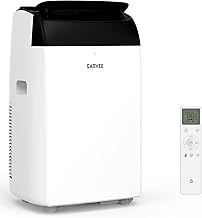
Confortotal 12,000 BTU 110V Mini Split
Not a window unit at all, but the one to consider if your window is architecturally important. The indoor head mounts high on a wall, leaves the glass completely untouched, and runs on 110 volts with Alexa compatibility — at the cost of a real installation.
Frequently Asked Questions
Can a window unit with heat replace my furnace?
No. Treat electric resistance heat as room-level supplemental warmth for spring, fall, and mild winter days. It will take the chill off a bonus room or a converted porch, not carry a house through a cold snap.
Will it work on a standard outlet?
Every unit here runs on 115V/60Hz household power. Give it a dedicated circuit where possible, since heat mode draws hard, and skip extension cords entirely.
How much daylight will I lose?
Expect a conventional unit to occupy 12 to 16 inches of vertical opening once the accordion panels are in. Saddle-mounted designs typically give back half that, which is meaningful in a room where the window is the primary light source.
Are these units loud enough to disrupt a bedroom?
Inverter models generally settle into a steady hush most people sleep through. Fixed-speed compressors cycle audibly, and that on-off transition is what wakes people, more than the running volume itself.
Final Thoughts
For most rooms, the Midea 12,000 BTU inverter is the balanced choice — quiet, efficient, and unobtrusive in both sound and light. If the window itself is a design feature you refuse to compromise, the Soleus Air saddle-mount preserves the glass and still delivers serious heat, while the Confortotal mini split leaves your window entirely alone. Smaller spaces are well served by the ROVSUN 8000 BTU without overspending.