Key takeaways
- Cutting capacity: Check both crosscut width and depth, especially if you build shelves, casework, benches, or wide trim. A larger blade does not automatically mean a wider cut.
- Bevel control: A double-bevel saw lets you tilt in either direction without repeatedly flipping the workpiece. That saves time when producing mirrored furniture parts.
- Visibility: A shadow light generally tracks the blade more intuitively than a laser, while a laser can still be useful for quick alignment. Good overhead illumination remains essential for accurate grain and pencil-line reading.
- Dust and workspace: Sliding rails need clearance, and dust collection affects both cleanup and the atmosphere of a small shop. Leave space behind the saw and position task lighting so the rails do not cast a shadow over the cut.
- Stability and support: Look for a firm base, positive angle stops, material support, and a dependable clamp. Long boards need outfeed support to prevent movement as the cut finishes.
What's inside
A sliding miter saw can be the difference between furniture components that meet cleanly and a workshop session spent correcting gaps, tear-out, and uneven shoulders. The challenge is that impressive specifications do not always translate into a pleasant, controlled cutting experience: visibility, dust, noise, footprint, and the quality of the work light matter just as much as blade diameter and capacity.
This guide compares leading sliding miter saws for furniture making, trim, renovations, and general workshop use. Alongside cutting range and bevel flexibility, it considers how each saw supports a calmer, better-lit work area—whether through an integrated shadow system, laser guide, ambidextrous controls, or a compact setup that leaves room for task lighting.
As an Amazon Associate we earn from qualifying purchases.


How to Choose a Sliding Miter Saw (2026)
- Cutting capacity: Check both crosscut width and depth, especially if you build shelves, casework, benches, or wide trim. A larger blade does not automatically mean a wider cut.
- Bevel control: A double-bevel saw lets you tilt in either direction without repeatedly flipping the workpiece. That saves time when producing mirrored furniture parts.
- Visibility: A shadow light generally tracks the blade more intuitively than a laser, while a laser can still be useful for quick alignment. Good overhead illumination remains essential for accurate grain and pencil-line reading.
- Dust and workspace: Sliding rails need clearance, and dust collection affects both cleanup and the atmosphere of a small shop. Leave space behind the saw and position task lighting so the rails do not cast a shadow over the cut.
- Stability and support: Look for a firm base, positive angle stops, material support, and a dependable clamp. Long boards need outfeed support to prevent movement as the cut finishes.
The Best Sliding Miter Saws (2026) Reviewed
DEWALT DWS780 12-Inch Double-Bevel Sliding Miter Saw
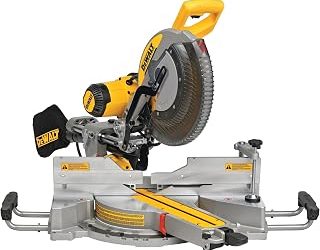
The DWS780 is the strongest all-around choice for serious furniture work, pairing broad capacity with double-bevel flexibility and DEWALT’s XPS LED shadow light system. That blade-shadow approach is particularly useful under changing shop illumination because it shows the cut line directly while preserving a clear view of the workpiece.
DEWALT DWS779 12-Inch Double-Bevel Sliding Miter Saw
The DWS779 offers the large-format reach and 15-amp power many makers want, along with a robust sliding compound design and increased crosscut capacity. It is a practical pick for substantial stock, though its workspace benefits from a bright, well-positioned task light since it does not include the DWS780’s XPS shadow system.
DEWALT DWS715 12-Inch Compound Miter Saw
The DWS715 suits shoppers who want a straightforward 12-inch saw for framing, trim, and furniture components without paying for every premium feature. Its single-bevel layout is less convenient for mirrored cuts, but its familiar controls and generous blade size make it a dependable centerpiece for a well-lit workshop.
DOVAMAN Updated 10-Inch Sliding Miter Saw
DOVAMAN’s 10-inch model is appealing for mixed-material projects and smaller workspaces, with ambidextrous operation, multiple TCT blades, nine positive stops, and a laser guide. Its compact scale can be easier to integrate into a furniture studio where open floor area and flexible lighting are more valuable than maximum capacity.
DEWALT DWS713 10-Inch Compound Miter Saw
The DWS713 is a sensible compact option for trim, small furniture parts, and occasional home projects. It is a single-bevel saw rather than a sliding double-bevel model, so buyers should choose it for its simpler footprint and predictable operation—not for wide crosscuts.
Frequently Asked Questions
Is a sliding miter saw better for furniture making?
Often, yes. The sliding mechanism expands crosscut capacity, which helps with wide boards and panels. For smaller parts, however, a compact non-sliding saw may occupy less space and feel easier to control.
Is a laser or shadow light better?
A shadow light typically creates a blade-width reference that remains easy to read across different materials. Lasers can be quick and familiar, but visibility may vary with ambient light and the color or finish of the stock.
Do I need a 12-inch saw?
Not necessarily. A 12-inch model is useful for wider or thicker material, while a 10-inch saw is often lighter, more compact, and economical to operate. Match the blade size to your usual stock rather than choosing solely by maximum specification.
How should I light a miter saw station?
Use bright, diffuse overhead lighting plus an adjustable task light aimed across—not directly into—the cutting area. Keep the light out of the blade path, reduce glare on finished surfaces, and avoid positioning it where your body creates a shadow over the pencil line.
Final Thoughts
For the fullest furniture-making capability, the DEWALT DWS780 is the standout thanks to its double-bevel layout and excellent XPS shadow visibility. The DWS779 is a strong large-capacity alternative, while the DOVAMAN 10-inch model makes a compelling choice for compact, flexible workspaces where thoughtful lighting and easy access matter most.