Key takeaways
- Coverage Area: Match the unit’s rated square footage to your actual room size. A purifier rated for 1,000 ft² will cycle air far more often in a 500 ft² space, meaning cleaner air faster — crucial when pets are actively shedding.
- Filter Type: True HEPA or H13 HEPA filters capture 99.97% of particles down to 0.3 microns, including pet dander and dust mites. Units with washable pre-filters save money over time and catch large hair before it clogs the main filter.
- Noise Profile: If the purifier lives in a bedroom, look for a dedicated sleep mode. Units running below 25 dB won’t compete with the sound of a dog’s breathing from across the room — and you’ll actually leave it on all night.
- Smart Monitoring: Built-in AQI displays or companion apps let you see air quality shift in real time, which is genuinely useful when you can’t smell whether the room is improving after cooking fish while the cat sits judgmentally on the counter.
- Pet-Specific Modes: Some purifiers include a dedicated pet-dander setting that adjusts fan speed dynamically. This feature isn’t a gimmick — it ramps filtration when the system detects a spike, rather than running at a fixed speed you have to manually toggle.
What's inside
As someone who designs the sensory experience of living spaces — the warmth of a lamp’s glow, the hush between rooms — I’ve learned that air quality is the invisible texture of a home. Pet owners know this intimately: the constant negotiation between loving a shedding, dander-producing companion and keeping indoor air breathable. Hair drifts through shafts of afternoon light. Dust bunnies colonize corners no matter how often you clean. And the lingering musk of wet fur can turn a cozy bedroom stale by morning.
This guide zeroes in on six air purifiers built for households where animals roam, sleep, and occasionally knock things off tables. I evaluated each unit not only on filtration specs but on how well it blends into a lived-in room — its noise floor, its footprint, its visual presence when the lights are low and you’re winding down. The picks below cover rooms from dorm-sized nooks to sprawling open-plan living areas, and all of them take pet dander, hair, and odor seriously.
As an Amazon Associate we earn from qualifying purchases.


How to Choose an Air Purifier for Pets (2026)
- Coverage Area: Match the unit’s rated square footage to your actual room size. A purifier rated for 1,000 ft² will cycle air far more often in a 500 ft² space, meaning cleaner air faster — crucial when pets are actively shedding.
- Filter Type: True HEPA or H13 HEPA filters capture 99.97% of particles down to 0.3 microns, including pet dander and dust mites. Units with washable pre-filters save money over time and catch large hair before it clogs the main filter.
- Noise Profile: If the purifier lives in a bedroom, look for a dedicated sleep mode. Units running below 25 dB won’t compete with the sound of a dog’s breathing from across the room — and you’ll actually leave it on all night.
- Smart Monitoring: Built-in AQI displays or companion apps let you see air quality shift in real time, which is genuinely useful when you can’t smell whether the room is improving after cooking fish while the cat sits judgmentally on the counter.
- Pet-Specific Modes: Some purifiers include a dedicated pet-dander setting that adjusts fan speed dynamically. This feature isn’t a gimmick — it ramps filtration when the system detects a spike, rather than running at a fixed speed you have to manually toggle.
The Best Air Purifier for Pets (2026) Reviewed
MOOKA KJ190H for Large Rooms
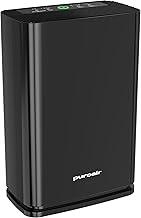
With a 2,200 ft² coverage rating, the MOOKA KJ190H handles open-concept homes where pets migrate freely from the living room to the kitchen. Its washable pre-filter is a practical touch — you can rinse it under the tap every couple of weeks instead of buying replacements — and the auto mode adjusts silently in response to air quality readings. In a dimly lit bedroom, the ambient AQI display reads as a soft, unobtrusive glow rather than an interrogator’s lamp.
KNKA APH4000
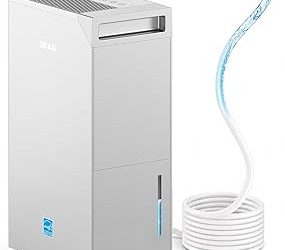
Knka’s APH4000 earns its AHAM verification and covers up to 1,695 ft² in a single hour. The pet-dander mode is well-tuned, cycling up when dander concentrations rise and settling back into a whisper during quiet hours. Visually, the white finish disappears against most wall colors, making it one of the more furniture-friendly options in this roundup.
WINIX 5510
The successor to the beloved 5500-2, the WINIX 5510 now offers app support — a meaningful upgrade for anyone who wants to schedule purification around their workday. Its high-deodorization carbon filter tackles pet odors with more authority than activated carbon alone, and coverage extends to 1,881 ft². The unit reads as thoughtfully designed: nothing about it screams “medical device” when it sits in your living space.
LEVOIT Vital 100S-P
LEVOIT’s Vital 100S-P is purpose-built for pet owners in tighter spaces — dorms, small bedrooms, and studio apartments up to 1,073 ft². The quiet sleep mode is genuinely near-silent, and the washable pre-filter means you won’t perpetually reorder parts. For a compact unit, it delivers air quality readings that feel honest and responsive rather than decorative.
MOOKA B-D02L
The smaller MOOKA rounds out the list with H13 HEPA filtration, a built-in night light, and coverage up to 1,076 ft². The night light doubles as a subtle ambient element — warm enough to orient you in a dark room without disrupting sleep. It’s an honest, no-nonsense purifier that does its job without demanding attention.
Frequently Asked Questions
Do air purifiers actually help with pet allergies?
Yes. True HEPA filters capture the microscopic dander particles that trigger allergic reactions. Running a purifier continuously in rooms where your pets spend time measurably reduces airborne allergen concentrations within hours.
How often should I replace the filters?
Most manufacturers recommend replacing the HEPA filter every 6–12 months, depending on usage and pet count. Washable pre-filters should be cleaned every 2–4 weeks to maintain airflow and extend the main filter’s lifespan.
Can one purifier handle multiple pets?
A single high-coverage unit like the MOOKA KJ190H or WINIX 5510 can manage homes with several pets, provided you size up for the room. Two or more smaller units strategically placed will outperform one oversized unit in an L-shaped or multi-room layout.
Are air purifiers safe to run around pets?
Completely. Modern purifiers emit no ozone at normal operating levels. Avoid ionizer-only models if you’re cautious, but every HEPA-based unit in this guide is safe to run 24/7 around dogs, cats, and other household animals.
Final Thoughts
For large, pet-heavy homes the MOOKA KJ190H is hard to beat on raw coverage and washable-filter economy. The WINIX 5510 brings the most refined smart features and odor control for mid-to-large rooms, while the LEVOIT Vital 100S-P is the standout choice for pet owners in compact spaces. Any of these three will meaningfully change how your home feels — and breathes.