Key takeaways
- CFM Output: Cubic feet per minute measures how much air the fan actually displaces. Anything above 5,000 CFM handles rooms over 300 square feet; the best models exceed 7,000 CFM for patios and open-plan areas where thermal comfort depends on constant circulation.
- Motor Type and Noise: DC motors consume roughly half the energy of AC motors and run nearly silent—critical if the fan sits above a dining area or bedroom. Look for models rated under 30 decibels at full speed.
- Blade Span and Count: Larger spans (60–72 inches) throw air across wider footprints. Eight-blade designs create broader, gentler diffusion, while three-blade configurations concentrate airflow downward—useful on patios or covered porches.
- Lighting Integration: Treat the fan’s light kit as a primary fixture, not an afterthought. Models offering adjustable CCT let you shift from warm 2700K evening glow to crisp 6500K task light without swapping bulbs—huge for multi-use rooms.
- Control and Smart Features: A responsive remote with dimming, speed memory, and timer functions means guests never fumble with pull chains. Reversible motor direction is equally important: counterclockwise in summer pushes cool air down; clockwise in winter recirculates warm air trapped near the ceiling.
What's inside
Every lighting-and-ambience designer knows the secret most homeowners miss: the most beautiful room in the world falls flat when the air sits still. Stagnant air muddies your carefully layered lighting, dulls the mood you’ve spent hours crafting, and leaves occupants shifting uncomfortably instead of settling in. Choosing a ceiling fan engineered to genuinely move air—not just spin decoratively—is where comfort and aesthetics converge.
This guide cuts through the noise. We evaluated six high-performance ceiling fans on raw airflow output, motor quietness, lighting versatility, and how well each one integrates into a thoughtfully designed room. Below you’ll find our curated picks plus a practical framework so you can match the right fan to your space without second-guessing.
As an Amazon Associate we earn from qualifying purchases.


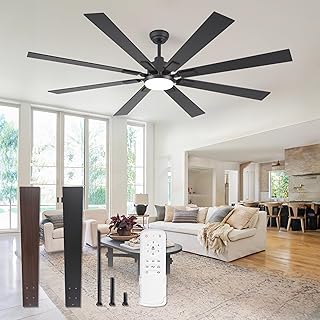
How to Choose a Ceiling Fan To Move Air (2026)
- CFM Output: Cubic feet per minute measures how much air the fan actually displaces. Anything above 5,000 CFM handles rooms over 300 square feet; the best models exceed 7,000 CFM for patios and open-plan areas where thermal comfort depends on constant circulation.
- Motor Type and Noise: DC motors consume roughly half the energy of AC motors and run nearly silent—critical if the fan sits above a dining area or bedroom. Look for models rated under 30 decibels at full speed.
- Blade Span and Count: Larger spans (60–72 inches) throw air across wider footprints. Eight-blade designs create broader, gentler diffusion, while three-blade configurations concentrate airflow downward—useful on patios or covered porches.
- Lighting Integration: Treat the fan’s light kit as a primary fixture, not an afterthought. Models offering adjustable CCT let you shift from warm 2700K evening glow to crisp 6500K task light without swapping bulbs—huge for multi-use rooms.
- Control and Smart Features: A responsive remote with dimming, speed memory, and timer functions means guests never fumble with pull chains. Reversible motor direction is equally important: counterclockwise in summer pushes cool air down; clockwise in winter recirculates warm air trapped near the ceiling.
The Best Ceiling Fan To Move Air (2026) Reviews
60″ High Airflow DC Fan with Light
Pushing north of 7,400 CFM through three optimized blades and a whisper-quiet reversible DC motor, this fan is the airflow champion of the roundup. The integrated three-CCT lighting and six-speed remote make it a one-box solution for anyone who wants serious air movement paired with a fully tunable light layer.
ZMISHIBO 72″ Ceiling Fan with Light
At 72 inches with a dual-finish blade design and damp rating, the ZMISHIBO balances raw power with design polish—the kind of piece a designer would happily spec for a transitional indoor-outdoor space. Its 24W three-CCT LED panel delivers even illumination without the harsh hotspot that plagues cheaper integrated fixtures.
Minislak 72″ Fan No Light
Sometimes the right move is letting your architectural lighting do the talking. The Minislak strips the fan down to its essential job—moving air—via eight aluminum blades and a quiet DC motor. It’s ideal for studios, garages, or any space where dedicated downlights and pendants already handle the light layer.
52″ Matte Black and Gold Ceiling Fan
This is the fan I’d reach for when the room demands a statement fixture that doesn’t scream “ceiling fan.” The matte black and gold palette reads sophisticated under warm accent lighting, and at 52 inches it tucks neatly into bedrooms without overwhelming the ceiling plane.
OPONL 52″ Ceiling Fan with Light
The OPONL earns its spot through sheer versatility: six CCT settings, full dimming, a noiseless reversible motor, and a clean silhouette that disappears into contemporary interiors. For designers juggling clients who can never decide between warm and cool light, this fan solves the argument permanently.
Frequently Asked Questions
What CFM rating do I need for my room size?
Aim for at least 1 CFM per square foot. A 200-square-foot bedroom needs roughly 2,000 CFM minimum, while a 400-square-foot living room benefits from 4,000 CFM or higher. Oversizing is rarely a problem—it simply means running the fan on a quieter setting.
Do ceiling fans actually lower room temperature?
Fans don’t cool air—they cool people. Moving air accelerates skin evaporation, creating a perceived drop of 4–6°F. Running a fan in summer lets you raise your thermostat about 4°F with no loss of comfort, translating to real savings on energy bills.
Is a DC motor worth the premium over AC?
Yes, especially if the fan runs daily. DC motors use up to 70% less energy, operate near-silently, and typically offer six speeds versus three or four on AC units. The payback period is usually under two years in a frequently used room.
Can I install a ceiling fan on a vaulted ceiling?
Most fans in this roundup support slopes up to 15 degrees with an included downrod adapter. For steeper angles, you’ll need a dedicated vaulted mount kit. Always verify the maximum ceiling angle in the specs before purchasing.
Final Thoughts
If you need maximum airflow above all else, the 60″ High Airflow DC Fan leads the pack with over 7,400 CFM of displacement. For indoor-outdoor spaces that demand both power and aesthetic refinement, the ZMISHIBO 72″ is the most complete package. And for bedrooms where a quieter, more compact profile matters most, the OPONL 52″ delivers the lighting flexibility and whisper-quiet operation that turn a functional fixture into a genuine design asset.