Key takeaways
- Light Output and Color Temperature: Look for fans offering tunable white (2700K–6500K) or at least a warm-to-neutral range. Dining rooms benefit from 2700K–3000K during meals; cooler settings work well for cleanup or casual daytime use. Dimmability is non-negotiable — a fixture locked at full brightness will flatten every conversation.
- Noise Floor: A dining room demands quiet. DC motors typically operate under 30 decibels, which keeps ambient sound below the level of soft conversation. Avoid older AC motors if acoustic sensitivity is a priority in your household.
- Blade Span and Ceiling Height: Flush-mount and low-profile designs work best under eight-foot ceilings, while retractable or fandelier-style fans handle ten-foot rooms with grace. Match blade diameter — 30 to 52 inches — to room square footage so air actually reaches the table.
- Remote and Smart Control: Multiple speed settings let you fine-tune airflow from a gentle drift on course one to a serious breeze at speed six. Timer functions and app-based control add convenience without adding a wall switch you don’t have.
- Design Cohesion: The fan should complement your dining room’s material palette. Brushed nickel pairs with contemporary fixtures; rose gold crystal reads luxury; vintage wood blades echo farmhouse warmth. Treat the fan as a design element, not an afterthought.
What's inside
Choosing a ceiling fan for a dining room is one of those deceptively tricky decisions. You need enough airflow to keep dinner guests comfortable without drowning conversation in blade noise, and the integrated light has to render food and skin tones beautifully — not wash everything out in cold blue or bathe the table in dim amber. Add the fact that most dining rooms double as gathering spaces, and you’re suddenly shopping for a fixture that needs to perform three jobs at once: circulate air, set the mood, and actually look like it belongs above your table.
This guide cuts through the noise. We evaluated six standout models against criteria that matter most to anyone who cares about how a room feels — light quality, dimming range, noise floor, motor type, and whether the design earns its place in a curated space. Our top five picks span fandelier hybrids, retractable-blade statements, and farmhouse essentials, so you can match your ceiling to your vision without compromise.
As an Amazon Associate we earn from qualifying purchases.


How to Choose a Dining Room Ceiling Fan With Light (2026)
- Light Output and Color Temperature: Look for fans offering tunable white (2700K–6500K) or at least a warm-to-neutral range. Dining rooms benefit from 2700K–3000K during meals; cooler settings work well for cleanup or casual daytime use. Dimmability is non-negotiable — a fixture locked at full brightness will flatten every conversation.
- Noise Floor: A dining room demands quiet. DC motors typically operate under 30 decibels, which keeps ambient sound below the level of soft conversation. Avoid older AC motors if acoustic sensitivity is a priority in your household.
- Blade Span and Ceiling Height: Flush-mount and low-profile designs work best under eight-foot ceilings, while retractable or fandelier-style fans handle ten-foot rooms with grace. Match blade diameter — 30 to 52 inches — to room square footage so air actually reaches the table.
- Remote and Smart Control: Multiple speed settings let you fine-tune airflow from a gentle drift on course one to a serious breeze at speed six. Timer functions and app-based control add convenience without adding a wall switch you don’t have.
- Design Cohesion: The fan should complement your dining room’s material palette. Brushed nickel pairs with contemporary fixtures; rose gold crystal reads luxury; vintage wood blades echo farmhouse warmth. Treat the fan as a design element, not an afterthought.
The Best Dining Room Ceiling Fan With Light (2026) Reviews
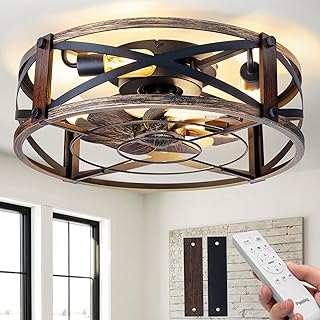
Passky 20″ Caged Fandelier
A compact caged design that punches well above its footprint. The reversible DC motor runs whisper-quiet through six speeds, and the four-hour timer makes post-dinner wind-down effortless. Its farmhouse silhouette works especially well in kitchens and breakfast nooks that flow directly into a dining area.
48″ Crystal Chandelier Fan
This is the fan for anyone who wants a chandelier and refuses to sacrifice airflow. The rose gold crystal accents catch light in a way that turns the fixture into a genuine focal point, while dimmable LEDs let you pull the brightness down to a candlelit glow for evening meals.
30″ Retractable Brushed Nickel Fan
The retractable blades disappear when the fan is off, leaving a sleek LED disk overhead. Tunable color temperature from 3000K to 6500K gives you genuine control over ambiance, and the brushed nickel finish plays nicely with stainless appliances or matte black hardware.
addlon 24″ Low Profile Fandelier
Wider airflow from a surprisingly small fixture makes the addlon a smart pick for compact dining spaces. The app control and memory function mean it remembers your preferred setting — a small luxury that adds up over time. Dimmable LEDs across a 3000K–6000K range handle everything from brunch to late-night wine.
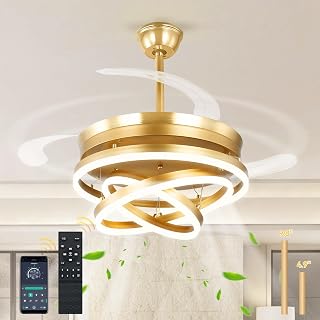
42″ Retractable Gold Fandelier
A modern chandelier-fan hybrid with a gold finish that reads warm and intentional. The six-speed silent DC motor and tunable 3000K–6500K LED panel make it versatile enough for a formal dining room or an open-concept living space where the fan needs to hold its own architecturally.
Frequently Asked Questions
What size ceiling fan do I need for a dining room?
For rooms up to 75 square feet, a 29-to-36-inch fan works well. Dining rooms between 76 and 144 square feet typically benefit from 36-to-48-inch models, while anything larger pairs best with a 52-inch fan. Size the blade span to the table’s reach so air circulates where people actually sit.
Are fandelier ceiling fans actually effective at moving air?
Yes, particularly models with DC motors and blade spans of 30 inches or more. The shorter blade radius trades raw cubic-feet-per-minute output for even distribution, which suits a dining setting where you want gentle circulation across the whole table rather than a column of wind.
Can I install a ceiling fan on a sloped ceiling?
Most low-profile and flush-mount fans require a flat ceiling or a slope under 15 degrees. Retractable and fandelier models often come with compatible angled-mount kits — check the product specifications before purchasing to confirm slope compatibility.
Is dimmable LED light important for a dining room fan?
Absolutely. Dimming capability is the single biggest factor in how a dining room feels. Full brightness works for holidays and homework; pulling it down to 20 percent transforms the same table into an intimate setting. Prioritize fans with smooth, flicker-free dimming across a warm-to-neutral range.
Final Thoughts
If you’re prioritizing ambient light quality and quiet operation in a compact space, the addlon 24″ Low Profile Fandelier stands out as our top all-around pick. For those who want a dining room centerpiece that doubles as a fan, the 48″ Crystal Chandelier Fan delivers genuine luxury without apology. And on a tighter budget or smaller ceiling, the Passky 20″ Caged Fandelier proves that great design and dependable airflow don’t require a premium price tag.