Key takeaways
- Tooth pattern: A 40- to 50-tooth combination grind is the practical middle ground for ripping boards and crosscutting panels. More teeth generally favor a cleaner finish, while fewer teeth often clear waste faster.
- Kerf: Thin-kerf blades remove less material, which can reduce resistance on smaller saws and preserve stock. Confirm that the blade remains compatible with your saw’s riving knife or splitter.
- Material: Carbide-tipped teeth are the sensible choice for furniture work because they retain an edge longer than basic steel teeth and can be sharpened when worn.
- Finish control: Anti-vibration slots, a nonstick coating, and a stable plate can help reduce chatter and resin buildup. These details matter when a cut edge will be visible under directional lighting.
- Compatibility: Check the 5/8-inch arbor, maximum RPM, blade clearance, and guard setup before buying. The blade diameter alone does not guarantee a safe fit.
What's inside
Choosing a table-saw blade often feels like a compromise: a fine-tooth blade can leave furniture panels beautifully clean but slow the cut, while an aggressive rip blade may move quickly and leave edges that need extra sanding. The visual quality of a project depends on that balance, especially when light will skim across a tabletop, cabinet face, or shelf.
This guide focuses on 10-inch combination blades that can move between ripping and crosscutting without constantly changing accessories. Along with tooth geometry, kerf, and arbor fit, we consider the finish each blade is likely to leave, how smoothly it should feed, and whether its design suits a home furniture workshop.
As an Amazon Associate we earn from qualifying purchases.




How to Choose a/an 10-Inch Combination Table Saw Blade (2026)
- Tooth pattern: A 40- to 50-tooth combination grind is the practical middle ground for ripping boards and crosscutting panels. More teeth generally favor a cleaner finish, while fewer teeth often clear waste faster.
- Kerf: Thin-kerf blades remove less material, which can reduce resistance on smaller saws and preserve stock. Confirm that the blade remains compatible with your saw’s riving knife or splitter.
- Material: Carbide-tipped teeth are the sensible choice for furniture work because they retain an edge longer than basic steel teeth and can be sharpened when worn.
- Finish control: Anti-vibration slots, a nonstick coating, and a stable plate can help reduce chatter and resin buildup. These details matter when a cut edge will be visible under directional lighting.
- Compatibility: Check the 5/8-inch arbor, maximum RPM, blade clearance, and guard setup before buying. The blade diameter alone does not guarantee a safe fit.
The Best 10-Inch Combination Table Saw Blade (2026)s Reviewed
Diablo D1050X Combination Blade
The Diablo D1050X is a strong all-purpose choice for a home furniture shop, pairing 50 ATB teeth with a thin .098-inch kerf for a controlled cut. Its Perma-Shield coating should help limit friction and residue, while the 15-degree hook angle offers a balanced feel for both ripping and crosscutting.
CMT Orange Tools 256.050.10
CMT’s Orange Tools combination blade uses a 50-tooth grind with a flat tooth included in the pattern, making it a versatile option for general woodwork. It is particularly appealing for makers who want a composed feed rate and a clean, furniture-friendly edge rather than maximum ripping speed.
Freud LU83R010 Industrial Combination Blade
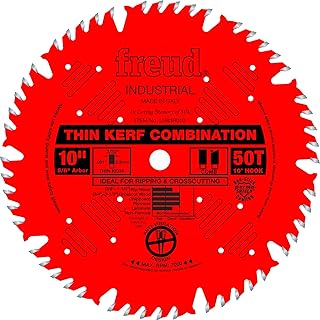
The Freud LU83R010 stands out for its premium TiCo high-density carbide blend and laser-cut anti-vibration slots. That combination suggests a quieter, steadier cut with good edge control, making it a compelling upgrade for hardwood, plywood, and projects where surface preparation needs to stay minimal.
ATB Combination Blade US1048ATBFK
This USA-made ATB blade offers 48 teeth and a standard 1/8-inch kerf, giving it a slightly more substantial cutting profile than thin-kerf alternatives. It is a sensible pick for users who prioritize predictable crosscuts and dependable ripping performance on a full-size saw.
10-Inch 50-Tooth Thin-Kerf Combination Blade
This generic 50-tooth option targets everyday versatility with carbide teeth, a thin kerf, and a nonstick coating. It makes the most sense for budget-conscious furniture builders who want a balanced blade for hardwood and plywood without moving into premium pricing.
Frequently Asked Questions
Is a combination blade suitable for furniture making?
Yes. A good combination blade is designed to handle both ripping and crosscutting, which makes it convenient for tables, shelving, cabinets, and smaller built-ins. For exceptionally clean joinery or repeated production work, a dedicated crosscut blade may still be worthwhile.
Is a thin-kerf blade better for a smaller table saw?
Often, yes. A thin-kerf blade typically places less load on the motor and wastes less material. However, confirm that its plate and tooth path align correctly with the saw’s riving knife or splitter before use.
Can I use a 10-inch blade on any table saw?
No. Verify the saw’s approved blade diameter, arbor size, maximum RPM, and guard clearance. A 10-inch blade commonly uses a 5/8-inch arbor, but the complete installation must still match the machine.
What tooth count is best for a smooth cut?
For general furniture work, 40 to 50 teeth is a useful compromise between clean crosscuts and efficient ripping. An 80-tooth blade, such as the FOXBC ultra-finish model, can be better for presentation-grade crosscuts but is less versatile as an everyday combination blade.
Final Thoughts
The Diablo D1050X is the easiest all-round recommendation, while the Freud LU83R010 is a strong premium choice for reduced vibration and demanding stock. Choose the CMT Orange Tools blade if controlled, versatile cutting is your priority, and always match the blade’s kerf and arbor details to your saw before installation.