Key takeaways
- Handrail presence: A ladder without a fixed handrail forces the user to grip the frame itself, which often has rounded, slippery tubing. Models like the WiberWi and KINGRACK integrate purpose-built handrails at a natural wrist height, dramatically reducing balance anxiety.
- Pedal surface and width: Narrow pedals with minimal texture are a fall risk. Look for wide, rubberized treads that accommodate the full foot — the HBTower models and HillhutApex all score well here, giving stable footing even in socks.
- Weight capacity vs. actual use: A 330 lb or 500 lb rating isn’t just about the user’s weight; it accounts for holding a box of books overhead. The KINGRACK’s 800 lb ceiling offers the largest safety margin if someone leans heavily or carries items.
- Folded profile and storage: In most homes the ladder lives between uses. Measure the gap beside your refrigerator or inside a pantry closet. The HillhutApex 3-step folds remarkably flat, and its walnut-toned finish means it can lean against a wall without looking industrial.
- Lock mechanism clarity: Elderly users need a lock they can see and hear. A ladder that “kind of” locks breeds hesitation. Look for a positive-click safe-lock design — the KINGRACK’s mechanism is particularly reassuring with a visual indicator confirming full engagement.
What's inside
Choosing a step ladder for an elderly loved one or yourself isn’t just about reaching a high shelf — it’s about buying confidence, stability, and peace of mind in a single object that lives in your home. Most buyers get overwhelmed by spec sheets and miss the details that actually matter day-to-day: grip texture, handrail placement, footprint in a tight kitchen, and whether the finish clashes with the room’s palette.
As someone who selects furniture and fixtures for how they look, feel, and coexist with surrounding surfaces, I evaluated these ladders not only on safety ratings but on how they sit in a space — material warmth, visual weight, and the tactile experience of every step. Here’s what deserves your attention in 2026.
As an Amazon Associate we earn from qualifying purchases.




How to Choose a Step Ladder For Elderly (2026)
- Handrail presence: A ladder without a fixed handrail forces the user to grip the frame itself, which often has rounded, slippery tubing. Models like the WiberWi and KINGRACK integrate purpose-built handrails at a natural wrist height, dramatically reducing balance anxiety.
- Pedal surface and width: Narrow pedals with minimal texture are a fall risk. Look for wide, rubberized treads that accommodate the full foot — the HBTower models and HillhutApex all score well here, giving stable footing even in socks.
- Weight capacity vs. actual use: A 330 lb or 500 lb rating isn’t just about the user’s weight; it accounts for holding a box of books overhead. The KINGRACK’s 800 lb ceiling offers the largest safety margin if someone leans heavily or carries items.
- Folded profile and storage: In most homes the ladder lives between uses. Measure the gap beside your refrigerator or inside a pantry closet. The HillhutApex 3-step folds remarkably flat, and its walnut-toned finish means it can lean against a wall without looking industrial.
- Lock mechanism clarity: Elderly users need a lock they can see and hear. A ladder that “kind of” locks breeds hesitation. Look for a positive-click safe-lock design — the KINGRACK’s mechanism is particularly reassuring with a visual indicator confirming full engagement.
The Best Step Ladder For Elderly (2026)s Reviewed
HBTower Folding Step Stool with Handrail
This is the entry point most families should start with — lightweight, easy to carry from room to room, and equipped with a handrail that doesn’t feel like an afterthought. The steel construction keeps it planted on tile or hardwood without the wobble that cheaper aluminum stools transmit through your palms. Ideal as a kitchen or pantry solution where space is limited but trust can’t be.
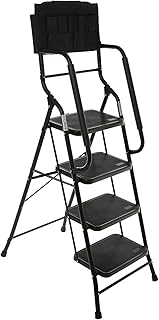
HBTower 4-Step Ladder with Tool Bag
Stepping up in both height and utility, this version adds an attachable tool bag that eliminates the dangerous habit of gripping items between your teeth while climbing. The four steps are spaced at an ergonomic cadence — short enough stride that knees don’t complain. The black powder coat reads clean against modern cabinetry, a small detail that prevents it from feeling like borrowed construction equipment.
HillhutApex Aluminum 3-Step Ladder (Walnut)
The most aesthetically considered option on this list. The walnut-toned aluminum frame is the kind of piece that sits beside a bookshelf and genuinely belongs there — warm, understated, almost furniture-like. The handgrip integrates into the top rail seamlessly, and the 330 lb capacity covers most users with room to spare. If your home’s ambience matters to you, this is the ladder that respects it.
WiberWi 4-Step Ladder with Handrails
Built around a 500 lb steel frame, this is the choice when the user is a larger individual or when the ladder will see heavy, frequent use. The dual handrails create a secure corridor as you ascend, and the included tool bag adds practical value. Visually it’s unapologetically utilitarian — all function, no pretense — but that honesty has its own design integrity.
KINGRACK 5-Step Ladder
The most capable option reviewed, with an 800 lb rating, five steps, and a safe-lock mechanism you can verify visually before every climb. For anyone who regularly reaches upper cabinets, ceiling fixtures, or high shelving in a living room with tall bookcases, this eliminates the need to overstretch — the single most common cause of ladder falls. It folds flat enough to slide behind a door.
Frequently Asked Questions
What makes a step ladder safer for elderly users?
The combination of a dedicated handrail, wide anti-slip pedals, and a reliable lock mechanism. A sturdy frame with minimal lateral wobble is equally critical — elderly users often lean slightly, and any give in the structure erodes confidence quickly.
How many steps do most elderly users actually need?
For standard kitchen and pantry use, three steps handle shelves up to about eight feet. If you have 9-10 foot ceilings or wall-mounted lighting fixtures to service, a four or five-step model prevents dangerous overreaching — the exact scenario that leads to falls.
Should I choose steel or aluminum construction?
Steel is heavier but more rigid, so it feels planted underfoot and doesn’t flex on hard floors. Aluminum saves weight for users who carry the ladder frequently but may transmit more vibration. For a fixed installation in one room, steel — like the KINGRACK or WiberWi — is preferable.
Can these ladders be used on carpet?
Yes, but wide rubber feet matter more on carpet than on hard floors because soft surfaces allow micro-sliding. All six models reviewed here have rubberized feet, though wider pads like those on the KINGRACK provide the most stable base on plush carpet.
Final Thoughts
For most families buying for an elderly user, the HBTower Folding Step Stool with Handrail hits the right balance of simplicity, affordability, and safety for everyday tasks. If aesthetic cohesion with your living space is a priority, the HillhutApex Aluminum 3-Step Ladder in Walnut is the rare ladder you won’t mind leaving in plain sight. And for anyone who needs maximum reach with the highest safety margin available, the KINGRACK 5-Step Ladder offers an 800 lb capacity and a lock system that removes guesswork from every climb. Pick the one that matches your room, your needs, and your peace of mind.