Key takeaways
- Voltage and Wiring: Most serious garage heaters run on 240V hardwired circuits because standard 120V outlets simply cannot push enough amperage for meaningful heat output in large spaces. Confirm your electrical capacity before committing to a 5000W or 7500W unit.
- Heat Distribution Geometry: Fan-forced heaters move warm air across a wider radius, while radiant quartz elements deliver intense direct warmth to objects and people in their line of sight. The right choice depends on whether you heat the whole bay or just a workstation.
- Mounting and Portability: Ceiling-mounted units free up floor space and eliminate trip hazards around tools, but portable heaters offer flexibility if you reconfigure your layout seasonally. Wall-mounted ECO models split the difference with low-profile installs.
- Thermostat Precision and Timers: Digital thermostats with multi-hour timers let you pre-warm a garage before arrival and auto-shut-off after work wraps, preventing the energy drain that comes with leaving a heater running unattended.
- Safety Certifications: Look for overheat protection, ETL or UL listing, and tip-over shutoff on portable models. These aren’t nice-to-haves in a space where combustible materials and fuel cans often share the floor with electrical equipment.
What's inside
Garages, workshops, and sheds present a unique thermal challenge: they’re typically large, poorly insulated boxes with concrete floors that siphon warmth faster than you can produce it. Picking the wrong heater means cold corners, wasted electricity, and frustration that drags through every winter project. The stakes matter because a well-chosen electric heater doesn’t just raise the air temperature — it reshapes how the entire space feels and functions.
This guide breaks down the strongest garage electric space heaters available in 2026, comparing wattage delivery, heat distribution patterns, mounting flexibility, and safety features. Whether you need a portable unit you can carry between zones or a ceiling-mounted workhorse wired directly into a 240V circuit, the picks below cover a range of shop and storage scenarios.
As an Amazon Associate we earn from qualifying purchases.


How to Choose a Garage Electric Space Heater (2026)
- Voltage and Wiring: Most serious garage heaters run on 240V hardwired circuits because standard 120V outlets simply cannot push enough amperage for meaningful heat output in large spaces. Confirm your electrical capacity before committing to a 5000W or 7500W unit.
- Heat Distribution Geometry: Fan-forced heaters move warm air across a wider radius, while radiant quartz elements deliver intense direct warmth to objects and people in their line of sight. The right choice depends on whether you heat the whole bay or just a workstation.
- Mounting and Portability: Ceiling-mounted units free up floor space and eliminate trip hazards around tools, but portable heaters offer flexibility if you reconfigure your layout seasonally. Wall-mounted ECO models split the difference with low-profile installs.
- Thermostat Precision and Timers: Digital thermostats with multi-hour timers let you pre-warm a garage before arrival and auto-shut-off after work wraps, preventing the energy drain that comes with leaving a heater running unattended.
- Safety Certifications: Look for overheat protection, ETL or UL listing, and tip-over shutoff on portable models. These aren’t nice-to-haves in a space where combustible materials and fuel cans often share the floor with electrical equipment.
The Best Garage Electric Space Heaters (2026) Reviewed
NewAir 240V Electric Space Heater
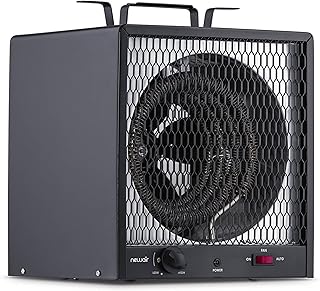
The NewAir portable 240V heater strikes a rare balance between raw industrial output and genuine portability. Its compact black housing belies a heating element that pushes warm air quickly into the far corners of a two-car garage, making it a solid choice for anyone who needs to relocate the unit between a workshop bench and a detailing bay. The built-in carry handle and plug-and-go design mean no electrician visit is required if you already have a 240V outlet in place.
Comfort Zone 5000W Ceiling Mounted Garage Heater
Comfort Zone’s ceiling-mounted 5000W unit is the kind of fixture you install once and forget about — exactly what you want in a working garage. Three heat settings let you dial between a gentle pre-heat and full-throttle warmth, while the overhead position distributes airflow evenly across the floor below. ETL listing and overheat protection add a layer of confidence when the unit runs for hours during a weekend build session.
5000W Fan-Forced Garage Heater with Remote
Equipped with a digital thermostat, remote control, and a 1 to 9-hour programmable timer, this fan-forced 5000W heater brings a level of convenience typically reserved for living-room appliances into the shop environment. It covers roughly 500 square feet with consistent warmth, and the option to mount it on either the wall or ceiling gives you layout freedom that many competing models lack.
TEMPWARE 7500W Hardwired Electric Garage Heater
When a project space demands serious BTUs, the TEMPWARE 7500W rises to the occasion. This hardwired ceiling-mount unit is purpose-built for warehouses and oversized garages where 5000W simply falls short. The 12-hour timer and remote control mean you can manage it from across the room without a ladder, and the digital thermostat maintains temperature within a tight range — a real advantage during paint curing or finish work that’s sensitive to thermal fluctuation.
Shinic 1500W Radiant Quartz Ceiling Heater
The Shinic takes a different engineering approach by using dual radiant quartz elements instead of a fan-forced blower. The result is a quieter, more directional warmth that heats people and surfaces directly beneath it rather than churning air throughout the room. A built-in work light and 90-degree rotation make it particularly useful over a single workstation, and five mode settings give you granular control over intensity.
Frequently Asked Questions
Can I run a 5000W garage heater on a regular household outlet?
No. A standard 120V/15A outlet maxes out at roughly 1800W. Any heater rated at 2400W or above requires a dedicated 240V circuit, and most 5000W models need a 30-amp breaker. Have a licensed electrician confirm your panel has capacity before purchasing.
What size heater do I need for a two-car garage?
A typical two-car garage spans 400 to 600 square feet. In most climates, a 5000W unit provides adequate coverage, while uninsulated or extremely cold regions may benefit from stepping up to a 7500W model. Always factor in ceiling height, insulation quality, and how often the garage door opens.
Are ceiling-mounted heaters safe to leave running unattended?
Certified models with overheat protection and automatic shutoff timers are designed for extended operation, but no electrical heating appliance should be left completely unmonitored overnight. Using the built-in timer to cap run-time is the safest practice.
What’s the difference between fan-forced and radiant quartz heaters?
Fan-forced heaters use a blower to circulate warmed air across a broad area, making them effective for whole-garage heating. Radiant quartz heaters emit infrared energy that warms objects and people directly in their path, offering quieter and more targeted comfort but less uniform ambient temperature.
Final Thoughts
For whole-garage warmth, the TEMPWARE 7500W dominates large spaces with unmatched output, while the Comfort Zone 5000W ceiling unit delivers reliable all-around coverage for standard two-car garages. If portability and zone flexibility matter most, the NewAir 240V portable heater earns its place as the most versatile option in the lineup. Match your heater to your circuit, your square footage, and the kind of work you do — the rest follows naturally.