Key takeaways
- Tooth count: Blades with fewer teeth usually cut faster and clear waste efficiently, while higher tooth counts produce cleaner edges for visible furniture parts.
- Cutting purpose: Choose a ripping blade for cuts along the grain, a crosscut or combination blade for versatile work, and a fine-finish blade for trim, plywood, and hardwood panels.
- Kerf: A thin-kerf blade removes less material and may reduce strain on smaller saws, while a full-kerf blade can feel especially stable on powerful cabinet saws.
- Arbor compatibility: Confirm the blade uses the correct arbor diameter—commonly 5/8 inch on 10-inch table saws—and check the maximum blade diameter and speed rating.
- Material and finish: Carbide-tipped teeth generally offer longer service life and can be resharpened; polished, low-friction designs may help limit heat, drag, and burn marks.
What's inside
Choosing a table saw blade is less straightforward than choosing a saw. Tooth count, kerf, carbide quality, arbor size, and the finish you want all affect the result—and a blade that glides beautifully through cabinet plywood may be the wrong tool for fast construction cuts. The wrong match can leave burn marks, chipped veneer, rough edges, or a workshop full of unnecessary noise and vibration.
This guide focuses on blades that suit furniture building, cabinetry, joinery, and general shop work. The selections below cover ultra-fine finishing, dependable crosscutting, efficient ripping, and useful multi-blade combinations, with attention to how each option influences the visual quality of the finished piece.
As an Amazon Associate we earn from qualifying purchases.



How to Choose 10 Table Saw Blades (2026)
- Tooth count: Blades with fewer teeth usually cut faster and clear waste efficiently, while higher tooth counts produce cleaner edges for visible furniture parts.
- Cutting purpose: Choose a ripping blade for cuts along the grain, a crosscut or combination blade for versatile work, and a fine-finish blade for trim, plywood, and hardwood panels.
- Kerf: A thin-kerf blade removes less material and may reduce strain on smaller saws, while a full-kerf blade can feel especially stable on powerful cabinet saws.
- Arbor compatibility: Confirm the blade uses the correct arbor diameter—commonly 5/8 inch on 10-inch table saws—and check the maximum blade diameter and speed rating.
- Material and finish: Carbide-tipped teeth generally offer longer service life and can be resharpened; polished, low-friction designs may help limit heat, drag, and burn marks.
The Best 10 Table Saw Blades (2026) Reviewed
FOXBC 80-Tooth Ultra-Finish Blade
The FOXBC 10-Inch Table Saw Blade uses 80 teeth to create a particularly refined cut on furniture components, veneered panels, and other surfaces where edge quality matters. Its 5/8-inch arbor suits many standard table saws, but the high tooth count favors controlled finishing work over fast stock removal.
DEWALT DWA11040 Fine-Finish Blade
The DEWALT Table Saw Blade DWA11040 brings a practical 40-tooth layout to general workshop duty, balancing reasonable feed speed with a cleaner edge than a dedicated ripping blade. Its ultra-sharp carbide teeth make it a sensible everyday choice for builders who want one dependable blade for shelves, frames, and basic cabinet parts.
WEN BL1080 Ultra-Fine Finish Blade
With 80 carbide-tipped teeth, the WEN BL1080 is aimed at smooth, presentation-ready cuts in wood. It works with both miter saws and table saws, making it useful in a two-saw workshop where matching the visual quality of crosscuts and panel cuts is more important than maximum speed.
WEN BL1060 60-Tooth Fine-Finish Blade
The WEN BL1060 occupies a versatile middle ground: its 60-tooth configuration should leave a cleaner surface than a coarse construction blade while remaining more productive than an ultra-fine 80-tooth model. It is well suited to furniture stock, trim, plywood, and projects that alternate between efficiency and appearance.
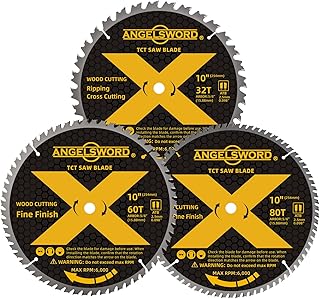
10-Inch 40T/60T Two-Pack
This 10 Inch Table Saw Blade/Miter Saw Blade 2-Pack is appealing for workshops that want two cutting personalities without buying separate premium blades. The 40-tooth option is positioned for ripping and crosscutting, while the 60-tooth blade is better matched to fine-finish wood cutting; both use a 5/8-inch arbor.
Frequently Asked Questions
Is a higher tooth count always better for furniture?
No. More teeth can produce a smoother edge, but they also remove waste more slowly and may heat up if pushed aggressively. For furniture, choose tooth count according to the operation: efficient ripping needs fewer teeth, while visible crosscuts and veneered material benefit from more.
Can these blades cut hardwood?
Many 10-inch carbide-tipped blades can cut hardwood when installed on a compatible saw and used with a steady feed rate. Dense stock demands sharp teeth, proper support, and patience; forcing the cut can increase heat, vibration, and the chance of a rough or burned edge.
Should I use one blade for every table saw task?
A quality combination or 40-tooth blade can handle a broad range of work, but dedicated blades usually deliver better results. A ripping blade improves speed along the grain, while a 60-tooth or 80-tooth blade can make exposed edges look noticeably more polished.
How often should a table saw blade be replaced?
Replacement depends on use, material, and maintenance. If the blade begins burning clean timber, wandering despite a properly aligned saw, producing repeated tear-out, or requiring unusual force, inspect it for resin buildup, damaged teeth, or dull carbide before deciding whether cleaning or replacement is appropriate.
Final Thoughts
For the smoothest furniture-focused finish, the FOXBC 80-tooth and WEN BL1080 are strong high-tooth-count choices, while the DEWALT DWA11040 is the more versatile everyday option. The WEN BL1060 and 40T/60T two-pack are practical alternatives for makers who want a balanced mix of speed, flexibility, and clean-looking results.