Key takeaways
- Noise Floor: A compressor running at 60–70 dB lets you hold a conversation nearby; anything above 80 dB demands ear protection and closes off the space to anyone else. Prioritize models under 75 dB if the unit will live near living areas or shared walls.
- Airflow (CFM at 90 PSI): Match CFM to your most demanding tool. Spray guns and framing nailers need sustained delivery; pin nailers and tire inflators are forgiving. Underspecced airflow causes frustrating mid-task stalls.
- Tank Size vs. Duty Cycle: Larger tanks (15–20 gallons) reduce motor cycling and extend tool run-time. Smaller 2–3 gallon units are nimble but suited to intermittent, lighter work.
- Oil-Free Design: Oil-free motors mean less maintenance, no spills on your shop floor, and cleaner air output — a genuine advantage when finishing furniture where moisture or oil mist would mar a coat of lacquer.
- Portability and Footprint: Consider the actual square footage available. Wheeled vertical units save floor space; compact horizontal tanks slide under a workbench. Weight and wheel quality determine whether relocation is effortless or a two-person task.
What's inside
Shopping for an air compressor on a 110-volt circuit sounds straightforward until you realize the market is flooded with models that either rattle your walls, stall mid-project, or occupy half your workspace like a small engine block. For homeowners outfitting a garage workshop, finishing furniture in a spare room, or tackling weekend auto repair, the real question isn’t just “Does it deliver enough PSI?” — it’s “Will it let me actually think while I work?” Noise output, tank footprint, and how the machine sits in your environment matter more than spec sheets usually admit.
This guide approaches the 110V compressor space the way I approach any project: by weighing performance against the sensory experience of the room it lives in. We compared decibel ratings, airflow delivery, tank capacity, oil-free convenience, and physical footprint across the leading models available in 2026. Below you’ll find our top picks, a clear buying framework, and honest assessments of what each unit actually feels like to operate in a home setting.
As an Amazon Associate we earn from qualifying purchases.



How to Choose a 110 Volt Air Compressor (2026)
- Noise Floor: A compressor running at 60–70 dB lets you hold a conversation nearby; anything above 80 dB demands ear protection and closes off the space to anyone else. Prioritize models under 75 dB if the unit will live near living areas or shared walls.
- Airflow (CFM at 90 PSI): Match CFM to your most demanding tool. Spray guns and framing nailers need sustained delivery; pin nailers and tire inflators are forgiving. Underspecced airflow causes frustrating mid-task stalls.
- Tank Size vs. Duty Cycle: Larger tanks (15–20 gallons) reduce motor cycling and extend tool run-time. Smaller 2–3 gallon units are nimble but suited to intermittent, lighter work.
- Oil-Free Design: Oil-free motors mean less maintenance, no spills on your shop floor, and cleaner air output — a genuine advantage when finishing furniture where moisture or oil mist would mar a coat of lacquer.
- Portability and Footprint: Consider the actual square footage available. Wheeled vertical units save floor space; compact horizontal tanks slide under a workbench. Weight and wheel quality determine whether relocation is effortless or a two-person task.
The Best 110 Volt Air Compressor (2026)s Reviewed
MZB 2.4 Gallon 1.0HP Ultra Quiet
Running at 65 dB, this MZB unit sits at a sweet spot between quiet operation and usable output. The dual steel tanks hold pressure well, and 5.65 CFM is enough for detail spray painting and finish nailers without overwhelming a small workshop. It’s compact enough to tuck beside a workbench without competing for elbow room — a detail that matters when every surface in your space is staged for precision work.
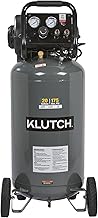
Klutch 20-Gallon 2 HP Vertical
The Klutch is the workhorse pick. At 175 max PSI and 4.2 SCFM at 90 PSI with a 75% duty cycle, it powers pneumatic tools through extended sessions without breaking a sweat. The vertical orientation minimizes its floor footprint, and large wheels make it genuinely mobile across a garage. At 75 dB it isn’t silent, but the quick recovery time means the motor cycles less frequently, giving you longer stretches of uninterrupted quiet.
Ultra Quiet 2.4 Gallon 1.5HP (60 dB)
At just 60 dB, this is the most acoustically considerate compressor in the lineup. It practically disappears into ambient room tone — a quality I appreciate in spaces where sound design matters. The 6.71 CFM at 115 PSI is surprisingly punchy for a unit this small, making it a strong candidate for finish carpentry, tire inflation, and detail spray work where calm surroundings help you focus.
California Air Tools 20020AD 20 Gallon
California Air Tools built its reputation on quiet operation, and the 20020AD delivers at 70 dB with a 2.0 HP motor and a generous 20-gallon tank. The automatic drain valve is a practical touch — it eliminates the forgotten-maintenance-drain scenario that leads to tank corrosion. For anyone running air tools regularly in a home workshop, the combination of capacity, quiet output, and automated upkeep makes this a strong long-term investment.
9.5 Gallon Ultra Quiet 2HP
This mid-capacity unit bridges the gap between portable and shop-grade. At 8.75 CFM and 70 dB, it handles heavier tools like framing nailers and HVLP guns without the noise penalty you’d expect. The wheeled design keeps it mobile, and the 9.5-gallon tank provides enough buffer to avoid constant motor cycling on sustained tasks. It’s a practical middle ground for homeowners who’ve outgrown a pancake compressor but don’t need a full 20-gallon system.
Frequently Asked Questions
Can I run a 110V air compressor on a standard household outlet?
Yes. All the compressors in this roundup plug into a standard 120V/15A or 20A household circuit. However, larger 2 HP models may trip a 15-amp breaker under heavy load — a dedicated 20-amp circuit is recommended for units above 1.5 HP to avoid nuisance trips mid-project.
What does “oil-free” actually mean, and is it better?
Oil-free compressors use self-lubricating cylinder coatings instead of a crankcase oil bath. They require less maintenance, won’t leak oil onto your workpiece, and produce cleaner air — a real advantage for finishing work where contamination shows instantly. The tradeoff is typically a slightly shorter motor lifespan and marginally higher operating noise compared to oil-lubricated equivalents at the same price point.
How loud is 60–70 dB in practical terms?
For context, a normal conversation sits around 60 dB, while a vacuum cleaner runs near 75–80 dB. A compressor at 60 dB blends into a workshop without demanding hearing protection; at 70 dB it’s noticeable but tolerable for extended use. Anything approaching 80+ dB changes the entire character of your workspace.
Is a larger tank always better?
Not necessarily. A larger tank reduces motor cycling and stores more compressed air, which is valuable for sustained tool use. But if you’re doing intermittent finish work — a few nail sets, occasional spray passes — a smaller 2–3 gallon unit recovers faster, weighs less, and takes up minimal space. Match tank size to your workflow, not to the biggest number on the label.
Final Thoughts
For most homeowners balancing noise, performance, and space, the California Air Tools 20020AD offers the best all-around package: quiet operation, generous capacity, and smart features like the automatic drain. If acoustic performance is your top priority, the Ultra Quiet 60 dB 2.4 Gallon is remarkable for its size. And for those who need serious tool-driving power without stepping up to a 220V circuit, the Klutch 20-Gallon delivers the airflow and duty cycle to keep up with demanding projects. Each of these fits a distinct use case — the right choice depends on the rhythm of work in your space.