Key takeaways
- CFM Output at 90 PSI: Framing nailers typically demand 2.0–2.5 CFM at 90 PSI. Look for a compressor that delivers at least this much — ideally higher — so the tool never starves between rapid-fire shots. A unit rated below this threshold will lag, costing you rhythm and time.
- Tank Capacity and Recovery: Larger tanks (5–6 gallons) buffer demand swings better, meaning fewer motor cycles during extended framing runs. Smaller tanks work fine for trim and brad work but can feel sluggish when you’re driving 16d nails into framing lumber all morning.
- Noise Level and Workspace Comfort: A compressor running at 80+ dB changes the entire character of your work environment. Quieter models — some as low as 59 dB — let you communicate, hear your work, and sustain focus without the constant roar that erodes attention over a full day.
- Portability and Physical Footprint: Consider how often you’re moving between floors, up ladders, or across a site. Pancake designs distribute weight well for carrying, while compact models with integrated handles excel in tight interior spaces where every square foot of floor room counts.
- Maintenance and Oil-Free Design: Oil-free pumps eliminate the need for regular oil changes and reduce the risk of spills on finished surfaces. For framing work, where your compressor sits on subfloor or bare joists, this is a practical advantage that pays off over months of ownership.
What's inside
Choosing an air compressor for a framing nail gun is one of those purchases that seems straightforward until you stand in front of a wall of options and realize every spec sheet is telling a different story. CFM ratings, PSI ceilings, tank sizes, noise levels — they all matter, but how they interact with your actual framing workload is where most buyers get lost.
This guide cuts through the noise. We evaluated the top compressors of 2026 not just on raw performance, but on how each one shapes the environment you work in — because the tool that powers your nailer also defines the atmosphere of your job site, garage, or workshop. Quiet operation, portability, and reliable airflow are the elements that separate a frustrating day from a productive one.
As an Amazon Associate we earn from qualifying purchases.



How to Choose an Air Compressor For Framing Nail Gun (2026)
- CFM Output at 90 PSI: Framing nailers typically demand 2.0–2.5 CFM at 90 PSI. Look for a compressor that delivers at least this much — ideally higher — so the tool never starves between rapid-fire shots. A unit rated below this threshold will lag, costing you rhythm and time.
- Tank Capacity and Recovery: Larger tanks (5–6 gallons) buffer demand swings better, meaning fewer motor cycles during extended framing runs. Smaller tanks work fine for trim and brad work but can feel sluggish when you’re driving 16d nails into framing lumber all morning.
- Noise Level and Workspace Comfort: A compressor running at 80+ dB changes the entire character of your work environment. Quieter models — some as low as 59 dB — let you communicate, hear your work, and sustain focus without the constant roar that erodes attention over a full day.
- Portability and Physical Footprint: Consider how often you’re moving between floors, up ladders, or across a site. Pancake designs distribute weight well for carrying, while compact models with integrated handles excel in tight interior spaces where every square foot of floor room counts.
- Maintenance and Oil-Free Design: Oil-free pumps eliminate the need for regular oil changes and reduce the risk of spills on finished surfaces. For framing work, where your compressor sits on subfloor or bare joists, this is a practical advantage that pays off over months of ownership.
The Best Air Compressor For Framing Nail Gun (2026)s Reviewed
Metabo HPT EC914S Pancake Compressor
This 6-gallon, 200 PSI unit is the workhorse of the group — its 4 CFM flow rate at 90 PSI means it can feed multiple nailers without breaking stride. The pancake design keeps the center of gravity low, and the 200 PSI ceiling translates to longer run times between cycles, which feels like a luxury when you’re framing out a room and don’t want to pause.
DEWALT DWFP55126 Pancake Compressor
At 165 PSI and 2.6 SCFM at 90 PSI, the DEWALT sits in a comfortable middle ground — powerful enough for consistent framing duty, compact enough to carry up a staircase without cursing. The oil-free pump is genuinely maintenance-free in practice, and the overall build quality suggests this unit will still be running strong years into regular use.
BOSTITCH BTFP02012-WPK Compressor Kit
What sets the BOSTITCH apart is the kit approach — you get the compressor plus compatible accessories, which lowers the barrier if you’re building out your setup from scratch. The 6-gallon, 150 PSI pancake handles framing nailers reliably, and its quieter-than-average operation makes it a good fit for residential job sites where neighbors are close by.
SENCO PC0968 Twin Tank Compressor
The twin-tank configuration gives the SENCO a different personality — smoother airflow delivery with less pulsation, which matters when precision meets power on finish and trim-adjacent framing tasks. At 2.5 gallons and 1.5 HP, it’s not the biggest player here, but its compact form factor and dual-tank balance make it easy to position wherever you need it.
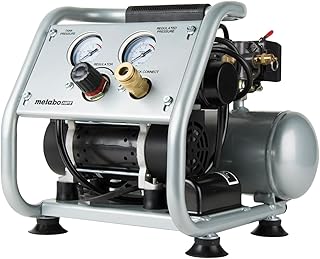
Metabo HPT EC28M Ultra-Quiet Compressor
At just 59 dB, this unit fundamentally changes what a job site sounds like. It’s the smallest on this list at 1 gallon, so it won’t power a framing nailer through a full day — but for punch-list framing, interior trim-adjacent work, or environments where noise is a genuine constraint, the EC28M creates an atmosphere that lets you think and work without interruption.
Frequently Asked Questions
Can I use a pancake compressor for framing?
Yes — pancake compressors like the Metabo HPT EC914S or DEWALT DWFP55126 are among the most popular choices for framing nail guns. Their tank size and output ratings handle framing nailers well, and their portable design suits the mobile nature of framing work across a job site.
How much CFM does a framing nailer actually need?
Most framing nailers require between 2.0 and 2.5 CFM at 90 PSI. However, choosing a compressor that exceeds this minimum — like the 4 CFM Metabo HPT EC914S — gives you headroom for sustained use and allows the compressor motor to cycle less frequently, extending its lifespan.
Is a quieter compressor worth the price premium?
If you work in occupied homes, residential neighborhoods, or shared garage spaces, absolutely. The difference between 80+ dB and 59 dB is transformative — it’s the difference between a hostile work environment and one where conversation, concentration, and courtesy coexist naturally.
What PSI should I set on my compressor for framing?
Most framing nailers operate optimally between 90 and 120 PSI at the tool. Set your regulator slightly above the nailer’s requirement to account for pressure drop in the hose. A compressor with a higher max PSI — like the 200 PSI Metabo HPT — maintains consistent delivery even during rapid firing.
Final Thoughts
For most framing work, the Metabo HPT EC914S strikes the best balance of raw output, tank capacity, and job-site practicality — it’s the compressor you reach for when productivity is the priority. The DEWALT DWFP55126 offers a refined alternative with proven durability and a slightly more manageable profile. And if your workspace demands quiet as much as power, the Metabo HPT EC28M proves that a thoughtful work environment isn’t a luxury — it’s a competitive advantage.