Key takeaways
- Noise Floor: If your build space shares walls with living areas or you work early mornings, prioritize dB ratings. The difference between 59 dB and 80+ dB is the difference between background hum and genuine disruption — it changes how long you can sustain focus without fatigue.
- Tank Capacity & PSI: A larger tank (6–9 gallons) stores more compressed air, meaning fewer motor cycles and a steadier stream of power. For framing nailers driving 3-inch nails into engineered lumber, consistent pressure above 150 PSI keeps every shot flush without bottoming out.
- CFM Output: Cubic feet per minute determines whether your compressor can keep pace with a rapid-fire framing session. Look for at least 4 CFM at 90 PSI if you plan to run multiple nailers or switch between tools without pausing.
- Tool Weight & Balance: A framing nailer you hold overhead during roof decking becomes punishing past 9 pounds. Lightweight bodies in the 7–7.5 lb range reduce wrist strain and let you read your work surface — illuminated or not — without fighting gravity.
- Portability vs. Stationary Power: Pancake compressors are easy to tuck under a workbench and out of the light path, while wheelbarrow units deliver brute force but dominate floor space. Match the form factor to how your workspace is actually laid out.
What's inside
Whether you’re framing out a new furniture workshop or retooling a garage that doubles as a finishing studio, the pairing of compressor and nailer defines how your workspace actually feels — not just functionally, but acoustically, spatially, and even in terms of how the light shifts when bulky gear eats up your floor plan. A loud, oversized compressor can drown out a podcast you use to pace long sheathing days, while a pinlight-dark corner cluttered with hose reels makes accurate nail placement harder than it should be.
This guide walks through six standout Metabo HPT and Paslode options — compressors and framing nailers alike — evaluated through both raw performance specs and the less-discussed ergonomics that shape a pleasant, productive build environment. After the product cards below, you’ll find a buyer’s framework, detailed reviews, and answers to the questions that actually matter before you click “Add to Cart.”
As an Amazon Associate we earn from qualifying purchases.



How to Choose an Air Compressor Framing Nailer (2026)
- Noise Floor: If your build space shares walls with living areas or you work early mornings, prioritize dB ratings. The difference between 59 dB and 80+ dB is the difference between background hum and genuine disruption — it changes how long you can sustain focus without fatigue.
- Tank Capacity & PSI: A larger tank (6–9 gallons) stores more compressed air, meaning fewer motor cycles and a steadier stream of power. For framing nailers driving 3-inch nails into engineered lumber, consistent pressure above 150 PSI keeps every shot flush without bottoming out.
- CFM Output: Cubic feet per minute determines whether your compressor can keep pace with a rapid-fire framing session. Look for at least 4 CFM at 90 PSI if you plan to run multiple nailers or switch between tools without pausing.
- Tool Weight & Balance: A framing nailer you hold overhead during roof decking becomes punishing past 9 pounds. Lightweight bodies in the 7–7.5 lb range reduce wrist strain and let you read your work surface — illuminated or not — without fighting gravity.
- Portability vs. Stationary Power: Pancake compressors are easy to tuck under a workbench and out of the light path, while wheelbarrow units deliver brute force but dominate floor space. Match the form factor to how your workspace is actually laid out.
The Best Air Compressor Framing Nailer (2026)s Reviewed
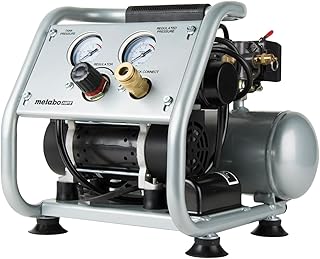
Metabo HPT Quiet Air Compressor EC28M
Running at a whisper-quiet 59 dB, the EC28M is the compressor you forget is on — perfect for small studios where ambient sound and workspace calm directly affect craftsmanship. Its 1-gallon tank and universal quick coupler make it a nimble choice for finish-oriented framers who value a clean, distraction-free environment over brute-volume output.
Metabo HPT Pancake Compressor EC914S
The 6-gallon EC914S hits a sweet spot for home shop users: 200 PSI of stored pressure and a 4 CFM flow rate that can power a framing nailer, siding gun, and brad nailer without breaking stride. Its compact pancake profile keeps the footprint low, leaving more floor space open for materials and better light access to your work area.
Metabo HPT Coil Framing Nailer NV83A5
Pro-preferred for good reason — the NV83A5’s 15-degree magazine accepts nails from 2 to 3-1/4 inches and feeds them with the kind of reliability that lets you focus on alignment rather than jams. Wall sheathing, roof decking, and subflooring all fall squarely in its wheelhouse, and the coil capacity means fewer reloads during long layout runs.
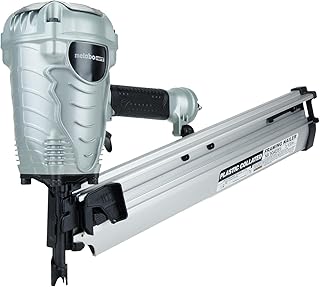
Metabo HPT Lightweight Framing Nailer NR90AES1
At just 7.5 pounds, the NR90AES1 is the framing nailer you reach for when the job demands hours of overhead or angled work. It drives 21-degree plastic-collated nails from 2 to 3-1/2 inches, and that featherweight design translates directly into cleaner, more precise placements — especially under task lighting where every shadow counts.
Paslode Pneumatic Framing Nailer F325R
The Paslode F325R has earned its reputation as a dependable workhorse that pairs seamlessly with virtually any pancake or quiet compressor. Its balanced body and consistent driving force make it a strong pick for framers who want a proven, no-surprises tool they can set up and trust from the first nail to the last.
Frequently Asked Questions
Can I use a quiet compressor with a framing nailer?
Absolutely. Units like the Metabo HPT EC28M at 59 dB produce enough pressure for lighter framing tasks, though you’ll want to verify CFM ratings match your nailer’s demands. For heavy-duty subflooring or engineered lumber, a higher-output compressor will prevent pressure drops during rapid firing.
What size nails do these framing nailers handle?
The nailers reviewed here accept nails ranging from 2 inches up to 3-1/2 inches, depending on the model. The NR90AES1 offers the longest reach at 3-1/2 inches, which is essential for structural framing members, while the NV83A5 tops out at 3-1/4 inches — still more than adequate for most sheathing and decking applications.
Do I need a 9-gallon compressor for home furniture projects?
For a home furniture site audience, a 6-gallon pancake compressor like the EC914S is typically sufficient. The 9-gallon wheelbarrow unit shines when you’re running pneumatic tools continuously on a framing site, but its size and weight make it overkill — and space-consuming — in a home workshop.
Is a lighter framing nailer actually better for accuracy?
Yes, measurably so. A 7.5 lb nailer like the NR90AES1 reduces operator fatigue over long sessions, and less fatigue means steadier hand positioning. When you’re working under focused task lighting — where shadows can obscure your mark line — that stability translates into tighter, more consistent nail placement.
Final Thoughts
For most home workshop framers, the Metabo HPT Pancake Compressor EC914S paired with the Metabo HPT Lightweight Framing Nailer NR90AES1 offers the best balance of power, portability, and ergonomic comfort. If workspace quiet is non-negotiable, the EC28M compressor deserves a serious look. Any of these picks will elevate your build environment from chaotic to considered — and that clarity shows in the finished work.