Key takeaways
- Tooth Count for Finish Quality: Anything above 60 teeth enters fine-finish territory, where individual tooth marks become nearly invisible. For plywood destined for visible surfaces in well-lit rooms, 80-tooth blades consistently deliver the kind of edge that reads as factory-smooth under overhead downlights.
- Tooth Geometry (ATB vs. TCT): Alternate top bevel teeth excel at clean crosscuts through layered veneers, while tungsten carbide-tipped teeth hold their edge far longer across abrasive glues and composite cores. Consider which matters more — initial sharpness or sustained sharpness over hundreds of linear feet.
- Kerf Width and Material Waste: Full-kerf blades (roughly 1/8 inch) cut with more stability but remove more material. Thin-kerf options reduce waste and strain on smaller motors, though they can deflect slightly in thick stock. Match the kerf to your saw’s horsepower and the sheet goods you cut most often.
- Arbor Size Compatibility: Measure your saw’s arbor before ordering — 5/8-inch is the near-universal standard on contractor and cabinet saws, but some compact jobsite saws run 1/2-inch. A mismatched arbor means a blade that never makes it out of the box.
- RPM Rating and Safety Headroom: Always verify the blade’s maximum rated RPM against your saw’s no-load speed. A blade rated at 6,000 RPM on a saw spinning at 5,000 is fine; the reverse is a safety hazard. Most quality blades list this clearly on the packaging or product page.
What's inside
Plywood is deceptive. A cut that looks clean under the fluorescent tubes of a big-box store reveals every micro-tear and fiber pull under the warm directional glow of a living room pendant. If you’re building furniture that will sit where light actually lives — beside a window, under a sconce, across from a candlelit dining setup — the blade on your table saw matters more than almost any other tool choice you’ll make.
This guide zeroes in on the six blades generating the most conversation among furniture makers right now. We narrowed the field to five standouts, weighing tooth geometry, kerf behavior, and the kind of surface finish that holds up when light grazes it at a low angle. Whether you’re ripping full sheets of Baltic birch or crosscutting mahogany-faced ply for cabinet doors, there’s a blade here matched to your workflow.
As an Amazon Associate we earn from qualifying purchases.


How to Choose the Best Table Saw Blade for Plywood (2026)
- Tooth Count for Finish Quality: Anything above 60 teeth enters fine-finish territory, where individual tooth marks become nearly invisible. For plywood destined for visible surfaces in well-lit rooms, 80-tooth blades consistently deliver the kind of edge that reads as factory-smooth under overhead downlights.
- Tooth Geometry (ATB vs. TCT): Alternate top bevel teeth excel at clean crosscuts through layered veneers, while tungsten carbide-tipped teeth hold their edge far longer across abrasive glues and composite cores. Consider which matters more — initial sharpness or sustained sharpness over hundreds of linear feet.
- Kerf Width and Material Waste: Full-kerf blades (roughly 1/8 inch) cut with more stability but remove more material. Thin-kerf options reduce waste and strain on smaller motors, though they can deflect slightly in thick stock. Match the kerf to your saw’s horsepower and the sheet goods you cut most often.
- Arbor Size Compatibility: Measure your saw’s arbor before ordering — 5/8-inch is the near-universal standard on contractor and cabinet saws, but some compact jobsite saws run 1/2-inch. A mismatched arbor means a blade that never makes it out of the box.
- RPM Rating and Safety Headroom: Always verify the blade’s maximum rated RPM against your saw’s no-load speed. A blade rated at 6,000 RPM on a saw spinning at 5,000 is fine; the reverse is a safety hazard. Most quality blades list this clearly on the packaging or product page.
The Best Table Saw Blades For Plywood (2026) Reviewed
FOXBC 10-Inch 80-Tooth Ultra Finish
The FOXBC delivers the kind of cut surface that catches ambient light without scatter — smooth enough that edge banding becomes optional on hidden joints. Its 5/8-inch arbor drops straight onto most contractor saws, and the 80-tooth ATB grind produces minimal tear-out on both face veneers and backer plies. For furniture builders who prioritize that first-cut-right finish under gallery-style lighting, this blade earns its place at the top of the stack.
KENDO 10-Inch 2-Pack (40T/60T)
KENDO’s dual-blade approach solves a real workflow problem: swap the 40-tooth rip blade for the 60-tooth crosscut blade mid-project without hunting through a drawer. The 60-tooth blade handles plywood, MDF, and laminate with a respectable finish — not quite mirror-smooth, but clean enough that a single pass with 220-grit puts it camera-ready. For shops that cut both sheet goods and solid lumber, this set eliminates the one-blade compromise.
Benchmark Abrasives TCT 8-1/2-Inch 60-Tooth
Designed for smaller circular and table saws, the Benchmark TCT blade punches above its compact size. The tungsten carbide tips chew through plywood cores and hardwood veneers without the blade drift that plagues cheaper 8-1/2-inch options. Under task lighting, cuts from this blade show a consistent edge line — a detail that separates assembled furniture from kit furniture in a room’s final read.
80-Tooth 10-Inch Fine Finish (Red)
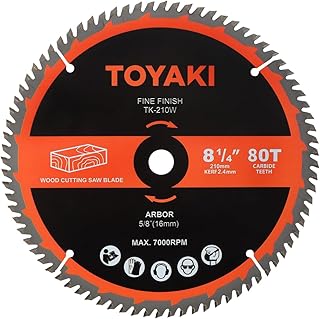
This blade’s 7,000 RPM ceiling gives it headroom on fast-spinning cabinet saws where lesser blades start to hum and wander. The 80-tooth layout produces crosscuts on plywood that look burnished rather than cut — a surface that absorbs warm accent lighting cleanly instead of scattering it across micro-grooves. At its price point, it’s a strong upgrade for anyone still factory-cresting their included blade.
10-Inch 80T Carbide Tipped for Wood and Composites
Engineered for the broad material range that modern furniture builders actually encounter — plywood, plastic laminates, and fiber composites — this blade handles a multi-material sheet inventory without switching tooling. The carbide tips maintain edge geometry through glue-heavy cuts that would dull HSS alternatives in half the time. Under even, diffused lighting, the cut faces read flat and uniform, which matters when finish work meets open-plan living spaces.
Frequently Asked Questions
Can I use one blade for both plywood and hardwood?
You can, but with trade-offs. A 60-tooth blade splits the difference acceptably — decent crosscuts on hardwood, acceptable tear-out on plywood. For projects where every joint sits in direct sight lines under focused lighting, dedicated rip and crosscut blades still outperform any single all-rounder.
Does blade quality really affect visible finish under room lighting?
Significantly. Micro-tears and tooth marks that look minor under a shop light become pronounced under warm directional fixtures, especially on open-grain veneers. A premium 80-tooth blade produces a surface that reads as intentionally smooth rather than merely sanded.
How often should I replace a plywood-cutting blade?
Expect 100 to 200 hours of cut time from quality carbide teeth before diminishing returns show up as increased tear-out and burn marks. If you’re suddenly reaching for filler before finishing, the blade is telling you something.
Thin kerf or full kerf for plywood furniture work?
Full kerf offers more stability and straighter cuts in thick plywood stacks, which translates to tighter joinery visible under raking light. Thin kerf saves material and eases motor strain, but demands a sharp blade and steady feed rate to avoid deflection on sheet goods.
Final Thoughts
For furniture that lives in the interplay of natural and designed light, the FOXBC 10-Inch 80-Tooth stands out as the best single-blade investment for plywood work. Builders who need rip-and-crosscut versatility will find strong value in the KENDO 2-Pack, while the Benchmark TCT is the pick for compact saw setups that still demand clean, light-ready edges.