Key takeaways
- CFM Rating: Most HVLP spray guns demand 8–14 CFM at 40 PSI; LVLP guns run efficiently on 3–6 CFM. Always match your compressor’s continuous output — not just peak — to your gun’s requirements or you’ll experience pressure drops mid-coat.
- Tank Capacity: Larger tanks (6–8 gallons) buffer demand spikes and keep pressure steady during long passes. For small touch-up work, 2–3 gallons suffice, but expect more frequent motor cycling on full panels.
- Noise Level: If your finishing lives inside a residential workshop or garage, decibels matter enormously. Units below 70 dBA let you work early or late without disturbing a household, while standard compressors often exceed 80 dBA.
- Portability vs. Power: Heavier twin-stack and pancake units deliver higher PSI and faster recovery but anchor you to one spot. Wheeled or compact designs trade raw output for mobility — ideal for on-site furniture refinishing jobs.
- Oil-Free vs. Oil-Lubricated: Oil-free pumps require less maintenance and won’t risk contaminating your spray environment with oil mist, which is a genuine concern when working under controlled lighting where every surface imperfection shows.
What's inside
Finishing a piece of furniture to showroom-level quality means controlling your environment as precisely as your technique — and the single most overlooked variable is airflow. An undersized compressor starves your spray gun mid-pass, leaving orange peel texture or dry spray that ruins hours of prep work, while an overpowered unit rattles through your shop and disturbs the finish on adjacent pieces.
This guide cuts through the noise (sometimes literally) to help you match the right compressor to your spray gun setup, your space constraints, and your tolerance for shop-floor racket. We tested portability, decibel output, tank recovery speed, and CFM delivery to identify five units that genuinely hold up under furniture finishing demands in 2026.
As an Amazon Associate we earn from qualifying purchases.



How to Choose an Air Compressor For Spray Gun (2026)
- CFM Rating: Most HVLP spray guns demand 8–14 CFM at 40 PSI; LVLP guns run efficiently on 3–6 CFM. Always match your compressor’s continuous output — not just peak — to your gun’s requirements or you’ll experience pressure drops mid-coat.
- Tank Capacity: Larger tanks (6–8 gallons) buffer demand spikes and keep pressure steady during long passes. For small touch-up work, 2–3 gallons suffice, but expect more frequent motor cycling on full panels.
- Noise Level: If your finishing lives inside a residential workshop or garage, decibels matter enormously. Units below 70 dBA let you work early or late without disturbing a household, while standard compressors often exceed 80 dBA.
- Portability vs. Power: Heavier twin-stack and pancake units deliver higher PSI and faster recovery but anchor you to one spot. Wheeled or compact designs trade raw output for mobility — ideal for on-site furniture refinishing jobs.
- Oil-Free vs. Oil-Lubricated: Oil-free pumps require less maintenance and won’t risk contaminating your spray environment with oil mist, which is a genuine concern when working under controlled lighting where every surface imperfection shows.
The Best Air Compressor For Spray Gun (2026)s Reviewed
California Air Tools 8010 PK Ultra Quiet Compressor with LVLP Spray Kit
This bundled kit solves the pairing puzzle out of the box — the 8-gallon steel tank and LVLP spray gun are designed to complement each other, and at 60 dBA it runs quieter than a normal conversation. The included wheeled cart makes repositioning effortless during multi-piece furniture runs, and the oil-free pump eliminates any risk of airborne oil settling into your fresh finish.
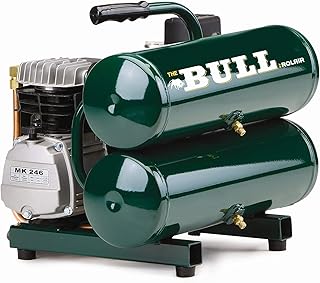
Rolair FC2002 Twin Stack Compressor
The twin-stack design delivers serious sustained CFM for users running higher-flow HVLP guns or spraying larger case goods, and the built-in overload protection with manual reset is exactly the kind of safeguard you want when a compressor sits unattended during a long finishing session. It trades lightness for muscle, making it best suited to a dedicated shop bench rather than field work.
Rolair JC10 Plus 2.5 Gallon Compressor
Where the JC10 Plus earns its keep is in tight, detail-oriented work — cabinetry interiors, drawer fronts, and small decorative pieces where you need just enough air to feather a coat without the bulk of a larger unit. The compact footprint tucks under a workbench, and its quieter operating profile suits late-night finishing sessions when the house is quiet and ambient sound control matters.
Metabo HPT EC914S 6 Gallon Pancake Compressor
Metabo HPT’s pancake delivers 200 PSI in a proven design with a 4 CFM flow rate that handles multiple nailers and, with the right low-volume gun, covers spray applications for smaller furniture projects. Its real strength is job-site readiness — rugged construction and rapid recovery mean it shrugs through back-to-back sessions without thermal fatigue, though the louder output means shop placement demands more thought.
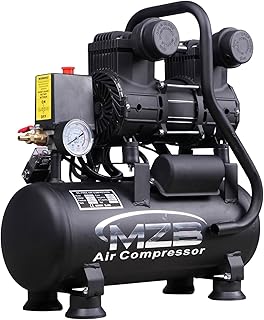
MZB 2.4 Gallon Ultra Quiet Air Compressor
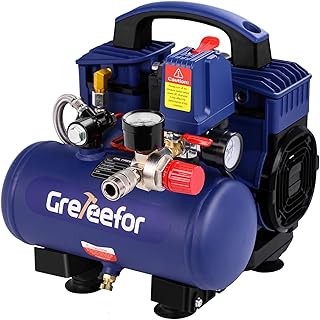
At 70 dB with 5.65 CFM on a 2.4-gallon tank, this unit threads a useful needle between quiet operation and meaningful airflow for LVLP spray work. The dual steel tanks hold pressure well during short-to-medium passes, and the oil-free design keeps maintenance minimal — a practical choice for hobbyist furniture builders who finish a few pieces a month rather than running production volumes daily.
Frequently Asked Questions
Can I use a pancake compressor for spray painting furniture?
Pancake compressors work for small touch-ups and LVLP guns with modest air demands, but their lower CFM output and faster pressure drops make them frustrating for full-panel spraying on dressers or tables. If spray finishing is your primary use, invest in a unit with higher continuous CFM and a larger tank.
What CFM do I need for an HVLP spray gun?
Most HVLP guns specify 8–14 CFM at 40 PSI in their operating requirements. Your compressor should meet or exceed that rating at the gun’s working pressure, not just at the tank outlet — check the manufacturer’s CFM chart at the specific PSI your gun needs.
Do oil-free compressors affect spray finish quality?
No — in fact, oil-free compressors are preferable for furniture finishing because they eliminate the risk of oil mist from a lubricated pump contaminating your spray environment. Under the controlled lighting a finishing shop demands, even microscopic oil particles can cause fish-eye defects in lacquer and clear coats.
How important is noise level in a workshop compressor?
If your finishing space shares proximity with living areas, noise becomes a practical constraint on when and how long you can work. Compressors under 70 dBA allow flexible scheduling without friction, while louder units above 80 dBA effectively require a detached or well-insulated workspace.
Final Thoughts
For most home furniture refinishing, the California Air Tools 8010 PK stands out as the most complete package thanks to its included LVLP gun, quiet operation, and generous tank size. The Rolair FC2002 is the pick for dedicated shop users who need uncompromising airflow for HVLP guns on larger projects. And for hobbyists working in small spaces who finish occasional pieces, the MZB 2.4 Gallon offers the best balance of quiet running, adequate CFM, and footprint economy.