Key takeaways
- Surface: Solid wood offers a warmer appearance and can often be refinished, while particle board and engineered tops provide practical value but need protection from moisture and deep impact.
- Lighting: Built-in LEDs are useful for close detail work, but check their position and color quality; a neutral-white light around 4000K–5000K usually reveals edges and finishes without feeling overly blue.
- Stability: Look for a rigid frame, sensible weight capacity, and feet that stay planted when you plane, clamp, or sand. Adjustable legs are especially helpful on uneven garage floors.
- Workflow: Pegboards, drawers, power strips, dog holes, and integrated vises can reduce reaching and keep tools within a consistent pool of light.
- Room fit: Measure both the footprint and the working clearance around it. A visually heavy bench may benefit from a lighter wall color and layered ambient lighting to prevent the area from feeling boxed in.
What's inside
A workbench top has to do more than survive hammer blows and spilled finishes. It shapes how comfortably you work, how clearly you see a cut line, and how inviting the entire workshop feels at the end of a long project. The wrong surface can amplify vibration, swallow useful light, or make a compact room feel cluttered and harsh.
This guide compares five compelling workbench-top solutions for 2026, from warm solid birch and European beech to integrated LED workstations and mobile steel-framed benches. Alongside durability, we consider height, storage, surface texture, task lighting, and the visual atmosphere each option brings to a garage, studio, or utility room.
As an Amazon Associate we earn from qualifying purchases.




How to Choose Workbench Tops (2026)
- Surface: Solid wood offers a warmer appearance and can often be refinished, while particle board and engineered tops provide practical value but need protection from moisture and deep impact.
- Lighting: Built-in LEDs are useful for close detail work, but check their position and color quality; a neutral-white light around 4000K–5000K usually reveals edges and finishes without feeling overly blue.
- Stability: Look for a rigid frame, sensible weight capacity, and feet that stay planted when you plane, clamp, or sand. Adjustable legs are especially helpful on uneven garage floors.
- Workflow: Pegboards, drawers, power strips, dog holes, and integrated vises can reduce reaching and keep tools within a consistent pool of light.
- Room fit: Measure both the footprint and the working clearance around it. A visually heavy bench may benefit from a lighter wall color and layered ambient lighting to prevent the area from feeling boxed in.
The Best Workbench Tops (2026) Reviewed
CAMMOO 48-Inch Garage Work Bench
The CAMMOO combines a rubberwood work surface with storage, a pegboard, a power strip, and an integrated LED light, making it a strong all-in-one choice for a garage workshop. Its substantial load rating suits demanding projects, while the overhead illumination helps reduce shadows across the bench; consider adding warmer surrounding light so the built-in fixture does not make the room feel stark.
Unfinished Birch Butcher Block Countertop
This 60-by-25-inch solid birch slab is the most visually adaptable option in the group. Its smooth, unfinished surface can be oiled for a natural satin glow, sealed for easier cleanup, or painted to coordinate with a studio or laundry room, though it requires a separate support structure and task-lighting plan.
BenchPro Adjustable Particle Board Workbench
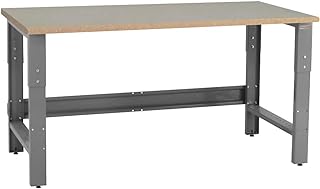
The BenchPro offers a straightforward 1-inch particle board top with a height range of 30 to 36 inches, giving users useful flexibility for standing or seated tasks. It is a sensible foundation for assembly, crafting, and light repair work; seal vulnerable edges and pair it with a clamp-on lamp or broad overhead fixture for more controlled illumination.
BORA Centipede T-Track Workbench Top
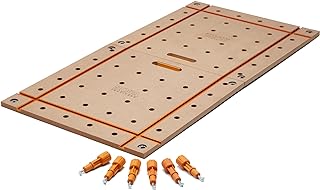
Built around a 3/4-inch dog-hole MFT-style surface, the BORA Centipede is aimed at makers who value accurate positioning and adaptable clamping. Its worktop encourages a tidy, precise workflow and packs well for temporary setups, although portable users should pay particular attention to balanced lighting because the top itself does not create a dedicated glow.
Smart Workstation Pro Vise Top
The compact Smart Workstation Pro Vise Top uses European beech construction and cushioned jaws in a portable 20 7/8-by-14 3/8-inch format. It is best understood as a focused clamping station rather than a full bench, ideal for small repairs or detail work where a close, glare-controlled lamp can make a bigger difference than a large surface.
Frequently Asked Questions
What is the best material for a workbench top?
Hardwood is generally the most satisfying choice for durability, repairability, and appearance. Birch and beech provide a good balance of strength and a relatively smooth surface, while engineered boards can work well for lighter-duty tasks when protected from water and heavy impact.
How bright should workbench lighting be?
A practical starting point is roughly 500 to 1000 lumens directed at the working area, with more light for intricate electronics, carving, or finishing. Use diffuse overhead light plus an adjustable task light to limit sharp shadows and reflected glare.
Is a thicker workbench top always better?
Not always. Thickness improves stiffness and helps resist vibration, but frame quality, support spacing, and the bench’s intended work matter just as much. A well-supported thinner top can outperform a thick slab on a flexible frame.
Should a workbench be against a wall?
Usually, yes, especially in a compact workshop where a wall can support pegboards, shelves, and cable management. Leave enough clearance to work comfortably, and avoid placing the bench where your body blocks the primary light source.
Final Thoughts
Choose the CAMMOO for an organized, illuminated garage station, the unfinished birch top for a custom bench with the warmest visual presence, or the BORA Centipede for flexible precision work. Each can be excellent when its surface, height, and lighting are matched to the way you actually build.