Key takeaways
- Blade span and ceiling height ratio: For ceilings above ten feet, target blades measuring sixty inches or wider. Larger sweep diameters displace more air at lower rotational speeds, which keeps noise down and eliminates the “wind tunnel” effect smaller fans create when pushed to maximum RPM.
- DC motor over AC: Brushless DC motors consume roughly half the energy of conventional AC motors, offer six or more discrete speed settings, and operate at decibel levels low enough that you forget the fan is running. At high-ceiling heights where the fan runs constantly, this efficiency gap compounds quickly.
- Integrated light quality and CCT: Look for adjustable correlated color temperature — ideally a range spanning 3000K to 6000K. In a room with tall ceilings, the fan light often becomes the primary ambient source, so tunable CCT lets you shift from warm evening glow to crisp task-oriented daylight without additional fixtures.
- Mounting flexibility and downrod length: A high ceiling demands a longer downrod to position the blades at the optimal eight-to-nine-foot clearance from the floor. Confirm the fan ships with or supports extended downrods, and check whether it is rated for vaulted or angled mounting if your ceiling geometry requires it.
- Smart controls and remote features: At ceiling heights above ten feet, reaching a wall switch is impractical. Prioritize fans bundled with responsive remotes — or better yet, Wi-Fi and app-based control with timer and memory functions that remember your preferred speed and light settings across power cycles.
What's inside
High ceilings transform a room’s presence, but they also create a stubborn airflow problem: standard fans simply cannot move air meaningfully across that vertical distance. The result is a space that looks grand but feels stuffy in summer and stratified in winter, with warm air trapped uselessly near the ceiling while occupants below reach for a second blanket.
As someone who designs lighting and atmosphere for residential interiors, I evaluate fans not just by CFM numbers but by how a fixture shapes the feel of a room — its sound, its light quality, its visual weight against tall ceilings. This 2026 roundup breaks down the strongest high-ceiling fans available on Amazon right now, covering airflow performance, motor technology, integrated lighting, and the kind of quiet that lets a room actually breathe.
As an Amazon Associate we earn from qualifying purchases.


How to Choose a Fan For High Ceiling (2026)
- Blade span and ceiling height ratio: For ceilings above ten feet, target blades measuring sixty inches or wider. Larger sweep diameters displace more air at lower rotational speeds, which keeps noise down and eliminates the “wind tunnel” effect smaller fans create when pushed to maximum RPM.
- DC motor over AC: Brushless DC motors consume roughly half the energy of conventional AC motors, offer six or more discrete speed settings, and operate at decibel levels low enough that you forget the fan is running. At high-ceiling heights where the fan runs constantly, this efficiency gap compounds quickly.
- Integrated light quality and CCT: Look for adjustable correlated color temperature — ideally a range spanning 3000K to 6000K. In a room with tall ceilings, the fan light often becomes the primary ambient source, so tunable CCT lets you shift from warm evening glow to crisp task-oriented daylight without additional fixtures.
- Mounting flexibility and downrod length: A high ceiling demands a longer downrod to position the blades at the optimal eight-to-nine-foot clearance from the floor. Confirm the fan ships with or supports extended downrods, and check whether it is rated for vaulted or angled mounting if your ceiling geometry requires it.
- Smart controls and remote features: At ceiling heights above ten feet, reaching a wall switch is impractical. Prioritize fans bundled with responsive remotes — or better yet, Wi-Fi and app-based control with timer and memory functions that remember your preferred speed and light settings across power cycles.
The Best Fan For High Ceiling (2026)s Reviewed
ZMISHIBO 72″ Ceiling Fan
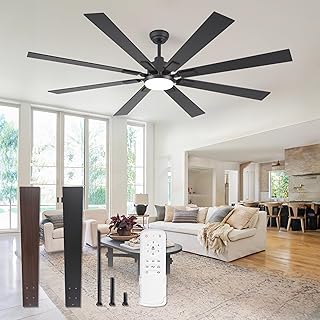
This dual-finish 72-inch model strikes the best balance between understated aesthetics and serious airflow for rooms between 400 and 600 square feet. The 24W three-CCT LED module delivers genuinely usable ambient light — not the washed-out glow many integrated fixtures produce — and the DC motor stays below conversational volume even at top speed. A strong choice when the ceiling height demands presence without visual heaviness.
ZMISHIBO 96 Inch Industrial Fan
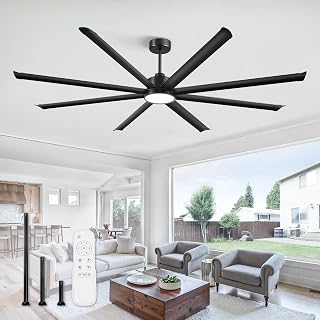
When the ceiling rises above fourteen feet and the room stretches past 700 square feet, this ninety-six-inch industrial unit is the most capable option in the roundup. Eight reversible aluminum blades generate enough cubic feet per minute to cycle air in commercial-scale garages, shops, and gazebos. The six-speed remote lets you dial from a gentle summer whisper to a serious winter downforce, and the damp rating means covered outdoor installations are fair game.
84 Inch Walnut and Black Ceiling Fan
The walnut-and-black blade finish reads warm and contemporary, making this 84-inch fan a natural fit for great rooms where the fixture needs to complement wood furniture or flooring rather than fight it. The memory function is a subtle standout: it recalls your last light and speed setting after a power interruption, which matters more than you expect in a room where reaching the fan manually requires a ladder.
ZMISHIBO 65″ 8-Blade Fan
Eight blades on a 65-inch frame is an unusual configuration, and it works. The additional blades distribute air more evenly across a wider area at lower speeds, which translates to a smoother, less directional breeze — exactly what you want in a living room or bedroom where a direct blast feels intrusive. The 3000-6000K dimmable light covers the full spectrum from candlelight warmth to bright overhead clarity.
60 Inch Wood Propeller Ceiling Fan
Three wide wood-grain blades give this sixty-inch fan a sculptural quality that reads more like a design object than an appliance — a significant advantage when the fan is the most prominent fixture in a room with soaring ceilings. Alexa, app, and remote tri-control options make it the most flexible in terms of integration, and the commercial damp rating opens installation possibilities on covered porches and exterior pavilions.
Frequently Asked Questions
How high should a ceiling fan hang in a room with a twelve-foot ceiling?
Position the blade tips at least eight feet above the finished floor for safety and optimal air circulation. A standard downrod typically places the fan around ten to eleven feet up on a twelve-foot ceiling, which leaves sufficient clearance while keeping the airflow within the occupied zone.
Can I use a high-ceiling fan year-round?
Yes, and you should. Reversing the blade direction in winter pushes accumulated warm air downward along the walls and back toward the floor, reducing heating costs by redistributing thermal stratification without creating a perceptible draft at occupant level.
Are DC motors worth the price premium over AC motors?
For high-ceiling installations, absolutely. DC motors draw roughly fifty percent less electricity, run substantially quieter, and offer finer speed granularity — typically six speeds versus three or four. Over the fan’s lifespan, the energy savings alone offset the initial cost difference.
Do I need a separate light fixture with a fan that has integrated LED?
With current high-output LED modules delivering 2000 lumens or more across tunable color temperatures, most rooms under 500 square feet need no supplementary ambient lighting. Larger or multi-functional spaces may still benefit from layered accent or task fixtures, but the fan light alone handles primary illumination effectively.
Final Thoughts
For most high-ceiling living spaces, the ZMISHIBO 72″ offers the strongest blend of airflow, light quality, and unobtrusive design. Rooms exceeding 500 square feet or featuring truly soaring ceilings benefit from the raw displacement of the 96-inch industrial model, while the 60-inch three-blade wood propeller fan is the pick when architectural aesthetics are non-negotiable. Match the fan to your room’s square footage and ceiling height using the guide above, and the rest falls into place.