Key takeaways
- Color Temperature Match: Hold a swatch under your room’s primary light source. Warm-toned LEDs (2700K–3000K) push reds and browns toward amber, while daylight-balanced bulbs (4000K+) reveal blue undertones. Pick a dye that reads correct under your actual lighting, not the product photo.
- Finish Level: Decide between matte, satin, and gloss before buying. A matte recoloring balm absorbs light and hides micro-imperfections, ideal for vintage leather. Satin finishes reflect just enough to revive worn areas without looking artificial in open-plan spaces.
- Leather Type Compatibility: Aniline, semi-aniline, and pigmented leather each absorb dye differently. Smooth aniline surfaces drink in pigment fast, while sealed pigmented leathers need a formula designed to bond on top of existing coatings rather than soak in.
- Application Method: Balms and creams work best for broad, even color restoration on large sofa panels. Liquid dyes with included daubers suit targeted touch-ups — seams, armrests, and edges where precision matters more than coverage speed.
- UV and Wear Resistance: Furniture near windows or in high-traffic family rooms demands a dye with built-in UV stabilizers and a finish that resists transfer onto clothing. Check whether the formula requires a separate topcoat or seals itself during application.
What's inside
Walk into any sun-drenched living room and you’ll notice what nobody talks about: leather that’s silently surrendered its depth. South-facing windows, daily wear, the slow chemistry of body oils and ambient heat — together they mute the richness that once made a sofa command the room. The wrong dye makes things worse, flattening texture into a plasticky mask that kills the way light plays across grain. The right one restores dimension.
This guide breaks down the best leather sofa dyes available in 2026, tested not just for color accuracy but for how each formula interacts with natural and artificial light — because a finish that looks correct under a store’s fluorescents can turn muddy under warm pendants. We evaluated ease of application, durability under real household conditions, and whether the result lets your sofa breathe aesthetically the way quality leather should.
As an Amazon Associate we earn from qualifying purchases.


How to Choose a Leather Sofa Dye (2026)
- Color Temperature Match: Hold a swatch under your room’s primary light source. Warm-toned LEDs (2700K–3000K) push reds and browns toward amber, while daylight-balanced bulbs (4000K+) reveal blue undertones. Pick a dye that reads correct under your actual lighting, not the product photo.
- Finish Level: Decide between matte, satin, and gloss before buying. A matte recoloring balm absorbs light and hides micro-imperfections, ideal for vintage leather. Satin finishes reflect just enough to revive worn areas without looking artificial in open-plan spaces.
- Leather Type Compatibility: Aniline, semi-aniline, and pigmented leather each absorb dye differently. Smooth aniline surfaces drink in pigment fast, while sealed pigmented leathers need a formula designed to bond on top of existing coatings rather than soak in.
- Application Method: Balms and creams work best for broad, even color restoration on large sofa panels. Liquid dyes with included daubers suit targeted touch-ups — seams, armrests, and edges where precision matters more than coverage speed.
- UV and Wear Resistance: Furniture near windows or in high-traffic family rooms demands a dye with built-in UV stabilizers and a finish that resists transfer onto clothing. Check whether the formula requires a separate topcoat or seals itself during application.
The Best Leather Sofa Dye (2026)s Reviewed
Leather Recoloring Balm – Color Restorer Conditioner
A forgiving, beginner-friendly balm that excels at reviving faded mid-tone sofas without requiring surgical precision. Its conditioning agents keep the leather supple, so the restored color looks like part of the original material rather than a patch applied on top — particularly convincing under diffused ambient light where harsh overlays tend to betray themselves.
Furniture Clinic Medium Brown Leather Dye
Engineered for couches and car seats alike, this dye delivers impressively even saturation across large surfaces. The medium brown tone sits in a versatile sweet spot that doesn’t skew too warm or too cool, making it a reliable choice for rooms where the sofa is the visual anchor and color consistency across sections is non-negotiable.
Angelus Leather Dye – Jet Black
A liquid dye favored by craftspeople for its flexibility, and that characteristic translates beautifully to furniture restoration. Jet black can easily turn a sofa into a light-absorbing void, but Angelus’s thin viscosity allows you to build color in controlled layers, preserving the natural grain variation that keeps black leather from looking flat under spot lighting.
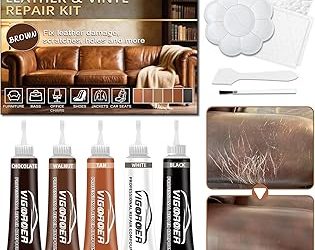
Dark Brown Leather Repair Kit
More than a dye, this kit pairs recoloring balm with repair compounds to tackle scratches and age damage simultaneously. For dark brown sofas that show every scuff and abrasion, it provides a one-session solution — apply the filler first, then the dye — that leaves a cohesive finish without visible transition lines between repaired and untouched areas.
Dark Brown Leather Recoloring Balm
A straightforward scratch remover and color restorer that punches above its weight on older leather. The balm blends into surrounding areas with minimal effort, making it especially effective on couches and car seats where uneven wear creates patchy discoloration. Under warm evening lighting, the restored sections merge convincingly with the original patina.
Frequently Asked Questions
Can I use leather dye on faux leather or vinyl furniture?
Some recoloring balms are formulated for both genuine leather and vinyl, but standard liquid dyes designed exclusively for real leather will not bond to synthetic surfaces. Always verify the product’s compatibility list before applying it to bonded or polyurethane-coated materials.
How long does a leather dye treatment last on a sofa?
With proper surface preparation and an occasional conditioning treatment, a quality dye job on a sofa lasts two to four years under normal household use. Direct sunlight and frequent heavy use shorten that window, so consider applying a UV-resistant topcoat if your living room gets afternoon sun.
Do I need to strip the old finish before dyeing?
It depends on the product type. Recoloring balms are designed to bond over existing finishes, while penetrating liquid dyes achieve their best results on clean, stripped leather. A quick wipe-down with a leather preparer or rubbing alcohol solution is usually sufficient for balms; deeper preparation is necessary for liquid formulas.
Will the dye rub off onto my clothes?
A properly applied and fully cured dye should not transfer. If your product requires a separate sealant or topcoat, applying it is essential to prevent color migration. Allow the recommended drying time — typically 24 to 48 hours — before sitting on the sofa to let the finish fully set.
Final Thoughts
For a quick, forgiving restoration that keeps leather looking authentically aged, the Leather Recoloring Balm is our top pick. If you’re tackling extensive fade and damage on dark leather, the Dark Brown Leather Repair Kit offers the most complete single-session solution. And for anyone restoring a black sofa under demanding lighting conditions, Angelus Leather Dye provides the layering control needed to preserve depth and grain without turning the piece into a matte monolith.