Key takeaways
- Scale and Proportion: A linear fixture should span roughly two-thirds the length of your island. Anything shorter looks like an afterthought; anything longer overwhelms the surface and creates uneven light distribution along the countertop edge.
- Colour Temperature Range: Islands pull double duty as prep stations and gathering spots. Look for fixtures that offer at least 3000K (warm task light) to 4000K (neutral daylight). Fixed-temperature pendants below 3000K will feel too amber for chopping vegetables at 7 PM.
- Mounting Height and Adjustability: The bottom of any island fixture should sit 30–36 inches above the countertop. Fixed-drop fixtures lock you into one configuration. Adjustable chains or rods give you room to adapt if you ever change counter height or reposition the island itself.
- Glass and Shade Opacity: Clear glass amplifies brightness and looks airy but exposes the bulb completely—meaning you need quality LED sources, not bargain store bulbs. Frosted or seeded glass diffuses more forgivingly and hides imperfections in the lamp itself.
- Material and Finish Durability: Matte black metal resists fingerprints and pairs with virtually every cabinet colour. Wood-tone accents add warmth but must be sealed properly to withstand kitchen humidity and grease vapour. Verify that finishes carry at least a two-year warranty against flaking or tarnishing.
What's inside
Choosing the right fixture over a kitchen island is deceptively complex. A light that looks stunning in a showroom listing can cast harsh shadows on countertops, clash with your cabinet hardware, or simply hang at the wrong height for your ceiling. Buyers bounce between farmhouse pendants and modern linear bars without a clear sense of scale, colour temperature, or how the fixture will actually perform once installed over a prep surface where task lighting matters as much as aesthetics.
This guide narrows the field. I evaluated six leading kitchen island lights across five dimensions—light output, material integrity, adjustability, colour temperature flexibility, and visual coherence with contemporary kitchen palettes. Below you’ll find the standout picks, a hands-on framework for choosing the right one, and answers to the questions that trip up most buyers.
As an Amazon Associate we earn from qualifying purchases.


How to Choose Kitchen Island Lighting (2026)
- Scale and Proportion: A linear fixture should span roughly two-thirds the length of your island. Anything shorter looks like an afterthought; anything longer overwhelms the surface and creates uneven light distribution along the countertop edge.
- Colour Temperature Range: Islands pull double duty as prep stations and gathering spots. Look for fixtures that offer at least 3000K (warm task light) to 4000K (neutral daylight). Fixed-temperature pendants below 3000K will feel too amber for chopping vegetables at 7 PM.
- Mounting Height and Adjustability: The bottom of any island fixture should sit 30–36 inches above the countertop. Fixed-drop fixtures lock you into one configuration. Adjustable chains or rods give you room to adapt if you ever change counter height or reposition the island itself.
- Glass and Shade Opacity: Clear glass amplifies brightness and looks airy but exposes the bulb completely—meaning you need quality LED sources, not bargain store bulbs. Frosted or seeded glass diffuses more forgivingly and hides imperfections in the lamp itself.
- Material and Finish Durability: Matte black metal resists fingerprints and pairs with virtually every cabinet colour. Wood-tone accents add warmth but must be sealed properly to withstand kitchen humidity and grease vapour. Verify that finishes carry at least a two-year warranty against flaking or tarnishing.
The Best Kitchen Island Lighting (2026) Reviewed
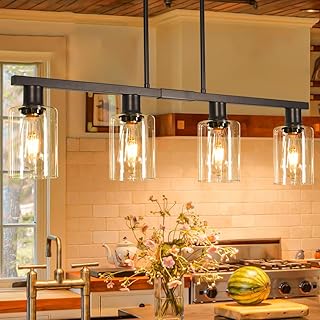
DSMJFU 4-Light Linear Island Bar
Four clear glass shades on a clean black bar give this fixture a restrained farmhouse energy that doesn’t shout. The adjustable drop makes it forgiving for non-standard ceiling heights, and the open glass design throws a generous, even pool of light across a mid-size island—exactly the kind of unobstructed wash a prep surface benefits from.
MELUCEE 7-Light Dimmable LED Linear
This is the most technically capable fixture in the roundup. At 43 inches, it covers a larger island comfortably, and the built-in LED module shifts between five colour temperatures from warm 3000K to cool 6000K. Dimmable operation means you can dial it from bright task mode down to an intimate dinner glow without swapping bulbs. For anyone who treats the island as the kitchen’s command centre, this is the one to beat.
35.4-inch Farmhouse Pendant with Wood Accents
The wood-and-matte-black combination gives this four-light fixture a tactile quality most island bars lack. It reads as handcrafted rather than mass-produced, and the wood grain introduces organic warmth into a space that can easily feel sterile. Best suited for kitchens with natural stone counters, open shelving, or rustic-modern crossover styling.
2-Pack Dome Pendants (Black & Gold)
Sometimes a single bar isn’t the answer. These individual dome pendants work beautifully as a paired set over a narrower island or flanking a sink area. The interior gold reflector adds a surprising amount of warmth to the downward light, turning a straightforward industrial shape into something with real character. E26 base compatibility keeps bulb sourcing simple.
Farmhouse 6-Light Adjustable Island Chandelier
Thickened metal construction sets this apart from lighter competitors—pick it up and you feel the heft immediately. Six lights across a wide span deliver substantial output, making it ideal for islands over five feet long or open-plan kitchens where the fixture needs to hold its own against pendant clusters and recessed cans nearby.
Frequently Asked Questions
How many lumens do I need for a kitchen island?
Aim for 1,500 to 3,000 lumens total across all bulbs in your island fixture. Task-heavy prep surfaces benefit from the higher end, while islands used mainly for casual dining can function comfortably at 1,200–1,500 lumens with a warm 3000K source.
Can I install kitchen island lighting on a sloped ceiling?
Most linear bars and adjustable-chain pendants accommodate slopes up to roughly 30 degrees. Look for fixtures that specify a sloped-ceiling adapter or a swivel canopy. Flat-mount fixtures without articulation will hang unevenly and cast skewed light on angled ceilings.
Are LED island lights worth the premium over standard bulb sockets?
Integrated LED modules consume roughly 60 to 70 percent less energy and last 25,000 to 50,000 hours—meaning you may never change a bulb. The trade-off is that you can’t swap in a different wattage or style later. If you value flexibility and the ability to match bulbs across multiple fixtures, choose a fixture with standard E26 or E27 sockets instead.
What finish holds up best in a high-grease kitchen?
Matte black powder-coated metal is the most resilient finish for kitchens. It hides splatter, wipes clean without streaking, and doesn’t show wear as quickly as brushed nickel or polished chrome. Avoid unlacquered brass or raw wood if your cooking generates significant airborne grease.
Final Thoughts
If you want a single standout, the MELUCEE 7-Light earns the top recommendation for its adjustable colour temperature and genuine dimming range—features that transform the island from workspace to dining centerpiece at the turn of a dial. For pure visual impact and build quality, the farmhouse 6-light adjustable chandelier delivers serious presence over a large island. And for buyers on a tighter budget who still refuse to compromise on style, the DSMJFU 4-light bar offers clean lines, real adjustability, and reliable light distribution at a price that leaves room in the renovation budget for the bulbs, dimmer switch, and professional installation that actually make the fixture shine.