Key takeaways
- Photograph your route in advance. Snap pictures of tight corners, stair railings, and doorframes from both sides so your helpers know what’s coming without walking the path repeatedly.
- Use painter’s tape on doorframes. A strip along each edge of the narrowest doorway gives you a visual margin and protects the wood from accidental scuffs during the squeeze-through.
- Keep a spray bottle of soapy water handy. If the mattress bag catches on a rough surface, a quick mist reduces friction and lets you slide past without tearing the polyethylene.
- Don’t forget the foundation. Box springs and platform bases need their own bags or blankets. Wrapping them alongside the mattress in one oversized bag is a common shortcut that usually ends with a ripped bag and exposed fabric.
What's inside
Moving a king size mattress isn’t like hauling a box of books — it’s a 76-by-80-inch wall of fabric, foam, and springs that catches every doorframe, stairwell corner, and tight hallway on sight. One wrong fold and you’ve compressed the wrong zone. One damp stretch on the truck floor and you’ve introduced a musty smell that takes weeks to leave. If you’ve invested in a quality mattress, the way you transport it matters as much as the way you sleep on it.
Below, we break the process into clear steps: the right protective gear, how to prep your space, the safest folding and carrying techniques, and truck-loading tactics that keep everything intact. We’ll also flag specific products — heavy-duty mattress bags, reinforced handles, adjustable buckle systems — that make the difference between a clean move and a damaged one.
As an Amazon Associate we earn from qualifying purchases.


Start With the Right Protective Bag
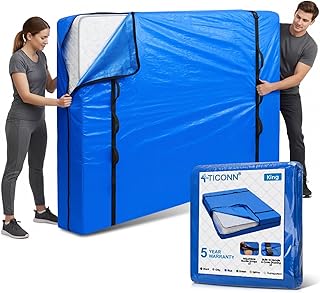
A king mattress weighs between 100 and 170 pounds depending on construction. Dragging it bare across carpet, concrete, or wet surfaces is the fastest way to stain or tear the cover fabric. A purpose-built mattress bag is non-negotiable. Look for extra-thick polyethylene (at least 1.5 mil), full-zip closure, and reinforced handles on all sides. Our top picks include the King Mattress Bags for Moving with 12 reinforced handles and strong zipper, the SGPAC Heavy Duty Mattress Bags made from new material with rip-prevention zip closure, the Nordic Elk King Size Mattress Bag featuring 8 heavy-duty reinforced handles, and the TICONN Mattress Bag with full-around handle and adjustable buckle system. Any of these will shield your mattress from moisture, dust, and abrasion. The TICONN model’s adjustable buckles are especially useful if you’re navigating narrow staircases where the bag might shift on its own.
Assess Every Passage Before You Lift
This is where a lighting-and-ambience mindset actually pays off during a move. Before anyone touches the mattress, walk the entire path — bedroom to hallway, hallway to stairwell, stairwell to truck — and illuminate every obstacle. A simple clip-on work light or even a portable LED panel hung at the tightest corner will reveal doorframe hardware, protruding hinges, and uneven threshold edges that you’d otherwise miss in ambient light. Measure the narrowest point in that path. A standard king mattress is 76 inches wide; most interior doors are 80 inches tall but only 30 to 36 inches wide when open. You’ll likely need to turn the mattress on its side and angle it diagonally. Knowing exactly where the pinch points are — and being able to see them clearly — saves you from gouging a wall or tearing your mattress bag at the worst possible moment.
Fold, Roll, or Carry Flat — Know the Difference
Not every king mattress should be folded. The two models we reference as examples — the King Size Mattress 14-Inch Medium Firm Hybrid with Individually Pocket Coils and the King Size Mattress 14-Inch Hybrid Memory Foam — are both bed-in-a-box designs that were originally compressed, rolled, and shipped in a single carton. That means they can tolerate being re-folded for transport without damaging internal structure. However, a traditional innerspring or pillow-top king cannot be folded without risking coil damage. If you’re moving a bed-in-a-box style hybrid, fold it in half lengthwise (hinge side up), slide it into your bag, and use the handles to maintain control. For non-folding mattresses, keep it flat and recruit at least two helpers — one at each end.
Loading the Truck: Mattress First, Always
Place the bagged mattress flat against the wall of the truck or cargo trailer before loading anything else. Stand it upright on its long edge, leaning against the side wall, and strap it in place using ratchet straps or strong bungee cords at two points — roughly one-third from each end. Never stack heavy boxes against a standing mattress. The weight will compress the foam or bend coils unevenly, and by the time you arrive, you’ll have a permanent body impression in the wrong spot. Keep it separated from furniture with moving blankets if possible.
Unloading and Re-Setting the Mattress
Once you’re at the new space, reverse the path assessment. Clear the route, set up the same clip-on work lights if you’re moving in during evening hours, and unwrap the mattress only once it’s positioned on the frame or foundation. Let a compressed hybrid mattress expand for at least 48 to 72 hours before sleeping on it. Airing it out with open windows or a standing fan will dissipate any off-gassing odor faster.
Tips
- Photograph your route in advance. Snap pictures of tight corners, stair railings, and doorframes from both sides so your helpers know what’s coming without walking the path repeatedly.
- Use painter’s tape on doorframes. A strip along each edge of the narrowest doorway gives you a visual margin and protects the wood from accidental scuffs during the squeeze-through.
- Keep a spray bottle of soapy water handy. If the mattress bag catches on a rough surface, a quick mist reduces friction and lets you slide past without tearing the polyethylene.
- Don’t forget the foundation. Box springs and platform bases need their own bags or blankets. Wrapping them alongside the mattress in one oversized bag is a common shortcut that usually ends with a ripped bag and exposed fabric.
Frequently Asked Questions
Can I move a king mattress by myself?
Technically, yes — if it’s a bed-in-a-box hybrid that folds. Use a bag with multiple reinforced handles and fold it in half. For any mattress over 120 pounds that doesn’t fold, you genuinely need two people minimum to avoid injury and damage.
Do I need a king mattress bag if I’m just driving across town?
Absolutely. Even a five-minute truck ride exposes the mattress to road dust, UV light through the truck window, and moisture from the truck bed floor. A bag costs a fraction of what a cleaning or replacement would.
How do I keep the mattress from sliding during transport?
Ratchet straps anchored to the truck’s tie-down points are the most reliable method. Run one strap around the mattress at each third-point and cinch until snug. Bungee cords work in a pinch but lack the tension control needed for a heavy king.
What if my king mattress won’t fit through the door?
Angle it diagonally — tip one end up toward the ceiling corner of the doorframe while pushing the other end through at floor level. This technique works on virtually every standard residential doorway. If it still won’t clear, check whether removing the door from its hinges buys you the extra two inches you need.
Conclusion
Moving a king size mattress comes down to three things: protecting it with a serious bag, seeing your path clearly before you start, and controlling weight distribution at every stage. Plan the route, gear up properly, and take your time — your mattress will arrive in the same condition you sleep on it every night.