Key takeaways
- Match PSI honestly: The rating on the cleaner is a ceiling, not a target. Check your washer’s actual output and its GPM, since flow rate drives the spin speed that produces an even finish. A 4500 PSI unit on a light electric washer will simply turn slowly and leave visible arcs.
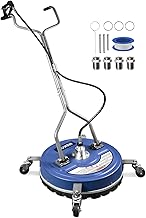
- Size for the deck, not the driveway: A 14 inch head tracks between joist lines and along stair treads without fighting you. Larger 16 to 20 inch heads finish open expanses faster but bridge awkwardly over cupped boards and stall at railing posts.
- Check the connector before anything else: Most consumer washers use a 1/4 inch quick connect. A 3/8 inch fitting signals a heavier commercial machine, and mismatched threads mean an adapter, a leak, and a pressure drop you will notice in the finish.
- Look at wheel count and travel: Four wheels hold the shroud parallel to the deck so the jets stay at consistent standoff distance. That consistency is precisely what keeps the dried surface reading as one continuous tone rather than a patchwork.
- Value the included extension wands: Two wands let you set working height so your wrists stay neutral and the head stays flat. Spare nozzles matter too, since a worn or clogged jet is the most common cause of a single dark stripe running the length of a board.
What's inside
A deck reads as light before it reads as wood. Late afternoon sun rakes across the boards at a low angle, and every streak, every lap mark, every faint arc left by a wand tip becomes a shadow you can see from the kitchen window. That is the real problem with cleaning a deck: the mess is easy to remove and almost impossible to remove evenly. A handheld nozzle carves narrow bright channels between dull ones, and once the surface dries, the eye picks up that rhythm instantly, the way it picks up a badly aimed spotlight on a wall.
Surface cleaners solve the evenness problem by keeping two spinning jets at a fixed height and a fixed angle, so the boards come up uniformly and reflect light as one plane instead of a hundred small facets. This guide looks at six of the strongest options for 2026, judged on deck-specific concerns: how wide a swath they cover without scalping softwood, how the wheels behave on cupped or slightly raised boards, whether the shroud clears railings and posts, and how well each one matches the pressure washer you already own.
As an Amazon Associate we earn from qualifying purchases.




How to Choose a Pressure Washer Deck Cleaner (2026)
- Match PSI honestly: The rating on the cleaner is a ceiling, not a target. Check your washer’s actual output and its GPM, since flow rate drives the spin speed that produces an even finish. A 4500 PSI unit on a light electric washer will simply turn slowly and leave visible arcs.
- Size for the deck, not the driveway: A 14 inch head tracks between joist lines and along stair treads without fighting you. Larger 16 to 20 inch heads finish open expanses faster but bridge awkwardly over cupped boards and stall at railing posts.
- Check the connector before anything else: Most consumer washers use a 1/4 inch quick connect. A 3/8 inch fitting signals a heavier commercial machine, and mismatched threads mean an adapter, a leak, and a pressure drop you will notice in the finish.
- Look at wheel count and travel: Four wheels hold the shroud parallel to the deck so the jets stay at consistent standoff distance. That consistency is precisely what keeps the dried surface reading as one continuous tone rather than a patchwork.
- Value the included extension wands: Two wands let you set working height so your wrists stay neutral and the head stays flat. Spare nozzles matter too, since a worn or clogged jet is the most common cause of a single dark stripe running the length of a board.
The Best Pressure Washer Deck Cleaner (2026)s Reviewed
Westinghouse Universal 16.5″ Surface Cleaner
Stainless housing, a genuine 4400 PSI ceiling, and enough width to move through a large deck in confident passes make this the most capable all-rounder here. Pair it with a gas washer at 3 GPM or better, otherwise the extra diameter works against you.
MEKOH 20″ Heavy-Duty Surface Cleaner
The dual-handle design and 4500 PSI rating are built for wide concrete, and on a large open deck the sheer coverage is genuinely satisfying. The 3/8 inch quick connect limits it to heavier machines, so verify your fitting before ordering.
LidoDola 14″ Surface Cleaner
A well-judged kit for typical residential decks: stainless housing, four wheels, two extension wands, and two spare nozzles at a sane size. The 14 inch footprint is the sweet spot for boards, stairs, and tight corners near railings.
Hourleey 14″ Surface Cleaner
Rated to 4000 PSI with a stainless shroud and smooth-rolling wheels, this one glides predictably across composite and pressure-treated lumber alike. The two included wands make it easy to find a height that keeps the head level through long passes.
Westinghouse Universal 15″ Surface Cleaner
The 3400 PSI rating is a deliberate match for mid-range electric and small gas washers, which is exactly why it performs cleanly on softer wood. Slightly wider than the 14 inch crowd without giving up maneuverability.
Frequently Asked Questions
Will a surface cleaner damage wood decking?
Far less than a handheld nozzle, because the fixed standoff distance prevents you from lingering too close. Start with a wider-degree nozzle on cedar or pine, and test one board in a corner first.
Why do I still see stripes after cleaning?
Almost always a worn nozzle, a partially clogged jet, or a spin speed too low for the head’s diameter. Swap in a fresh nozzle and confirm your washer’s GPM supports the size you bought.
Do I need a specific pressure washer?
You need matching fittings and adequate flow. Confirm the connector size, then check that your GPM sits in the range the manufacturer lists rather than focusing only on PSI.
How close to railings can these reach?
Expect a small perimeter strip the shroud cannot enter. Finish those edges with a handheld wand held at a consistent distance so the lighting stays uniform across the whole surface.
Final Thoughts
For most decks, the LidoDola 14″ hits the best balance of size, kit contents, and price, while the Westinghouse 15″ is the smarter choice if your washer tops out around 3400 PSI. Step up to the Westinghouse 16.5″ only when you have the flow to drive it and enough open deck to justify the extra width.