Key takeaways
- Reach height, not ladder height: Add roughly four feet to the top step to estimate comfortable working reach. For an 8-foot ceiling, a 4-step model is plenty; for 9 to 10 feet with a hanging fixture, step up to 5 or 6 steps.
- Free hands at the top: Fixture work needs two hands — one holding a shade, one threading a nut. A handrail or grip bar lets you lean your hips against something stable instead of gripping for balance.
- Platform depth: Wide, deep pedals matter more than load rating for most homes. Standing for ten minutes while you fuss with a canopy plate is far easier on a broad step than a narrow rung.
- Where it stores: A ladder that lives behind a door gets used. One that lives in the garage doesn’t. Measure your closet gap before you buy, and favor slim folded profiles for indoor tasks.
- Feet and finish: Non-marking rubber feet protect hardwood and tile. Powder-coated steel resists scuffs; aluminum saves weight if you’ll be carrying it up stairs.
What's inside
Every lighting project starts the same way: you’re standing on the floor, looking up at a fixture you can’t reach. Swapping a dining pendant, cleaning dust off a chandelier’s arms, running a picture-light cord along a crown molding, or repositioning a track head by six inches so it stops glaring off a framed print. The work is delicate and often overhead, which means the ladder underneath you matters as much as the bulb in your hand. Wobble at the top of a step stool turns a two-minute adjustment into a job you keep postponing, and a ladder too short for a 10-foot ceiling means you’re reaching sideways at exactly the moment you should be steady.
This guide looks at home ladders through that specific lens — reaching fixtures, aiming light, and working comfortably at height without a second person spotting you. We’ve grouped six options by the kind of ambience work they suit best, from low kitchen under-cabinet fittings to stairwell pendants hanging in open air. Whether you need a compact stool that lives in a pantry or a multi-position aluminum frame that handles an entryway chandelier, the picks below cover the practical range.
As an Amazon Associate we earn from qualifying purchases.




How to Choose a Ladder For Home Use (2026)
- Reach height, not ladder height: Add roughly four feet to the top step to estimate comfortable working reach. For an 8-foot ceiling, a 4-step model is plenty; for 9 to 10 feet with a hanging fixture, step up to 5 or 6 steps.
- Free hands at the top: Fixture work needs two hands — one holding a shade, one threading a nut. A handrail or grip bar lets you lean your hips against something stable instead of gripping for balance.
- Platform depth: Wide, deep pedals matter more than load rating for most homes. Standing for ten minutes while you fuss with a canopy plate is far easier on a broad step than a narrow rung.
- Where it stores: A ladder that lives behind a door gets used. One that lives in the garage doesn’t. Measure your closet gap before you buy, and favor slim folded profiles for indoor tasks.
- Feet and finish: Non-marking rubber feet protect hardwood and tile. Powder-coated steel resists scuffs; aluminum saves weight if you’ll be carrying it up stairs.
The Best Ladder For Home Use (2026)s Reviewed
5-Step Folding Ladder, 330 lbs Capacity
The five-step height hits the sweet spot for standard 8- to 9-foot ceilings, putting your shoulders level with most flush-mount and semi-flush fixtures. Wide anti-slip steps make it steady enough for the fiddly part — aligning a canopy while holding a shade in your other hand.
KINGRACK 4 Step Folding Ladder, 800lbs
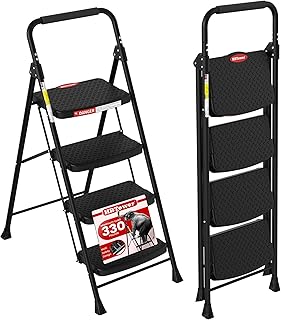
The safety lock and handrail combination is what sets this one apart for detail work; the rail gives you a point of contact so both hands can stay on the fixture. Its white finish disappears in a kitchen or pantry, and the generous load rating means it feels planted rather than springy underfoot.
HBTower 4 Step Ladder
Steel construction gives this one a reassuring lack of flex, which is exactly what you want when you’re rotating a track head by small increments. It’s a straightforward, well-built choice for under-cabinet strips, closet fittings, and anything at or below 9 feet.
6 Step Aluminum Ladder, 12 Ft Reach
For vaulted rooms, stairwell pendants, and high-ceiling fixtures, the 12-foot working reach opens up jobs the shorter models can’t touch. Aluminum keeps it light enough to carry one-handed between rooms, and the handgrip helps at the upper steps where you feel the height most.
LANBITOU A-Frame Multi-Position, 14 FT
The multi-position design is the standout for anyone dealing with an entryway chandelier or a light over a staircase, where a standard A-frame can’t sit level. It converts between configurations and folds down compactly, making it the most versatile pick here for awkward geometry.
Frequently Asked Questions
What height do I need for a standard ceiling fixture?
For an 8-foot ceiling, a 3- or 4-step ladder gives comfortable access. At 9 to 10 feet, choose 5 or 6 steps. Remember that hanging fixtures sit lower than the ceiling, so measure to the fixture’s canopy, not the drywall.
Aluminum or steel for indoor lighting work?
Steel feels more rigid and is often less expensive, making it ideal for a ladder that stays in one room. Aluminum is significantly lighter, which matters if you’re carrying it upstairs or moving between rooms during a full-house bulb swap.
Do I need a handrail?
For fixture work, yes — it’s genuinely useful. Wiring, shade alignment, and bulb changes all want two free hands, and a rail lets you brace your body instead of holding on.
Will a folding ladder mark my floors?
Check for rubber or plastic non-marking feet, which most quality models include. On delicate finishes, a folded towel under each foot adds cheap insurance.
Final Thoughts
For most homes, the KINGRACK 4 Step with its handrail and safety lock covers the majority of everyday lighting tasks with confidence to spare. If your ceilings run high, the 6 Step Aluminum model earns its place for the 12-foot reach at a manageable weight, while the LANBITOU multi-position frame is the one to choose when stairwells and awkward chandelier placements are part of the picture.