Key takeaways
- Decibel rating, read honestly: Manufacturer dBA figures are measured at roughly one meter in open air. A 60 dBA unit in a bare concrete garage will read higher because hard surfaces reflect sound the same way they reflect light. Assume five to eight decibels of real-world penalty unless you’ve added absorption.
- CFM at 90 PSI: This is the number that determines whether a tool actually works. Brad nailers and tire chucks are content with 1 to 2 SCFM. Orbital sanders, spray guns, and impact wrenches want 4 SCFM or more, sustained.
- Tank volume versus recovery: A larger tank means fewer motor cycles, which matters enormously for perceived quiet. Twenty gallons running intermittently is far less intrusive than two gallons cycling every ninety seconds, even at identical dBA.
- Oil-free versus oil-lubricated: Oil-free means no maintenance schedule, no drips on a sealed floor, no crankcase to monitor. The tradeoff is a shorter service life, though the better units are now rated well past 3,000 hours.
- Footprint and mobility: Vertical tanks reclaim floor space in a way horizontal ones cannot. If your garage does double duty, wheels and a genuine carry handle are worth more than a marginal gain in pressure.
What's inside
Most of my work is about what a room feels like after dark: how a 2700K bulb warms a walnut credenza, where a dimmer should sit so the light doesn’t fight the furniture. But the thing that undoes a well-composed space fastest isn’t a bad fixture. It’s noise. A garage that doubles as a workshop, a gym, or the room where you refinish a chair on Sunday afternoons has an ambient signature just like a dining room does, and a conventional air compressor detonates it. Ninety-plus decibels of oil-slick piston clatter travels through shared walls, up stair treads, and straight into the room where somebody is trying to read.
Quiet compressors changed that calculation. The current crop of oil-free, low-RPM induction motors runs in the 60 to 75 dBA range, which is closer to a dishwasher than a jackhammer, and that shift makes a compressor a legitimate fixture in a finished garage rather than something you apologize for. Below I’ve gathered the models worth considering for 2026, judged the way I judge any element in a space: by what it contributes, what it costs the room in comfort, and whether it earns its footprint.
As an Amazon Associate we earn from qualifying purchases.



How to Choose a Quiet Air Compressor For Home Garage (2026)
- Decibel rating, read honestly: Manufacturer dBA figures are measured at roughly one meter in open air. A 60 dBA unit in a bare concrete garage will read higher because hard surfaces reflect sound the same way they reflect light. Assume five to eight decibels of real-world penalty unless you’ve added absorption.
- CFM at 90 PSI: This is the number that determines whether a tool actually works. Brad nailers and tire chucks are content with 1 to 2 SCFM. Orbital sanders, spray guns, and impact wrenches want 4 SCFM or more, sustained.
- Tank volume versus recovery: A larger tank means fewer motor cycles, which matters enormously for perceived quiet. Twenty gallons running intermittently is far less intrusive than two gallons cycling every ninety seconds, even at identical dBA.
- Oil-free versus oil-lubricated: Oil-free means no maintenance schedule, no drips on a sealed floor, no crankcase to monitor. The tradeoff is a shorter service life, though the better units are now rated well past 3,000 hours.
- Footprint and mobility: Vertical tanks reclaim floor space in a way horizontal ones cannot. If your garage does double duty, wheels and a genuine carry handle are worth more than a marginal gain in pressure.
The Best Quiet Air Compressor For Home Garage (2026)s Reviewed
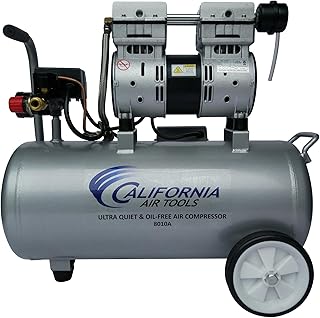
California Air Tools 8010A Ultra Quiet, 8 Gallon
The 8010A remains the reference point for anyone who cares about acoustics: 60 dBA from a 1.0 HP motor, an aluminum tank that resists rust in an unconditioned garage, and enough capacity for nailing, inflation, and light spray work. It is the unit I recommend when a compressor has to coexist with a living space directly overhead.
Stealth 20 Gallon Ultra Quiet, 1.8 HP
At 68 dBA this is louder than the smaller units, but the 20-gallon reservoir and 5 SCFM at 90 PSI mean the motor spends most of its time off, which is the quiet that actually matters over a two-hour session. This is the pick for sanding, painting, and shop tools with real appetite.
Klutch 20-Gallon, 2 HP Vertical
A 75% duty cycle and 175 PSI put the Klutch in a different class of workload, and the vertical layout gives back a meaningful patch of floor. It is the least whisper-quiet entry here, so pair it with an insulated wall or a corner away from shared partitions.
Ultra Quiet 6.4 Gallon, 2 HP Oil-Free
A genuinely well-balanced middle option: 60 dBA, 6.71 CFM at 115 PSI, and a tank sized for automotive and woodworking tasks without dominating a bay. Strong choice for spray finishing, where consistent delivery matters more than peak pressure.
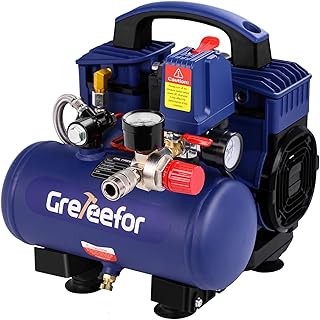
Stealth 2 Gallon Ultra Quiet (SAQ-1234)
Under 60 dB and small enough to live on a shelf, this 3/4 HP unit handles tires, trim nailers, and blow-off duty with no fuss. Expect frequent cycling if you push it, which is precisely why it belongs to the occasional-project category rather than the shop-tool one.
Frequently Asked Questions
How quiet is 60 dBA in practice?
Roughly a normal conversation, or a refrigerator in a small kitchen. You can talk over it without raising your voice, and it will not carry meaningfully through an insulated ceiling.
Can I run a spray gun on a small tank?
Not comfortably. HVLP guns draw continuously, so anything under six gallons will cycle constantly and risk pressure drop mid-pass. Size up.
Does an oil-free compressor need any maintenance?
Drain the tank after every use to prevent internal corrosion, and check the intake filter seasonally. That is essentially the whole routine.
Will a rubber mat reduce the noise?
Yes, noticeably. Most perceived loudness in a garage is structure-borne vibration through concrete. An anti-vibration pad is the cheapest acoustic improvement available.
Final Thoughts
For a garage that shares walls with living space, the California Air Tools 8010A is still the most considerate machine on this list. If your projects involve sanders or spray equipment, the Stealth 20 Gallon buys you long quiet stretches between cycles, and the 6.4-gallon ultra quiet unit splits the difference gracefully for anyone who wants one compressor to cover everything.