Key takeaways
- Finish sheen over finish color: Matte and eggshell whites diffuse light and stay quiet under a ceiling fixture. High-gloss laminate mirrors your bulb as a bright disc roughly at the changing surface, which is precisely where a baby is looking up. If you only have overhead lighting, choose the lower-sheen option every time.
- Warm-tone whites for night use: A cool, blue-leaning white reads clinical under 2700K bulbs and can look grey once the sun drops. Whites with a slightly creamy or greige undertone hold their character across daylight, lamplight, and nightlight, so the room does not shift personality after bedtime.
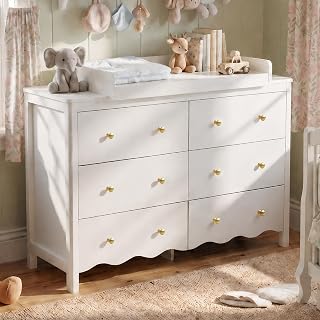
- Shadow lines and panel relief: Shaker fronts, fluted panels, and recessed pulls create their own soft shadow gradients, which gives a plain white piece depth without extra lighting. Flat slab fronts need a lamp with some directionality or they read as a blank rectangle.
- Top height and surface reflectivity: Aim for a changing surface between 36 and 40 inches so it sits below your standing eyeline and above your task lamp’s spill. Avoid glass or mirrored tops entirely; they bounce light unpredictably and complicate wipe-downs.
- Leg profile and floor light: Raised wood legs let baseboard uplight and daylight travel under the case, which visually lightens the piece and keeps a small nursery from feeling bottom-heavy. Plinth-base units read more solid and grounded, which suits larger rooms with plenty of ambient fill.
What's inside
Most nursery furniture is shopped for in the flat, even glare of a store aisle or a product photo shot on a seamless backdrop. Then it arrives, gets pushed against a wall, and lives under a single overhead fixture and one 2 a.m. nightlight for the next three years. That gap between how a dresser photographs and how it actually reads in a dim room is where buyers get burned: a finish that looked crisp turns cold and bluish, a glossy top throws a hard hotspot straight into a baby’s eyeline, and drawer gaps you never noticed become dark seams in raking lamplight.
This guide looks at nursery dresser changing tables through the lens of light. We cover how finish sheen, panel depth, hardware profile, and top height interact with the two lighting conditions that matter most in a nursery: soft daylight for play and dressing, and low-level warm light for night changes. Below, six current options are compared, followed by a selection framework, individual reviews, and answers to the questions that come up most once the room is actually lit.
As an Amazon Associate we earn from qualifying purchases.



How to Choose a Nursery Dresser Changing Table (2026)
- Finish sheen over finish color: Matte and eggshell whites diffuse light and stay quiet under a ceiling fixture. High-gloss laminate mirrors your bulb as a bright disc roughly at the changing surface, which is precisely where a baby is looking up. If you only have overhead lighting, choose the lower-sheen option every time.
- Warm-tone whites for night use: A cool, blue-leaning white reads clinical under 2700K bulbs and can look grey once the sun drops. Whites with a slightly creamy or greige undertone hold their character across daylight, lamplight, and nightlight, so the room does not shift personality after bedtime.
- Shadow lines and panel relief: Shaker fronts, fluted panels, and recessed pulls create their own soft shadow gradients, which gives a plain white piece depth without extra lighting. Flat slab fronts need a lamp with some directionality or they read as a blank rectangle.
- Top height and surface reflectivity: Aim for a changing surface between 36 and 40 inches so it sits below your standing eyeline and above your task lamp’s spill. Avoid glass or mirrored tops entirely; they bounce light unpredictably and complicate wipe-downs.
- Leg profile and floor light: Raised wood legs let baseboard uplight and daylight travel under the case, which visually lightens the piece and keeps a small nursery from feeling bottom-heavy. Plinth-base units read more solid and grounded, which suits larger rooms with plenty of ambient fill.
The Best Nursery Dresser Changing Table (2026)s Reviewed
FURNJOYLIFE Nursery Dresser with Baby Changing Table
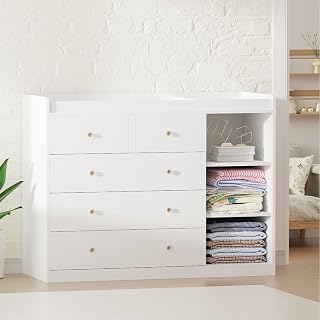
The three-drawer-plus-open-shelf layout is the most lighting-friendly configuration here: the open cubbies catch and hold soft light rather than sealing it out, so the piece never reads as a solid block. Its white finish sits in comfortable mid-sheen territory, which means it takes a warm 2700K bulb without going yellow.
BOLUO Baby Dresser with Changing Table Top
Six fabric drawers are the quiet standout for anyone doing frequent night changes; woven textile absorbs light instead of reflecting it, so the drawer bank stays visually calm when a nightlight rakes across it. The included storage shelf gives you a natural home for a small warm-LED task lamp.
White Nursery Dresser with Changing Table, 6 Drawers
A wooden case with a genuinely deep drawer bank, and the six-drawer grid produces a regular rhythm of shadow lines that keeps a large white surface from flattening out. Best paired with a wall sconce or table lamp rather than relying on the ceiling alone.
White 6 Drawer Dresser with Solid Wood Legs
The raised solid-wood legs are doing real visual work: light passes beneath the case, the footprint feels lighter, and the wood tone gives a warm anchor against an otherwise cool white. The most flexible pick if you expect the room to become a bedroom later.
Nursery Dresser Changing Table with Changing Top
A straightforward, well-proportioned case with a removable-style changing top and a clean silhouette that takes finish-dependent lighting gracefully. Good baseline choice for rooms that already have layered lamp light and do not need the furniture to carry the mood.
Frequently Asked Questions
What kind of light should I put near a changing table?
A low-output warm source at or below waist height, aimed at the wall rather than the mattress. Indirect bounce gives you enough to see by without a glare disc in your baby’s field of view, and it keeps everyone closer to sleep.
Does drawer type really affect how the room feels?
Yes. Fabric and rattan fronts scatter light softly and hide fingerprints; painted MDF and laminate reflect more and show every smudge under sidelight. It is a maintenance decision as much as an aesthetic one.
Are open shelves worth losing drawer space for?
For lighting, yes. Recessed openings create depth and reduce the monolithic look of a tall white case. For tidiness, plan on baskets, since open storage under a lamp shows clutter clearly.
Should the changing top match the dresser finish?
Matching is safe, but a slightly warmer or lower-sheen top is better. It reduces the brightness contrast at the exact spot your eye and your baby’s eye both land.
Final Thoughts
For most nurseries, the FURNJOYLIFE Nursery Dresser with Baby Changing Table is the best-balanced pick, with open shelving that keeps the piece light and a finish that behaves under warm bulbs. Choose the BOLUO Baby Dresser with Changing Table Top if night changes are your priority and you want glare-free fabric drawers, or the White 6 Drawer Dresser with Solid Wood Legs if you want a piece that carries the room from nursery to bedroom without looking dated.