Key takeaways
- Cut depth versus your real stock: Most of these top out between 12mm and 26mm. For 3mm acrylic diffusers, 6mm ply shade panels, and thin hardwood bases that is plenty, but if you plan to rip 20mm blocks for lamp plinths, buy at the top of that range rather than the bottom.
- Variable speed, not just raw wattage: Speed control matters more than the headline 200W figure. Acrylic and polycarbonate melt and cloud at high RPM, leaving a hazy edge that scatters light unpredictably. A seven-step or fully variable dial lets you slow down for plastics and open up for wood.
- Table flatness and fence trueness: Check that the deck is machined or cast rather than thin stamped metal that flexes underhand. A fence that sits square to the blade is what gives you diffuser panels that seat flush in their channel without a visible light-leak gap.
- Bevel and angle adjustment: Mitred corners are how you get seamless boxed shades and continuous cove reveals. Look for a tilting blade or adjustable table with clear detents at 45 degrees, and expect to verify it with your own square.
- Accessories and dual-tool duty: Many of these units double as grinders, engravers, sanders, and drills. That is genuinely useful for deburring channel ends or polishing an acrylic edge back to clarity, but treat bundled bit counts as a bonus rather than proof of quality.
What's inside
Lighting work lives or dies on small parts. A frosted acrylic diffuser trimmed 2mm too short, a birch veneer shade rib with a chipped edge, an aluminum LED channel cut off-square so the end cap sits proud — every one of those flaws shows up the moment the fixture is switched on. Light is a merciless inspector. A hand saw tears thin plastics, a craft knife wanders on plywood, and a full-size contractor saw is absurd overkill for a 40mm strip of 3mm acrylic. What most makers actually need is a benchtop tool small enough to sit beside the soldering iron.
This guide looks at mini table saws through the lens of ambience work: building sconce mockups, lamp bases, diffusion panels, PCB carriers for addressable strips, and the fiddly interior joinery of miniature or model-scale lighting. We cover the specs that matter for clean, glare-free edges, the ones that are just marketing noise, and five compact saws worth putting on a bench in 2026.
As an Amazon Associate we earn from qualifying purchases.
![Mini Table Saw for Crafts & Hobbyists [Dual 795 Motors & Switches] 200W/12,000RPM/26mm Adjustable Height with Accessories – Perfect for DIY Crafts, Handmade Gifts & Exploring Hobbies](https://m.media-amazon.com/images/I/71yotzYsRaL._AC_UL320_.jpg)

![Super Mini Table Saw for Crafts & Hobbyists, [Dual Motor & Switches] 7 Speeds 200W Max, Multifunctional, 122+ Accessories, Cut/Engrave/Polish/Drill, Compact for Model Making, Gift for Creators](https://m.media-amazon.com/images/I/71XhPTpz18L._AC_UL320_.jpg)

How to Choose a Mini Table Saw For Crafts (2026)
- Cut depth versus your real stock: Most of these top out between 12mm and 26mm. For 3mm acrylic diffusers, 6mm ply shade panels, and thin hardwood bases that is plenty, but if you plan to rip 20mm blocks for lamp plinths, buy at the top of that range rather than the bottom.
- Variable speed, not just raw wattage: Speed control matters more than the headline 200W figure. Acrylic and polycarbonate melt and cloud at high RPM, leaving a hazy edge that scatters light unpredictably. A seven-step or fully variable dial lets you slow down for plastics and open up for wood.
- Table flatness and fence trueness: Check that the deck is machined or cast rather than thin stamped metal that flexes underhand. A fence that sits square to the blade is what gives you diffuser panels that seat flush in their channel without a visible light-leak gap.
- Bevel and angle adjustment: Mitred corners are how you get seamless boxed shades and continuous cove reveals. Look for a tilting blade or adjustable table with clear detents at 45 degrees, and expect to verify it with your own square.
- Accessories and dual-tool duty: Many of these units double as grinders, engravers, sanders, and drills. That is genuinely useful for deburring channel ends or polishing an acrylic edge back to clarity, but treat bundled bit counts as a bonus rather than proof of quality.
The Best Mini Table Saw For Crafts (2026)s Reviewed
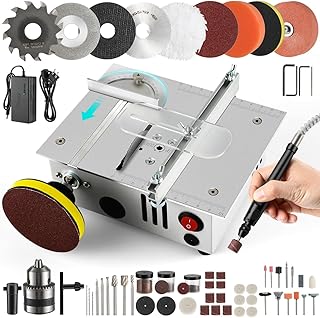
Mini Table Saw for Crafts & Hobbyists (Dual 795 Motors)
The twin 795 motors and independent switches give this one real composure under load, and the 26mm adjustable height is the most generous in this group — enough for solid lamp bases, not just panel stock. At 12,000 RPM it wants a slow, steady feed on acrylic, but on 6mm ply it leaves an edge that needs almost no sanding.
MIMYTH Multifunctional Portable Table Saw
MIMYTH’s strength is adjustability: angle, speed, and depth all move independently, which makes short work of mitred shade corners and stepped rebates for hiding a strip channel. The grinding and sanding functions are the ones you will reach for most when dressing an acrylic edge back to even diffusion.
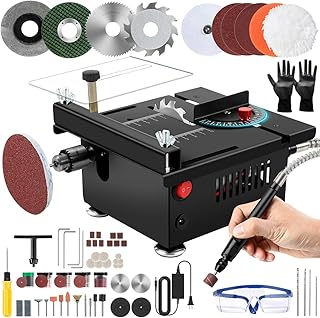
Super Mini Table Saw (Dual Motor, 122+ Accessories)
Seven speeds plus dual-motor control make this the most flexible option for mixed-material lighting builds, and the accessory set genuinely covers cut, engrave, polish, and drill in one footprint. Best suited to model-scale and small fixture work rather than anything approaching furniture-weight timber.
MXBAOHENG Mini Table Saw S3
A precision-first choice: the S3’s seven-speed supply is smooth and predictable, which is exactly what thin veneer and 2mm acrylic reward. The half-inch cut depth is the limitation, so treat it as a miniature and panel specialist rather than a general-purpose saw.
Mini Multi-Functional Table Saw (Wood/PCB/Acrylic)
Explicit PCB capability is the standout here, and if you cut your own strip carriers or driver mounting boards that alone justifies the bench space. Speed and angle are both adjustable, though the deck is small enough that longer diffuser rips need an outfeed support.
Frequently Asked Questions
Will a mini saw cut frosted acrylic without clouding the edge?
Yes, if you slow the blade down and feed steadily. Melting is a heat problem, not a power problem. Finish with fine abrasive or a polishing bit to restore an even edge, since a scorched edge scatters light and creates visible hotspots.
What blade should I use for thin plywood and veneer?
A high-tooth-count fine blade, backed with masking tape along the cut line. Tape supports the surface fibres and keeps the show face clean — important when the edge will sit in raking light.
Can these saws safely cut PCB and aluminium LED channel?
Several handle PCB well, and thin aluminium extrusion is possible at low speed with the correct blade. Wear eye protection, collect the dust, and never cut a channel with a strip already fitted.
Is 200W enough for real furniture work?
No. These are precision tools for small parts, prototypes, and fixture components. For anything structural, step up to a proper benchtop or contractor saw.
Final Thoughts
For a single saw that covers most lighting and small-furniture tasks, the dual 795-motor model earns the pick on cut depth and stability. Choose the MIMYTH if your work is angle-heavy shade and cove construction, and the MXBAOHENG S3 if fine, repeatable precision on thin stock matters more than capacity.