Key takeaways
- Swing and throat depth: Swing is twice the distance from column to spindle center, so a 10-inch machine reaches 5 inches in from an edge. Measure the widest panel you realistically drill — chair seats and cabinet sides eat throat depth fast.
- Speed range: Wood wants speed. Small brad-point bits are happiest well above 2,000 RPM, while 2-inch Forstners need to drop under 500 RPM or they scorch. Variable speed spares you the belt-and-pulley ritual; five-step pulleys are fine if you batch similar operations.
- Illumination and alignment: An onboard LED positioned near the quill puts light under the shadow line instead of behind it. A crosshair laser is a genuine aid for centering on end grain and dowel holes, but only if it can be calibrated — check that both diodes adjust independently.
- Table tilt and travel: A table that bevels a full 45 degrees opens up angled leg joinery and splayed stretchers. Rack-and-pinion height adjustment beats a bare clamp collar when you’re swapping between thick stock and thin.
- Spindle stroke and chuck: Two inches of quill travel handles most furniture parts; three is better for deep dowel holes. A 1/2-inch keyed chuck grips forstner shanks without creeping under load.
What's inside
Every home shop has a moment where the work stops being about the tool and starts being about what you can actually see. You line up a mortise on walnut, lean in, and your own shoulder throws a shadow across the layout line. Most drill press shopping guides bury this under swing measurements and amp draw, but anyone who has spent time thinking about how light falls on a surface knows the truth: a hole is only as accurate as your view of where it’s supposed to go. Dark cast iron tables swallow pencil marks. Overhead shop fixtures put the beam behind your head instead of on the workpiece. And on figured hardwood, glare can flatten grain into a featureless sheet just when you need to read it.
This guide looks at benchtop and portable drill presses for woodworking through that lens — how well each one lights and marks its own work zone, alongside the usual concerns of rigidity, speed range, and table geometry. Below you’ll find picks that range from a full 12-inch cast iron machine down to a pocketable guide that turns a handheld drill into something square and repeatable, plus the specifications that genuinely change results on wood.
As an Amazon Associate we earn from qualifying purchases.




How to Choose a Wood Drill Press (2026)
- Swing and throat depth: Swing is twice the distance from column to spindle center, so a 10-inch machine reaches 5 inches in from an edge. Measure the widest panel you realistically drill — chair seats and cabinet sides eat throat depth fast.
- Speed range: Wood wants speed. Small brad-point bits are happiest well above 2,000 RPM, while 2-inch Forstners need to drop under 500 RPM or they scorch. Variable speed spares you the belt-and-pulley ritual; five-step pulleys are fine if you batch similar operations.
- Illumination and alignment: An onboard LED positioned near the quill puts light under the shadow line instead of behind it. A crosshair laser is a genuine aid for centering on end grain and dowel holes, but only if it can be calibrated — check that both diodes adjust independently.
- Table tilt and travel: A table that bevels a full 45 degrees opens up angled leg joinery and splayed stretchers. Rack-and-pinion height adjustment beats a bare clamp collar when you’re swapping between thick stock and thin.
- Spindle stroke and chuck: Two inches of quill travel handles most furniture parts; three is better for deep dowel holes. A 1/2-inch keyed chuck grips forstner shanks without creeping under load.
The Best Wood Drill Presses (2026), Reviewed
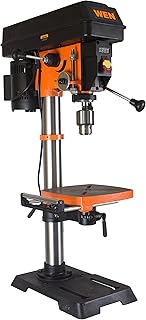
WEN 12-Inch Benchtop Drill Press (DP1263V)
The most complete package here: a 6.2-amp variable speed motor that sweeps its range without touching a belt, plus a laser crosshair and an LED that actually clears the quill shadow. The cast iron mass keeps chatter out of clean cuts in maple and oak, and 12 inches of swing covers most furniture panels.
SKIL 6.2 Amp 10-Inch Benchtop Drill Press (DP9505-00)
SKIL’s five-speed setup pairs the same motor output with a tidier footprint, and the bit-mounted work light throws a broad, even pool rather than a hot spot. A sensible pick if your bench space is tight but you still want serious drilling authority.
WOODSKIL 8-Inch Benchtop Drill Press
An induction motor makes this the quiet one, which matters more than people expect in a shop that shares a wall with living space. The 45-degree beveling cast iron table and 1/2-inch keyed chuck punch above the 2.3-amp rating for small-parts joinery.
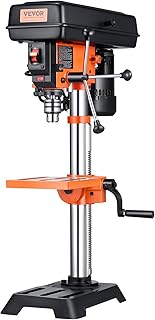
VEVOR 10-Inch Benchtop Drill Press
A straightforward five-speed cast iron machine that handles wood and light metal without drama. The 0–45 degree tilting worktable and honest build quality make it the value play for occasional projects.
SpeTool Portable Drill Guide (S04003)
Not a drill press so much as a discipline device: liner ball bearings hold your handheld drill to 0.004-inch precision, and the all-aluminum base lets you work on assembled pieces no benchtop machine can reach. Indispensable for shelf pin holes and on-site repairs.
Frequently Asked Questions
Is a laser guide worth it, or is the work light enough?
The light does the heavier lifting. A laser accelerates rough centering, but final positioning should always come from lowering the bit onto your mark — verify laser calibration before trusting it.
What speed should I use for wood?
Roughly 3,000 RPM for bits under 1/4 inch, 1,500 for 1/2 inch, and 400–500 for large Forstners. Slower for dense exotics, faster for softwoods.
Can these drill metal too?
Yes, at low speeds with cutting fluid. Cast iron frames and induction or 6.2-amp motors handle mild steel and aluminum comfortably.
Do I need a benchtop machine if I already own a drill guide?
A guide gives you square holes; a press gives you repeatable depth, stable clamping, and controlled feed pressure. They complement rather than replace each other.
Final Thoughts
For most home furniture makers, the WEN DP1263V is the one to buy — variable speed plus genuinely useful task lighting removes the two biggest sources of error. Choose the SKIL DP9505-00 if bench real estate is scarce, and keep the SpeTool S04003 nearby for holes that have to be drilled where the workpiece already lives.