Key takeaways
- Sightlines before dimensions: Lie down in the intended spot at night before you buy. Whatever fixture sits in your upward field of view — a floodlight, a neighbor’s soffit can, a bare bulb over the back door — will dominate the experience. Orient the long axis of the stand so the brightest source ends up behind your head, not above your face.
- Fabric color under warm light: Most string lights and outdoor bulbs land around 2200–2700K, which is heavy on amber and thin on blue. Warm neutrals and oranges glow under that light. Cool blues and grays lose saturation and go slate. Neither is wrong, but know which mood you’re buying.
- Frame finish and glare: Powder-coated matte steel scatters light softly. Glossier or lighter frames catch highlights and pull the eye, which can work as a deliberate accent near a planting bed but reads as clutter in a small yard.
- Footprint versus light pooling: A 9-foot space-saving stand fits inside the useful throw of a single wall fixture or one catenary string run. Wider stands often straddle the boundary between lit and dark, leaving one end of the hammock in shadow.
- Portability as a lighting tool: A stand with a carrying bag lets you follow the light — morning shade, late-afternoon glow, then in under a covered string run after dinner. That flexibility beats any fixed placement compromise.
What's inside
Most hammock shopping happens in a spreadsheet: weight rating, frame gauge, assembly time. But the hammock is the one piece of outdoor furniture people use at dusk, when the yard stops being a visual space and becomes a felt one. Place a stand without thinking about where the light falls and you get a predictable set of complaints — a porch fixture burning a hole in your peripheral vision, fabric that read cheerful at noon and turns muddy under warm bulbs, and a steel leg lurking unlit in the walking path.
This guide approaches the category the way I approach a lighting plan: the object first, then how it behaves once the sun drops. Below you’ll find capacity and footprint notes alongside the things spec sheets skip — how each fabric handles low, warm light, whether the frame reads as visual noise after dark, and how portability lets you chase good light across a yard instead of committing to one mediocre spot.
As an Amazon Associate we earn from qualifying purchases.


How to Choose a Backyard Hammock With Stand (2026)
- Sightlines before dimensions: Lie down in the intended spot at night before you buy. Whatever fixture sits in your upward field of view — a floodlight, a neighbor’s soffit can, a bare bulb over the back door — will dominate the experience. Orient the long axis of the stand so the brightest source ends up behind your head, not above your face.
- Fabric color under warm light: Most string lights and outdoor bulbs land around 2200–2700K, which is heavy on amber and thin on blue. Warm neutrals and oranges glow under that light. Cool blues and grays lose saturation and go slate. Neither is wrong, but know which mood you’re buying.
- Frame finish and glare: Powder-coated matte steel scatters light softly. Glossier or lighter frames catch highlights and pull the eye, which can work as a deliberate accent near a planting bed but reads as clutter in a small yard.
- Footprint versus light pooling: A 9-foot space-saving stand fits inside the useful throw of a single wall fixture or one catenary string run. Wider stands often straddle the boundary between lit and dark, leaving one end of the hammock in shadow.
- Portability as a lighting tool: A stand with a carrying bag lets you follow the light — morning shade, late-afternoon glow, then in under a covered string run after dinner. That flexibility beats any fixed placement compromise.
The Best Backyard Hammock With Stand (2026)s Reviewed
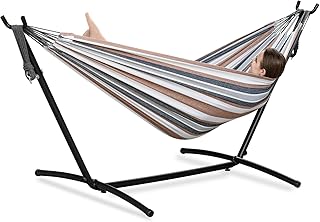
Double Hammock with Stand, Coffee
The coffee weave is the strongest performer under warm ambient light in this group, deepening into a rich brown rather than flattening out, and the 450 lb steel frame keeps a tight 9-foot footprint that sits neatly inside a single pool of light. A sensible default for patios lit by one fixture.
ANAGOO Double Hammock with Stand, White
White fabric acts as a reflector, bouncing warm light back upward and softening shadows on faces — genuinely flattering at dusk, and a good choice for darker yards where you want the hammock to read as a bright form. Tool-free assembly and a 500 lb capacity make it easy to reposition seasonally.
Amazon Basics Double Hammock with Steel Stand
The sunset orange stripe is effectively pre-tuned to amber lighting, holding its color where cooler patterns go dull, and the included carrying case supports moving it around the yard as light shifts through the season. Compact 110-inch length and 450 lb rating cover typical two-person use.
ANAGOO 2 Person Hammock with Stand, Wide Blue
Adjustable height is the quiet advantage here: raising or lowering the bed changes your sightline to overhead fixtures, which is the cheapest fix for glare there is. Expect the blue to read as deep slate under warm bulbs and as true blue under daylight or cooler LEDs.
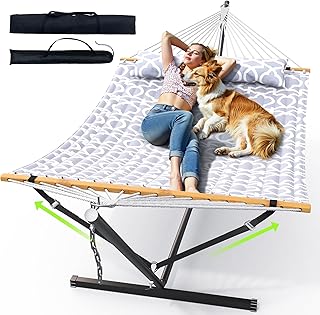
Portable Hammock with Stand, Dark Blue
Built for movement, with a carrying bag, pillow, and balance ropes, this is the pick if your best light lives in a different place each hour. The dark fabric recedes visually after sunset, which suits yards where you’d rather the planting or path lighting stay the focal point.
Frequently Asked Questions
How high should string lights hang over a hammock?
Aim for roughly nine feet above grade, well outside your reclined field of view. Bulbs hanging at seated eye level become glare sources the moment you lie back.
Do dark hammocks get hotter in the sun?
Yes, noticeably so on unshaded afternoons. Dark fabrics also disappear against a night yard, so pair them with low-level path lighting near the stand legs.
Can I leave a steel stand outdoors year-round?
Powder-coated frames tolerate a full season outside, but overwintering invites rust at joints and hardware. Bagging it in a garage is the better habit.
Does a spreader-bar hammock feel less stable?
Spreader bars and anti-tip designs trade a little cradling for a flatter, easier entry, which matters most in low light when you can’t see the fabric clearly.
Final Thoughts
For most yards, the coffee Double Hammock with Stand is the safest pairing with warm evening light, while the ANAGOO white model earns its place in darker spaces by bouncing light back where you want it. If you’d rather follow the good light than settle for one spot, the portable dark blue set with its carrying bag is the more useful investment.