Key takeaways
- Airflow over waterproofing: A rug that sheds water is good; a rug that lets the deck breathe underneath is better. Flatweaves and open plastic-straw weaves dry from both sides, while dense rubber-backed styles need lifting after heavy rain so boards don’t stay damp.
- Reflectance value: Pale sand, beige, and ivory bounce roughly twice the light of charcoal or deep brown, meaning fewer fixtures and softer shadows. Go dark only if you want a moody, contained pool of light rather than an evenly lit space.
- Sheen and glare: Slick polypropylene straw can throw hot spots when a downlight hits it directly. Textured or matte weaves diffuse the beam instead, which is why I aim lights across a rug rather than straight down onto it.
- Backing versus finish: Rubber particles grip beautifully but can mark sealed wood over time. On a freshly finished deck, choose reversible unbacked rugs and add a breathable pad, or plan to rotate the rug seasonally.
- Size to the light, not the deck: Let the rug define your lit zone. Furniture legs should sit fully on it, with the edge landing just inside the pool cast by your string lights or sconces so the boundary reads intentional after dark.
What's inside
Deck lighting lives or dies by what it lands on. I spend my days aiming path lights, tucking LED strips under bench seating, and dimming string lights until a backyard feels like a room instead of a stage, and the single biggest variable is almost never the fixture. It’s the floor. Bare wood drinks warm light and gives back very little, which is why so many beautifully lit decks still feel flat after sunset. Homeowners buy another lantern when what they actually needed was a surface that reflects, softens, and holds the glow in place.
An outdoor rug also has to survive the specific cruelty of a wooden deck: trapped moisture rotting the boards, grit sanding the finish, and UV bleaching a pattern into a ghost by August. This guide looks at outdoor rugs through both lenses — how they behave under lamplight and low evening sun, and how they treat the deck underneath. Below are the picks I keep recommending to clients, plus the specifications that actually matter.
As an Amazon Associate we earn from qualifying purchases.




How to Choose a Outdoor Rug For Wooden Deck (2026)
- Airflow over waterproofing: A rug that sheds water is good; a rug that lets the deck breathe underneath is better. Flatweaves and open plastic-straw weaves dry from both sides, while dense rubber-backed styles need lifting after heavy rain so boards don’t stay damp.
- Reflectance value: Pale sand, beige, and ivory bounce roughly twice the light of charcoal or deep brown, meaning fewer fixtures and softer shadows. Go dark only if you want a moody, contained pool of light rather than an evenly lit space.
- Sheen and glare: Slick polypropylene straw can throw hot spots when a downlight hits it directly. Textured or matte weaves diffuse the beam instead, which is why I aim lights across a rug rather than straight down onto it.
- Backing versus finish: Rubber particles grip beautifully but can mark sealed wood over time. On a freshly finished deck, choose reversible unbacked rugs and add a breathable pad, or plan to rotate the rug seasonally.
- Size to the light, not the deck: Let the rug define your lit zone. Furniture legs should sit fully on it, with the edge landing just inside the pool cast by your string lights or sconces so the boundary reads intentional after dark.
The Best Outdoor Rug For Wooden Deck (2026)s Reviewed
Adiva Rugs Outdoor Indoor Area Rug, 9′ x 12′
The one to buy when a large deck is swallowing your lighting whole — at 9×12 it covers enough surface to lift ambient levels noticeably once lanterns come on. Weather-resistant construction and a wipeable surface make it practical under a full dining set, and the neutral wood-toned palette keeps the deck reading as one continuous material.
Flatweave Textured Outdoor Patio Rug, 6×9
The textured flatweave is the most forgiving surface here under directional light, breaking up beams from downlights and deck-post fixtures into a soft, even wash. Rubber-particle backing holds it steady in wind, though I’d lift a corner after storms to let the boards dry.
Smiry Reversible Boho Outdoor Rug, 5×8
The black-and-beige geometry does something useful at dusk: the light fields carry lamplight while the dark lines add contrast that stops the pattern from washing out under warm 2700K bulbs. Quick-drying, foldable, and light enough to shift between deck and camper without effort.
MontVoo Outdoor Patio Rug, 4×6
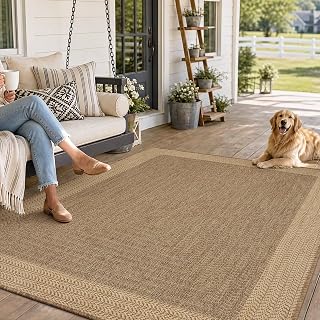
A precise, small-scale choice for a landing, balcony, or a single pair of chairs under a wall sconce. The neutral brown textured weave is matte enough to avoid glare, and the tight construction holds up in high-traffic doorways where grit does the most damage to decking.
Pauwer Waterproof Outdoor Rug, 5×8
UV resistance is where this one earns its place — the leaf-brown pattern resists the chalky fade that ruins cheaper straw rugs by their second summer. It’s reversible, rinses clean with a hose, and the woven plastic dries fast enough that morning dew is a non-issue.
Frequently Asked Questions
Will an outdoor rug damage my wooden deck?
Only if moisture and debris get trapped beneath it. Choose a breathable weave, sweep under the rug monthly, and lift it after heavy rain. Reversible plastic-straw rugs like the Pauwer or GENIMO models are the safest bet for sealed wood.
What color rug works best with warm string lights?
Light neutrals — beige, sand, soft grey — reflect warm light without turning orange. Cool-toned greys can look muddy under 2200K bulbs, so match the rug’s undertone to your bulb temperature.
How do I stop the rug sliding on smooth decking?
Rubber-particle backing handles most cases. For unbacked rugs, add a breathable outdoor pad or weight the corners with planters, which doubles as a spot for uplights.
Can these rugs stay out all winter?
Most tolerate it, but the deck won’t. Roll and store the rug once temperatures drop so the boards can dry and your finish survives the freeze-thaw cycle.
Final Thoughts
For large lit decks, the Adiva 9×12 gives you the reflective surface area to make existing fixtures work harder. On mid-sized spaces, the textured Flatweave 6×9 handles directional light most gracefully, while the Smiry reversible boho rug is the pick if you want pattern that still reads clearly once the lights come down low.