Key takeaways
- Visual Mass and Light: Open-frame or shelf-based designs (like the Huuger O-Shaped or the VASAGLE LIRY) allow overhead and floor-level light to pass through, keeping a tight hallway feeling breathable. Solid-back tables absorb light and work better in wider, well-lit foyers where they can anchor the wall.
- Depth Relative to Traffic Flow: Measure the distance from wall to door swing first. Anything deeper than 14 inches will start nudging foot traffic sideways in a corridor under four feet wide. The Tribesigns 40-inch model, at a slender depth, is the safest bet for truly tight passages.
- Storage That Matches Your Ritual: Drawers hide daily clutter (mail, lanyards, sunglasses) but add bulk. Open shelves keep items visible and grabable — ideal if your entryway doubles as a launch pad. Decide which behavior you actually have, not which you wish you had.
- Surface Durability Under Wet Keys and Umbrellas: A honey-brown or rustic-brown finish with a sealed MDF top resists ring marks better than raw veneer. VASAGLE’s thick tabletop and the longer Tribesigns farmhouse models both handle the “dump everything here” habit without showing damage within months.
- Proportional Harmony with Adjacent Lighting: A console’s length should echo the width of whatever light fixture hangs above it — within roughly six inches on each side. If you plan a pendant or wall sconces, match the table’s footprint to that fixture’s spread for a composed vignette rather than a lopsided collision.
What's inside
Your entryway sets the tone for every room beyond it — yet most buyers browse for an entryway table without a plan, grab something that fits the dimensions, and end up with a surface that either swallows keys in a black-hole drawer or sheds clutter onto the floor nightly. A poorly chosen console can make a narrow hallway feel claustrophobic or leave a wide foyer looking strangely empty.
This guide cuts through that guesswork. Drawing on the same spatial-reasoning principles I use when layering ambient, task, and accent light in residential projects, I evaluated six popular console tables on footprint, visual weight, storage logic, and how each one interacts with the light that actually falls on it in a real home. Below you will find curated picks, a decision framework, and honest one-line verdicts on every model worth your attention.
As an Amazon Associate we earn from qualifying purchases.



How to Choose an Entryway Table (2026)
- Visual Mass and Light: Open-frame or shelf-based designs (like the Huuger O-Shaped or the VASAGLE LIRY) allow overhead and floor-level light to pass through, keeping a tight hallway feeling breathable. Solid-back tables absorb light and work better in wider, well-lit foyers where they can anchor the wall.
- Depth Relative to Traffic Flow: Measure the distance from wall to door swing first. Anything deeper than 14 inches will start nudging foot traffic sideways in a corridor under four feet wide. The Tribesigns 40-inch model, at a slender depth, is the safest bet for truly tight passages.
- Storage That Matches Your Ritual: Drawers hide daily clutter (mail, lanyards, sunglasses) but add bulk. Open shelves keep items visible and grabable — ideal if your entryway doubles as a launch pad. Decide which behavior you actually have, not which you wish you had.
- Surface Durability Under Wet Keys and Umbrellas: A honey-brown or rustic-brown finish with a sealed MDF top resists ring marks better than raw veneer. VASAGLE’s thick tabletop and the longer Tribesigns farmhouse models both handle the “dump everything here” habit without showing damage within months.
- Proportional Harmony with Adjacent Lighting: A console’s length should echo the width of whatever light fixture hangs above it — within roughly six inches on each side. If you plan a pendant or wall sconces, match the table’s footprint to that fixture’s spread for a composed vignette rather than a lopsided collision.
The Best Entryway Tables (2026) Reviewed
Huuger 47.2 Inch Industrial Console
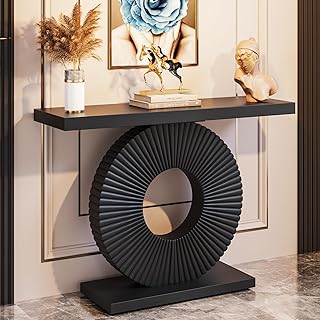
The O-shaped metal frame doubles as both structure and design statement, letting warm overhead light rake through its open silhouette and cast interesting linear shadows on the wall behind. Rustic-brown MDF pairs with matte-black steel to read as intentional rather than industrial-default, and the mid-height shelf holds baskets without dominating the visual field. Best for renters who want presence without permanence.
Tribesigns 40-Inch Modern Console
At just 40 inches long, this geometric-base table slides into apartments where every inch counts, yet its black wood-grain top absorbs hallway light in a way that creates a grounding focal point — a trick stage designers use to make small entries feel deliberately curated. The angular legs add sculptural interest without adding visual clutter.
Tribesigns 63-Inch Farmhouse Sofa Table
The longest Tribesigns model distributes its mass horizontally, making it ideal for placement behind a couch where it catches the warm spill from living-room lamps. Its rustic-brown grain reads as textured under directional lighting, which helps conceal the minor surface wear that comes with daily use. A solid choice for open-plan layouts needing a visual divider.
Tribesigns 70.9-Inch Extra-Long Industrial Table
Nearly six feet of surface means this table can absorb a serious amount of daily entry clutter and still look composed. The narrow depth keeps it from protruding into walkways, while the extended length lets you zone the top — keys on one end, a table lamp on the other — creating two distinct pools of light and function on one piece.
VASAGLE Thick-Top Farmhouse Console
The generous tabletop thickness gives this model a visual gravitas that thinner alternatives lack, and its honey-brown tone reflects warm-toned lighting upward rather than deadening it. Behind a couch, it acts almost like a secondary architectural ledge; in a hallway, it anchors the wall convincingly even without décor stacked on top.
Frequently Asked Questions
What length should an entryway table be relative to the wall?
Aim for a table that covers roughly two-thirds to three-quarters of the wall space it sits against. A 63-inch console works on an eight-foot wall, while a 40-inch model suits a five- to six-foot span. Proportion keeps the eye from feeling like the furniture is either floating aimlessly or crowding the room.
Do open-shelf entryway tables collect more dust?
They do, but the trade-off is worth it in smaller spaces because the visual openness makes the hallway feel larger. A quick weekly wipe of the shelves is far less of a burden than navigating around a bulky, closed-storage cabinet in a tight corridor.
Can I put a console table behind a couch that has no legs?
Yes, as long as the couch’s back height is at or below the table’s top surface. Measure from floor to the couch’s top edge, then confirm the table’s height — most consoles land around 29 to 30 inches, which clears most standard sofas comfortably.
How much weight can a typical MDF entryway table hold?
Most MDF-top consoles with metal or engineered-wood frames safely support 50 to 80 pounds distributed across the surface. That is plenty for lamps, books, and decorative objects, but avoid concentrating a single heavy item in the center of a span longer than 48 inches to prevent long-term sag.
Final Thoughts
For tight hallways where light needs to flow freely, the Tribesigns 40-Inch Modern Console wins on pure spatial efficiency. For open foyers and behind-couch placements that demand generous surface area, the Tribesigns 70.9-Inch Extra-Long Table is hard to beat. And if you want a single piece that reads as furniture-with-character rather than purely functional hardware, the VASAGLE Thick-Top Farmhouse Console delivers warmth and visual weight that justifies every inch it occupies.