Key takeaways
- Sustained CFM, not peak: Check the CFM rating at 90 PSI and compare it to your spray gun’s requirement with roughly 20 to 30 percent headroom. An HVLP gun asking for 4 CFM wants a compressor rated near 5, or you’ll be chasing pressure drops mid-panel.
- Tank size and recovery time: Volume buys you quiet minutes between motor cycles. Anything under 8 gallons will cycle constantly on a full panel; 13 to 30 gallons lets you finish a door and a fender before the pump kicks back in.
- Noise floor: A 68 to 70 dB machine sits near conversation level, which matters if your workspace shares a wall with living areas. Traditional units can hit 90 dB and turn a Saturday project into a neighborhood event.
- Moisture and oil separation: Water in the line is the single most common cause of fisheyes and cloudy patches. Plan on an inline desiccant filter and regulator regardless of which tank you buy, and drain the tank after every session.
- Duty cycle and mobility: Oil-free pumps are low maintenance but run hotter; check the rated duty cycle if you’re spraying clear coat in one continuous pass. Real wheels and a balanced handle matter more than you’d think when the tank is full.
What's inside
Paint is a lighting material. Long before a car leaves the garage, its color is really just a surface waiting to bend light, and any flaw in that surface shows up as a distortion in a reflection: a wavy highlight along the door, a soft halo around a taillight, a sheen that drops off across the hood. Most of those distortions trace back to air, not technique. A compressor that can’t hold steady pressure makes a gun stutter, atomization coarsens, and the film dries with a texture that scatters light instead of reflecting it cleanly.
This guide looks at compressors through that lens: which ones deliver enough uninterrupted air to keep a spray fan consistent from panel to panel, and which ones stay quiet and dry enough to work in a home garage or a converted workshop space. Below you’ll find a buying framework, honest notes on six popular machines, and answers to the questions that come up once you start pricing gear.
As an Amazon Associate we earn from qualifying purchases.


How to Choose an Air Compressor To Paint A Car (2026)
- Sustained CFM, not peak: Check the CFM rating at 90 PSI and compare it to your spray gun’s requirement with roughly 20 to 30 percent headroom. An HVLP gun asking for 4 CFM wants a compressor rated near 5, or you’ll be chasing pressure drops mid-panel.
- Tank size and recovery time: Volume buys you quiet minutes between motor cycles. Anything under 8 gallons will cycle constantly on a full panel; 13 to 30 gallons lets you finish a door and a fender before the pump kicks back in.
- Noise floor: A 68 to 70 dB machine sits near conversation level, which matters if your workspace shares a wall with living areas. Traditional units can hit 90 dB and turn a Saturday project into a neighborhood event.
- Moisture and oil separation: Water in the line is the single most common cause of fisheyes and cloudy patches. Plan on an inline desiccant filter and regulator regardless of which tank you buy, and drain the tank after every session.
- Duty cycle and mobility: Oil-free pumps are low maintenance but run hotter; check the rated duty cycle if you’re spraying clear coat in one continuous pass. Real wheels and a balanced handle matter more than you’d think when the tank is full.
The Best Air Compressor To Paint A Car (2026)s Reviewed
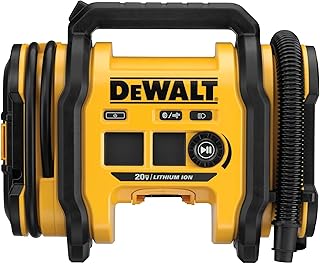
DEWALT 20V MAX Tire Inflator (DCC020IB)
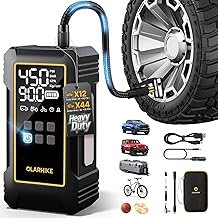
This is a cordless inflator, not a paint compressor, and it’s worth being clear about that: it can’t supply the volume a spray gun needs. It earns a place in the same toolbox as a support tool for seating tires, blowing dust off masked panels, and topping off pressures before a test drive.
Klutch 29-Gallon Air Compressor, 2.5 HP
With 5.1 CFM at 90 PSI and a 29-gallon vertical tank, this is the one I’d choose for a full respray, since it keeps the gun fed long enough to lay wet coats across an entire side without pausing. The oil-free pump and accessible tank drain keep upkeep minimal, and the vertical footprint gives back floor space in a tight garage.
VEVOR 13-Gallon Air Compressor, 2 HP
At 4.6 SCFM and 66 dB, this hits a genuinely useful middle ground: enough air for panel work and bumpers, quiet enough to run without hearing protection. The thickened steel body and wheels make it a practical single-machine setup for someone doing repairs rather than full body restorations.
8.1 Gallon Ultra Quiet Air Compressor, 1.5 HP
The 4.52 CFM output is strong for the tank size, so it sprays well in short bursts, but expect frequent cycling on larger surfaces. Best suited to touch-ups, spot blending, and trim where a consistent short pass is all you need.
8 Gallon Quiet Oil Free Compressor with Hose, 2 HP
A sensible starter bundle at 4.2 CFM and 68 dB, with the hose included so you’re spraying the same day. Pair it with a proper water trap before the gun and it handles primer and single-stage color on smaller repairs comfortably.
Frequently Asked Questions
How much CFM do I need to paint a whole car?
Plan for at least 5 CFM at 90 PSI paired with a 20-gallon or larger tank. Less air still works, but you’ll spray in segments and risk visible dry edges where coats overlap.
Can I paint with an 8-gallon compressor?
Yes, for bumpers, doors, panels, and touch-ups. The limitation is continuous run time, not pressure, so break the job into panels and let the tank recover.
Do I need a filter and dryer?
Always. A desiccant filter and regulator at the gun cost little and prevent the moisture blemishes that ruin an otherwise clean finish.
Are quiet compressors worth the premium?
In an attached garage or a shared building, absolutely. Dropping from 90 dB to around 68 dB changes how long you’re willing to work, which usually improves the result.
Final Thoughts
For full-car work where the finish has to hold a clean reflection, the Klutch 29-Gallon is the most capable pick here. The VEVOR 13-Gallon is the smarter buy for mixed repair and woodworking duty, and the 8.1 Gallon Ultra Quiet unit is a solid choice if your projects are mostly panels and touch-ups.