Key takeaways
- CFM before anything else: Match the compressor’s rating at 90 PSI to your gun’s requirement with headroom to spare. HVLP guns often want 9–12 CFM; LVLP guns can work happily on 3–5 CFM, which is why gun choice and compressor choice should be made together.
- Tank volume as a buffer: A larger tank does not create air, it stores it. Bigger capacity means fewer motor cut-ins during a pass, and fewer pressure dips means fewer visible bands in the final sheen.
- Dry, clean air: Moisture and oil carryover leave fisheyes and blush that only reveal themselves once the light hits them. Oil-free pumps help, but budget for a regulator, water trap, and ideally a desiccant stage at the gun.
- Noise you can work in: Around 60 dBA you can hear your own gun trigger and hold a conversation. Near 90 dBA you stop noticing detail, rush your passes, and the finish records that fatigue.
- Duty cycle and recovery: Look for how quickly the unit refills and whether it is rated for continuous work. Thermal cutouts mid-clearcoat are how good jobs turn into wet-sanding weekends.
What's inside
A painted panel is really a lighting instrument. It bends, scatters, and returns whatever light you put in front of it, and that is why a refinish job either disappears into the original bodywork or announces itself from across the driveway. I spend my working life shaping how surfaces read under light, and the same rule holds in a spray booth as it does in a living room: unevenness shows up in the highlights first. Orange peel, tiger stripes, dry edges, and mottled metallic all come from air that arrives at the gun in fits and starts rather than as one continuous, dry, steady stream.
That is the real buying problem. Most compressors sold for garage duty are sized for impact wrenches and brad nailers, which sip air in bursts. Spray guns drink continuously, and once the tank falls behind, pressure sags mid-pass and your reflection line goes wobbly. This guide looks at the machines worth considering for automotive paint work in 2026, from quiet eight-gallon units that will not shake the house to a 29-gallon vertical for full-panel work, plus a pair of small airbrush compressors for graphics and detail passes.
As an Amazon Associate we earn from qualifying purchases.


How to Choose a/an Air Compressor For Automotive Painting (2026)
- CFM before anything else: Match the compressor’s rating at 90 PSI to your gun’s requirement with headroom to spare. HVLP guns often want 9–12 CFM; LVLP guns can work happily on 3–5 CFM, which is why gun choice and compressor choice should be made together.
- Tank volume as a buffer: A larger tank does not create air, it stores it. Bigger capacity means fewer motor cut-ins during a pass, and fewer pressure dips means fewer visible bands in the final sheen.
- Dry, clean air: Moisture and oil carryover leave fisheyes and blush that only reveal themselves once the light hits them. Oil-free pumps help, but budget for a regulator, water trap, and ideally a desiccant stage at the gun.
- Noise you can work in: Around 60 dBA you can hear your own gun trigger and hold a conversation. Near 90 dBA you stop noticing detail, rush your passes, and the finish records that fatigue.
- Duty cycle and recovery: Look for how quickly the unit refills and whether it is rated for continuous work. Thermal cutouts mid-clearcoat are how good jobs turn into wet-sanding weekends.
The Best Air Compressor For Automotive Painting (2026)s Reviewed
California Air Tools 8010 PK with LVLP Spray Kit
The smartest starting point here, because it pairs a 60 dBA oil-free pump and 8-gallon steel tank with an LVLP gun that is actually matched to the airflow on offer. At that noise level you can spray in an attached garage on a Sunday morning and still hear the compressor decide to cycle, which is genuinely useful feedback while you are laying a coat.
Klutch 29-Gallon Vertical Air Compressor
With 5.1 CFM at 90 PSI and 175 PSI maximum, this is the pick for anyone doing hoods, doors, and full-panel blends rather than touch-ups. The vertical footprint keeps a small shop walkable, and the accessible tank drain matters more than it sounds, because water left in the tank is water headed for your basecoat.
California Air Tools CAT-4610AC Twin Tank
An aluminum twin-tank build that stays quiet and light enough to carry to the work rather than dragging the work to it. Best suited to bumpers, mirror caps, spoilers, and other single-panel jobs where a 4.6-gallon reserve and a low-consumption gun are a sensible pairing.
VEVOR 13-Gallon Air Compressor
A middle ground worth a serious look: 4.6 SCFM at 90 PSI and roughly 66 dB in a thickened steel body on wheels. It has enough reserve for sustained clearcoat passes and enough versatility to handle tires and woodworking on the days you are not painting.
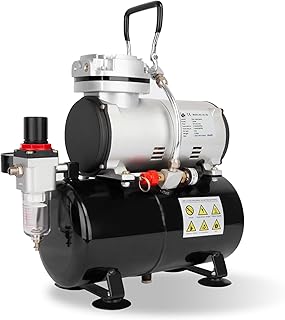
Timbertech ABPST08 Mini Airbrush Compressor
For pinstripes, shading, kandy graphics, and any work where you are modulating a fine line, the 3L tank with regulator and moisture trap gives you pulse-free air and precise low-pressure control. The cooling fan is the detail that lets you keep going through a long session instead of pausing to let the unit rest.
Frequently Asked Questions
How much CFM do I actually need to paint a car?
It depends entirely on the gun. Traditional HVLP guns commonly want 9–12 CFM at 90 PSI, while modern LVLP guns can produce excellent results on 3–5 CFM. Choose the gun first, then buy a compressor that exceeds its rating.
Can I spray a whole car with an 8-gallon compressor?
Yes, with a low-consumption LVLP gun, patient panel-by-panel sequencing, and attention to when the motor cycles. Full-body work in single sessions is easier with 13 to 29 gallons behind you.
Do I still need a moisture trap on an oil-free compressor?
Absolutely. Oil-free addresses oil carryover, not condensation. Compressed air always sheds water as it cools, so a regulator, trap, and a desiccant filter near the gun are non-negotiable for a clean finish.
Does compressor noise really affect the result?
Indirectly, and more than people expect. Quieter machines let you work slower, hear the gun, and stay in the booth long enough to inspect each coat under raking light rather than hurrying to finish.
Final Thoughts
For most home refinishers, the California Air Tools 8010 PK is the balanced choice, since the bundled LVLP gun removes the guesswork from CFM matching and 60 dBA keeps the shop livable. Step up to the Klutch 29-Gallon if you are covering full panels and want recovery time on your side, and add the Timbertech ABPST08 when the job moves from coverage to fine graphics work.