Key takeaways
- Delivered CFM at 90 PSI: Ignore peak horsepower and match the SCFM figure to your thirstiest tool plus 30 percent headroom. An HVLP gun wants 12 to 14 CFM continuous; a die grinder or DA sander can ask for more than a 15.5 CFM machine comfortably gives.
- Single-stage vs. two-stage pump: Two-stage units compress in steps, run cooler, deliver higher pressure with less duty cycle stress, and last longer under sustained load. If you spray finishes weekly, the extra cost pays for itself in pump life and cleaner air.
- Power supply reality check: Confirm your panel before you buy. Single-phase 230V covers most garages and basements; three-phase machines need a rotary phase converter or genuine commercial service, and that expense is easy to overlook.
- Moisture and oil management: Water in the line is the enemy of a flawless topcoat. Look for an automatic tank drain, and plan on a downstream separator plus desiccant filter regardless of what the compressor includes.
- Acoustic footprint: Measure the space, not just the decibel rating. Cast-iron two-stage pumps at low RPM produce a deep, tolerable thrum; high-RPM oil-free units produce a piercing whine that reflects off hard surfaces and dominates a room.
What's inside
In a finishing studio, air is a design material. I spend my working life balancing warm sconces against cool daylight and spraying lacquer on walnut consoles that will sit under those lights forever, and I’ve learned that the compressor in the corner decides more than people think. Starve an HVLP gun of volume and you get orange peel that catches every raking beam. Run a noisy single-stage unit through a long session and the whole room feels harsh, which changes how you judge color and sheen. Buyers usually shop on horsepower and end up with a machine that surges, sweats water into the line, and drones at a pitch that makes a calm workspace impossible.
Eighty gallons is the sweet spot for a serious home shop or a small furniture and fixture studio: enough stored air to finish a dining table without chasing pressure, compact enough to stand against a wall behind a bench. This guide compares six stationary 80-gallon units across delivered CFM, pump design, power requirements, moisture control, and acoustic character, then explains which one suits spray work, which suits pneumatic tools, and which is overbuilt for anything short of a production floor.
As an Amazon Associate we earn from qualifying purchases.




How to Choose a/an 80 Gallon Air Compressor (2026)
- Delivered CFM at 90 PSI: Ignore peak horsepower and match the SCFM figure to your thirstiest tool plus 30 percent headroom. An HVLP gun wants 12 to 14 CFM continuous; a die grinder or DA sander can ask for more than a 15.5 CFM machine comfortably gives.
- Single-stage vs. two-stage pump: Two-stage units compress in steps, run cooler, deliver higher pressure with less duty cycle stress, and last longer under sustained load. If you spray finishes weekly, the extra cost pays for itself in pump life and cleaner air.
- Power supply reality check: Confirm your panel before you buy. Single-phase 230V covers most garages and basements; three-phase machines need a rotary phase converter or genuine commercial service, and that expense is easy to overlook.
- Moisture and oil management: Water in the line is the enemy of a flawless topcoat. Look for an automatic tank drain, and plan on a downstream separator plus desiccant filter regardless of what the compressor includes.
- Acoustic footprint: Measure the space, not just the decibel rating. Cast-iron two-stage pumps at low RPM produce a deep, tolerable thrum; high-RPM oil-free units produce a piercing whine that reflects off hard surfaces and dominates a room.
The Best 80 Gallon Air Compressor (2026)s Reviewed
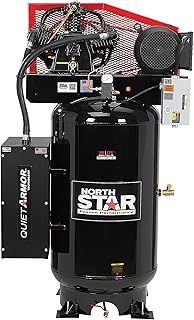
NorthStar 7.5 HP Quiet Armor
Twenty-six CFM at 90 PSI with genuinely restrained noise makes this the most livable option for a studio where you also want to think, sketch, and evaluate finishes. Service points are easy to reach, which matters more than any spec sheet after year three.
EMAX 80 Gal 7.5 HP Two-Stage
A 200 PSI ceiling and 26 CFM give you real reserve for sandblasting and long sanding sessions, and the splash-lubricated two-stage pump is built like shop equipment rather than a consumer appliance. Expect industrial noise levels and plan your enclosure accordingly.
Industrial Plus Silent 7.5 HP, 31 CFM
The highest airflow here paired with a pressure-lubricated pump and automatic drain, which is the combination I’d choose for continuous spray production. It is a heavy, expensive machine that rewards shops running air most of the day.
Campbell Hausfeld 80-Gallon Vertical, 5 HP
The sensible entry point: 140 PSI, a familiar service network, and a footprint that tucks behind a bench. Airflow limits it to one gun or one tool at a time, so treat it as a finishing compressor rather than a shop-wide supply.
VEVOR 80 Gallon Oil-Free, 6.5 HP
Oil-free means no crankcase maintenance and no oil mist near fresh lacquer, a real advantage in a small finishing room. The tradeoff is a shorter service life and a sharper sound signature than any cast-iron pump on this list.
Frequently Asked Questions
Is 80 gallons overkill for a home shop?
Not if you spray. Tank volume buys you steady pressure through a full pass, which is exactly what prevents the ripple and dry spray that show up under directional lighting.
Do I need three-phase power?
Only for the largest units, and only if your building already has it. For most home studios, a single-phase 230V machine on a dedicated circuit is the practical answer.
How do I keep water out of my finish?
Cool the air before you filter it. Run 25 feet of hard line with a drop leg, add a separator and desiccant filter at the gun, and drain the tank after every session.
Can I make one of these quieter?
Yes. A closet enclosure with baffled intake and exhaust vents, plus rubber isolation pads under the feet, cuts perceived noise substantially without restricting cooling airflow.
Final Thoughts
For most furniture and fixture studios, the NorthStar Quiet Armor is the balanced choice: ample airflow, easy maintenance, and a noise profile you can work beside all day. Step up to the Industrial Plus 31 CFM if you spray continuously and need the volume, or start with the Campbell Hausfeld if your air use is occasional and budget matters more than reserve capacity.