Key takeaways
- Roof geometry and shadow pattern: Tight slat spacing throws crisp banded shadows at midday and diffuses uplighting beautifully at night; wider spacing feels airier but lets more light escape upward. Arched roofs bounce light in a softer curve, which flatters seated conversation areas.
- Beam depth and fixture load: Look for rafters at least 2×6 in section if you want to hang anything heavier than string lights. Deeper beams let you recess or conceal fixtures along the top edge so guests see glow rather than hardware.
- Integrated power access: A built-in outlet or conduit channel is worth real money. Without it, you’re running an extension cord across a patio, which limits both safety and layout freedom.
- Wood species and finish reflectance: Cedar in a natural or reddish tone warms light noticeably, pushing color temperature toward amber. Dark stains absorb output, so plan roughly 20 to 30 percent more lumens for a deep brown frame than a pale one.
- Anchoring and footprint: Concrete anchors and a genuine wind rating matter for anything you plan to load with fixtures. Measure your span before ordering; a 12×24 frame needs a very different site plan than a 10×12.
What's inside
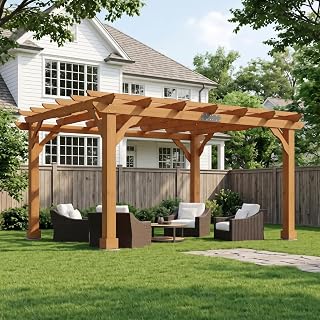
Most people shop for a pergola thinking about shade, then discover the real problem after sundown: a beautiful timber frame that vanishes into the dark by 7pm. The structure works hard from noon to five, and then the whole investment goes quiet. From a lighting-and-ambience standpoint, that’s a missed opportunity, because a wood pergola is one of the few backyard structures that gives you overhead mounting points, vertical posts at seated eye level, and slat spacing that can either scatter or soften every lumen you add.
This guide evaluates six cedar and timber pergola kits with a designer’s eye on how they hold light as much as how they hold up. I’ve weighed roof geometry against beam shadow, looked at where cables and fixtures can realistically be routed, and noted which frames offer enough mass to carry heavier pendants or a run of café bulbs without sag. Build quality, weather resistance, and assembly reality still matter, and they’re covered here too.
As an Amazon Associate we earn from qualifying purchases.



How to Choose a Wood Pergola (2026)
- Roof geometry and shadow pattern: Tight slat spacing throws crisp banded shadows at midday and diffuses uplighting beautifully at night; wider spacing feels airier but lets more light escape upward. Arched roofs bounce light in a softer curve, which flatters seated conversation areas.
- Beam depth and fixture load: Look for rafters at least 2×6 in section if you want to hang anything heavier than string lights. Deeper beams let you recess or conceal fixtures along the top edge so guests see glow rather than hardware.
- Integrated power access: A built-in outlet or conduit channel is worth real money. Without it, you’re running an extension cord across a patio, which limits both safety and layout freedom.
- Wood species and finish reflectance: Cedar in a natural or reddish tone warms light noticeably, pushing color temperature toward amber. Dark stains absorb output, so plan roughly 20 to 30 percent more lumens for a deep brown frame than a pale one.
- Anchoring and footprint: Concrete anchors and a genuine wind rating matter for anything you plan to load with fixtures. Measure your span before ordering; a 12×24 frame needs a very different site plan than a 10×12.
The Best Wood Pergola (2026)s Reviewed
Backyard Discovery Beaumont 12′ x 10′ Cedar Pergola
The Beaumont’s built-in PowerPort is the standout feature for anyone planning an evening-use space, giving you a code-friendly place to plug in transformers, low-voltage drivers, or a fan without improvising. Its trellis roof and high-wind rating mean the frame can carry a full perimeter of café lighting and still shrug off a summer storm.
AMERLIFE 12×10 FT Cedar Pergola Kit
The heavy-duty frame and red-brown finish make this a strong choice when you want light to read warm and intimate rather than clinical. Solid cedar posts here take lag-mounted sconces well, which is my preferred way to light a dining zone without glare at eye level.
Jocisland 12×24 FT Premium Cedar Pergola
At 12 by 24 feet this is an event-scale structure, and it rewards a zoned lighting plan: brighter task light over a serving area, dimmer ambient wash at the far end. The included stakes and weather-resistant supports keep the long span stable, though budget for a helper and a full weekend on assembly.
Outsunny 10′ x 12′ Arched Roof Wood Gazebo
The arched roof is the most interesting canvas in this group, curving light downward in a soft gradient that flat slats can’t replicate. Pair it with climbing vines and warm 2200K bulbs and you get dappled, lantern-like shadows across the deck after dark.
BlueWish 10′ x 12′ Cedar Patio Pergola
A straightforward, solidly built cedar kit with a slatted trellis roof that handles clip-on string lights and simple hanging fixtures without fuss. It’s the practical pick if you want a clean frame to build your own lighting scheme onto rather than a feature-heavy structure.
Frequently Asked Questions
How many lumens do I need under a wood pergola?
For relaxed ambient use, aim for roughly 100 to 200 lumens per fixture across eight to twelve points rather than one bright source. Dining areas benefit from a dimmable 400 to 600 lumen fixture centered over the table.
Can I mount light fixtures directly into cedar beams?
Yes, cedar holds screws well, but pre-drill pilot holes and use stainless or coated hardware to avoid staining from tannin reaction. Keep loads under the fixture manufacturer’s rating and mount into rafters rather than thin slats.
Do wood pergolas need annual sealing?
Cedar weathers to silver-gray on its own without structural harm, but a UV-blocking sealer every two to three years preserves the original tone. Warmer wood tone means warmer reflected light, which is worth maintaining if ambience is the goal.
Is a hardtop gazebo better than an open pergola for lighting?
A hardtop like the 12’x20′ double-roof model gives you a solid ceiling for flush fixtures and full weather protection for electrics. Open slat pergolas trade that for a more natural, dappled look and better sightlines to the sky.
Final Thoughts
If you want a pergola that’s genuinely designed for after-dark use, the Backyard Discovery Beaumont earns the top spot for its integrated PowerPort and wind rating, with the AMERLIFE 12×10 close behind for its substantial cedar frame and warm finish. For a softer, more atmospheric result on a smaller footprint, the Outsunny arched-roof gazebo shapes light more gracefully than anything else here.