Key takeaways
- Add a strip light under the chest’s top overhang at 3500K to 4000K. Warmer light muddies color-coded handles; cooler light exaggerates glare on chrome.
- Label drawer faces in white on black at a size readable from standing height, roughly 20mm characters, so you never open a drawer to check.
- Leave one empty tray per drawer as a staging bay for the current job. Loose tools in transit are what break a system.
- Recheck your layout after a month. Whatever migrated to the front lip on its own is telling you what your real high-frequency set is.
What's inside
Ask anyone who fits out kitchens or studios for a living and they’ll tell you the same thing: a drawer is a small room with terrible lighting. Overhead fixtures sit behind you, your shoulders block half the beam, and the chest itself throws a hard shadow across the front two inches of every drawer you open. That shadow is where tools disappear. Most people who think they have an organization problem actually have a visibility problem, and the fix is closer to stage design than to tidying.
This guide treats your tool chest the way a lighting designer treats a set: sightlines first, contrast second, then layout. You’ll learn how to read the shadow pattern in your own drawers, why matte black trays outperform every other finish for finding steel, how to build vertical relief so sockets stop vanishing into a flat plane, and how to keep a mobile chest legible when it rolls between a bright bench and a dim corner. A handful of pieces do most of this work, and they’re inexpensive.
As an Amazon Associate we earn from qualifying purchases.



Read the Shadow Before You Buy a Single Tray
Open every drawer with your normal light on and your body in its normal position. Photograph each one on your phone without flash. The photo flattens the scene and shows you exactly what your eye has been compensating for: a dark band at the front lip, a bright hotspot in the center, glare where chrome catches the fixture. Anything sitting in that front band needs either a light-colored marker, a raised edge, or a different home. This five-minute audit changes where you put things far more than any product will.
Build Contrast, Not Just Compartments
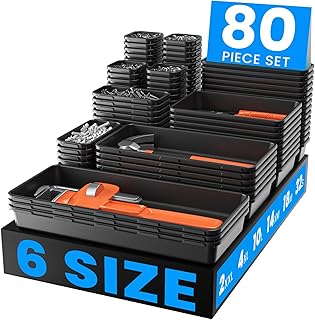
Steel tools are mid-to-high value in brightness terms. Put them on bare metal or gray foam and they merge with the background at low light levels. Put them on deep matte black and every edge reads instantly, because the eye is tracking luminance difference rather than shape. This is why the black divider systems work so well in practice. A set like the A-LuGei 69-piece tray divider kit in five sizes gives you a uniform dark floor across a whole drawer, and the matte surface kills the specular bounce that makes chrome hard to distinguish. If you’re outfitting a wider chest with mixed contents, the 80-piece six-size A-LuGei set covers more tool profiles without forcing you to mix finishes, and finish consistency matters more than people expect: two shades of black in one drawer creates a visual seam your brain has to work around every time.
Zone by Sightline, Then by Frequency
Conventional advice sorts tools by category. Lighting-wise, that’s backwards. The best-lit real estate in any chest is the upper drawers’ middle third, because that’s where your working light lands without your torso interrupting it. Put daily drivers there: drivers, pliers, tape, whatever you reach for without thinking. Push seasonal and specialty items to the deep drawers and the far corners where you’ll be pulling the whole tray out anyway. For smaller chests, the 46-piece A-LuGei set in five sizes is usually the right density, since over-subdividing a compact drawer creates so many small dark wells that scanning gets slower rather than faster.
Give Sockets Vertical Relief
Sockets are the worst-case lighting object: cylindrical, chrome, and identical from above. Flat in a tray, they’re a field of dark circles. Standing them on a magnetic rail changes the geometry so light rakes across the printed size markings instead of dropping straight into the bore. The EACELIY magnetic socket organizer set covers 1/4″, 3/8″, and 1/2″ drives in deep and shallow, holds around 141 sockets, and clamps to any steel drawer wall or cart side. Mounting a rail vertically on the inside face of a chest panel is the single highest-return change most people can make, because it moves sockets out of the shadow floor entirely.
Plan for Mobile Chests Changing Light
A rolling box lives under three or four different lighting conditions in a day: bright bench, dim corner, outdoor daylight, headlamp only. Contrast that works at the bench fails at the corner, so mobile storage benefits from redundancy: dark trays for contrast, plus labels on the drawer faces so you’re not scanning at all. Modular systems handle this well. The Keter Stack N Rolling Tool Box, a three-piece setup with all-terrain wheels and a telescoping handle, lets you break the stack apart and carry only the lit portion you need to the job. Inside each module, extra-thick trays hold their shape better under load; the six-size A-LuGei extra-thick tray set is worth the small premium here, since thin dividers bow and let tools slide into shadow.
Tips
- Add a strip light under the chest’s top overhang at 3500K to 4000K. Warmer light muddies color-coded handles; cooler light exaggerates glare on chrome.
- Label drawer faces in white on black at a size readable from standing height, roughly 20mm characters, so you never open a drawer to check.
- Leave one empty tray per drawer as a staging bay for the current job. Loose tools in transit are what break a system.
- Recheck your layout after a month. Whatever migrated to the front lip on its own is telling you what your real high-frequency set is.
Frequently Asked Questions
How many divider sizes do I actually need?
Most home chests are well served by four to six sizes. Fewer than four and you waste depth on small items; more than six and you spend longer deciding where something goes than putting it away. Start with a five-size set and add sizes only where you see chronic overflow.
Are black trays really better than gray or clear?
For metal hand tools, yes, and it’s a contrast effect rather than a style preference. Clear plastic bounces light unpredictably and shows scuffing quickly. Gray sits too close to the brightness of chrome and cast steel, so edges lose definition as ambient light drops.
Should I use foam cutouts instead of trays?
Foam shadowboards are excellent for fixed sets that never change, like a socket kit or a torque wrench. They’re a poor fit for growing collections, since every addition means recutting. Trays win on flexibility; foam wins on instant inventory checks.
What about magnetic strips inside drawers?
They work well for flat items like wrenches and hex keys, and they lift tools off the drawer floor, which helps visibility. Keep magnets away from anything with sensitive electronics, and avoid them for precision measuring tools that can pick up residual magnetism.
Conclusion
Organizing a tool chest well is mostly about making things easy to see, and that means designing for the light you actually have rather than the light you imagine. Audit the shadows, lay down a consistent matte black floor, stand your sockets up on a magnetic rail, and reserve the best-lit drawer space for the tools you touch every day. Do those four things and the chest starts working like a well-lit room: you find what you need without looking for it.