Key takeaways
- Micron rating: Anything at or below 0.5 micron catches the fine sediment that seeds cloudy cores in a cube. Sub-micron ultrafiltration goes further and is the choice if your municipal water runs visibly turbid after main work.
- Certification: Look for NSF/ANSI 42 at minimum. It verifies chlorine, taste, and odor reduction under test conditions rather than on a label claim, which is the difference between marketing and measurement.
- Service life and capacity: Rated years assume average household draw. A high-traffic entertaining setup or a nugget machine pulls far more water, so treat a five-year rating as roughly three, and swap on flow rate rather than the calendar.
- Fittings and line length: Push-to-connect 1/4-inch fittings are the standard and require no tools. Confirm your tubing is genuinely 1/4-inch OD, and buy extra line if the filter needs to sit somewhere you can reach without pulling the appliance out.
- Where it will live: Cabinet interiors run warm near a compressor. Mount vertically with the inlet arrow correct, in a spot you can see, because a filter you have to unscrew a panel to reach is a filter you will forget.
What's inside
Ice is the only material in your home that has to look good, taste like nothing, and melt on schedule. Under a warm picture light on a bar cart, or on a backlit shelf where every glass edge catches a highlight, cloudy cubes read as dust. Chlorinated water is usually the reason: it clouds the freeze, dulls the surface, and carries a faint pool-water note that lands the moment a drink warms. You notice it most in the rooms you designed hardest, because everything else in them is deliberate.
This guide covers in-line filters that install on the 1/4-inch supply line feeding your refrigerator or standalone ice machine. We look at what actually changes cube clarity and flavor, how long each cartridge holds up before flow drops off, and which certifications mean something. Below are six options worth considering in 2026, sized for everything from a galley kitchen to an RV wet bar.
As an Amazon Associate we earn from qualifying purchases.


How to Choose an In-Line Water Filter For Ice Maker (2026)
- Micron rating: Anything at or below 0.5 micron catches the fine sediment that seeds cloudy cores in a cube. Sub-micron ultrafiltration goes further and is the choice if your municipal water runs visibly turbid after main work.
- Certification: Look for NSF/ANSI 42 at minimum. It verifies chlorine, taste, and odor reduction under test conditions rather than on a label claim, which is the difference between marketing and measurement.
- Service life and capacity: Rated years assume average household draw. A high-traffic entertaining setup or a nugget machine pulls far more water, so treat a five-year rating as roughly three, and swap on flow rate rather than the calendar.
- Fittings and line length: Push-to-connect 1/4-inch fittings are the standard and require no tools. Confirm your tubing is genuinely 1/4-inch OD, and buy extra line if the filter needs to sit somewhere you can reach without pulling the appliance out.
- Where it will live: Cabinet interiors run warm near a compressor. Mount vertically with the inlet arrow correct, in a spot you can see, because a filter you have to unscrew a panel to reach is a filter you will forget.
The Best In-Line Water Filters for Ice Makers (2026), Reviewed
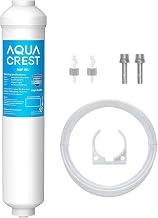
AQUA CREST INL-PLUS
The high-capacity version of AQUA CREST’s inline platform, and the one to pick if your ice maker earns its keep through a full holiday season of guests. Sediment and chlorine reduction hold steady well past the point where cheaper cartridges start choking flow, which shows up as cubes that stay glassy instead of gradually fogging over.
Waterdrop 15UC-UF
Ultrafiltration at 0.01 micron, which is a real step down from the 0.5-micron carbon norm, and NSF/ANSI 42 certified for taste and odor. This is the pick for older buildings with iffy pipes, where the visible haze in a cube is particulate rather than dissolved gas.
AQUA CREST INL 5-Year
The quiet workhorse: direct-connect 1/4-inch fittings, a long rated life, and enough chlorine knockdown to make a difference in a spirit served over one large cube. Well suited to RVs and secondary bars where you want the install to be a one-afternoon job you never revisit.
Waterdrop INL
A one-year, NSF-certified cartridge that trades longevity for a lower cost of entry, which suits renters and anyone testing whether filtration solves their taste complaint before committing. Straightforward to install, and the annual swap cycle is easy to remember.
Inline Water Filter 2-Pack with Fittings
Two NSF 42 certified filters plus tubing and quick fittings in one box, so you can treat a fridge and a countertop ice maker at the same time. The best-value option here if you have more than one water-fed appliance in play.
Frequently Asked Questions
Will a filter make my ice completely clear?
Filtration removes the sediment and chlorine that cause haze and off-flavor, but the milky center in a standard cube comes from trapped air during fast freezing. Filtered water plus a slower freeze gets you close to bar-quality clarity.
Do I need one if my fridge already has an internal filter?
Usually not, though an in-line unit ahead of it extends the internal cartridge’s life. It matters most for standalone ice makers and older refrigerators with no filtration at all.
How hard is the installation?
Fifteen minutes with the water off. Push-to-connect fittings need no tools, and kits like the PureWater Filters Inline Kit include a T-connector and a long NSF-rated line if you are running fresh tubing.
Does a filter reduce water pressure?
A fresh cartridge has negligible effect. Slow ice production is the classic sign a filter is past its useful life.
Final Thoughts
For most homes, the AQUA CREST INL-PLUS is the sensible default: long service life, solid chlorine and sediment reduction, and an install that stays out of the way. Step up to the Waterdrop 15UC-UF if your water carries visible particulate, or take the two-pack with fittings if you are feeding both a refrigerator and a countertop machine. Any of the three will get your ice looking like it belongs in the room.