Key takeaways
- Solid modular tile gives a continuous plane with a fine grid of shadow lines. The 48-pack of 12″ interlocking plastic tiles rated to 40,000 lb is the accessible entry point here — antislip, oil resistant, and forgiving of slightly uneven slabs.
- Open-grid tile reads as texture rather than surface. SnapLock RaceDeck Free-Flow tiles drain meltwater straight through and carry an 80,000-lb rolling load, but the open cells absorb light and create a deep, matte field. Beautiful under directional lighting, dim under flat lighting.
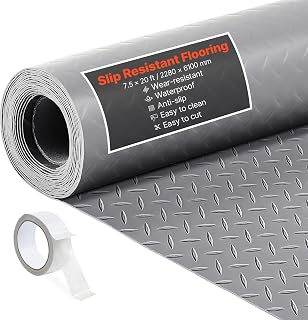
- Rolled vinyl is the seamless option. The VEVOR 7.5 x 20 ft diamond plate roll at 2.2 mm, or the thicker 8×20 ft 2.8 mm roll, unroll as one continuous sheet with no repeating shadow grid at all.
What's inside
Most garage floors are chosen like a tire: by load rating, warranty, and whether it survives a dropped wrench. Fair enough. But spend a career shaping how rooms feel under artificial light and you notice something the spec sheets never mention — the floor is the largest light-handling surface in a garage. Ceilings are usually low and cluttered with joists or ductwork, walls disappear behind shelving and bikes, and the only uninterrupted plane left is the one under your feet. Whatever you put down there becomes a giant reflector, a diffuser, or a light sink. Choose badly and you’ll add fixtures forever without ever getting a room that reads as bright.
This guide walks through garage flooring the way I’d approach any interior surface: reflectance value, texture and its effect on glare, seam behavior under raking light, and then the practical stuff — load capacity, drainage, install method, and total cost per square foot. By the end you’ll know which of the three main formats (modular tile, open-grid tile, or rolled sheet) suits your bay, and how to pair it with the lighting you already have so the space feels finished rather than merely covered.
As an Amazon Associate we earn from qualifying purchases.




Start With Reflectance, Not Color
Light-colored flooring can return roughly 40–55% of the light that strikes it; bare grey concrete typically manages 20–25%, and matte black grid tile often lands under 10%. That difference is worth more than an extra shop light. A pale, low-sheen surface like the Swisstrax Ribtrax PRO in Pearl Grey pushes bounce light back into the underside of a lifted hood or into the footwells of a car — exactly where task light never reaches. If you’re committed to black or graphite for the look, plan on a second row of fixtures or wall-mounted uplights to compensate. Colour is aesthetic; reflectance is engineering.
Three Formats, Three Optical Personalities
- Solid modular tile gives a continuous plane with a fine grid of shadow lines. The 48-pack of 12″ interlocking plastic tiles rated to 40,000 lb is the accessible entry point here — antislip, oil resistant, and forgiving of slightly uneven slabs.
- Open-grid tile reads as texture rather than surface. SnapLock RaceDeck Free-Flow tiles drain meltwater straight through and carry an 80,000-lb rolling load, but the open cells absorb light and create a deep, matte field. Beautiful under directional lighting, dim under flat lighting.
- Rolled vinyl is the seamless option. The VEVOR 7.5 x 20 ft diamond plate roll at 2.2 mm, or the thicker 8×20 ft 2.8 mm roll, unroll as one continuous sheet with no repeating shadow grid at all.
Texture Decides Whether You Get Glow or Glare
Diamond plate embossing is the classic garage texture and it does something specific optically: each raised facet catches highlights at a different angle, which spreads reflections into a soft sparkle instead of a mirror. That’s desirable under a single overhead fixture. Perfectly smooth vinyl, by contrast, will show a hard hot spot directly beneath every LED and can wash out at low sun angles through an open door. Coin-top and ribbed profiles sit in between. Whichever you pick, look at a sample under your actual lights before committing — a texture that looks subtle in a showroom can strobe unpleasantly under cheap high-output fixtures.
Match the Format to How the Bay Gets Used
Snow belt, wet tires, and salt runoff point toward open grid or a raised drainage tile. Woodworking or a home gym favours a continuous surface that a caster or a dropped chisel won’t catch. If your main worry is drips and slush contained in one place, an absorbent option like the oversize 8.8 x 22 ft garage parking mat works as a containment zone under the vehicle without committing the whole floor. And if you’re chasing showroom presentation, snap-together commercial-grade polypropylene tile handles both the load and the visual crispness.
Prep, Measure, and Plan the Seams
Measure the bay, then subtract nothing — order 5–10% extra for cuts and future repairs. Clean and fully dry the slab; trapped moisture under vinyl causes haze and adhesion failure. For rolls, let the material relax flat for 24–48 hours before taping down the edges with the supplied double-sided tape. Critically, run the seam or tile direction *parallel* to your main light source. Perpendicular seams catch raking light and read as ridges even when they’re flat.
Tips
- Test any sample at night, under your real fixtures, not in daylight through the open door.
- Leave a 1/4″ expansion gap at walls; vinyl and polypropylene both move with temperature.
- Keep 4–8 spare tiles boxed. Colour batches shift, and a hot tire or spilled solvent eventually claims one.
- Pair a dark floor with light walls, or a light floor with any wall colour — never dark on dark unless you’re doubling the lumens.
Frequently Asked Questions
Will hot tires damage plastic garage tiles?
Quality polypropylene tiles are formulated to resist hot-tire pickup. Cheap PVC and thin rolls are more vulnerable — if you park a car with performance tires straight off a summer highway, favour a rigid tile over a thin sheet.
Do I need to seal the concrete first?
Not for loose-laid tile or rolls. Sealing helps if the slab weeps moisture, but the floor covering itself doesn’t require it.
Tile or roll — which is easier to install alone?
Tile, comfortably. Snap-together systems need no adhesive and go down in sections, while a 20-foot roll is heavy and awkward to align without a second pair of hands.
How much thickness do I actually need?
For rolls, 2.2 mm handles normal passenger vehicles; step up to 2.8 mm or more for jack stands, rolling toolboxes, or a rougher slab that will telegraph through thin material.
Conclusion
Pick your format for how the bay is used, your reflectance for how bright you want it to feel, and your texture for how it behaves under the lights you already own — get those three in agreement and you’ll end up with a garage that works hard and still looks intentional.