Key takeaways
- Vertical clearance: Flush-mount and hugger housings sit within four to eight inches of the ceiling. Aim for at least seven feet of clearance from floor to the lowest moving part, and measure before you shop rather than after the box arrives.
- Diffuser quality over raw lumens: A frosted or opal shade spreads light across a wider ceiling patch and softens the shadow edges that low ceilings exaggerate. Exposed LED arrays look brighter on paper and harsher in practice.
- Tunable color temperature: Look for 3CCT switching or stepless tuning from roughly 3000K to 6000K. Warm light in the evening keeps a compressed room feeling calm; cool light earns its place in kitchens and workspaces during the day.
- DC motor and speed range: Six-speed DC motors let you run a barely-there breeze overnight without the hum that AC motors produce at low settings. Reversible airflow also pushes warm air down in winter, which matters more in short rooms.
- Visual footprint: On a low ceiling, a bulky fixture reads heavier than its actual dimensions. Enclosed fandeliers and slim white housings recede; dark or deep-bodied fixtures become the focal point whether you intended that or not.
What's inside
In a room with eight-foot ceilings, the fixture overhead is doing two jobs at once, and most of them fail at one. A standard downrod fan drops the blade plane into head-height territory and turns every lumen into a strobe; a flush-mount ceiling light keeps the ceiling clean but leaves the air stagnant. Anyone who has stood under a wobbling builder-grade fan watching shadows chop across a dining table knows the feeling: the room reads busy and unsettled, even when the temperature is fine. Low-ceiling spaces punish bad overhead choices because there is nowhere for glare or turbulence to soften before it reaches you.
This guide looks at low-profile fans the way a lighting designer would evaluate any ceiling element: how the diffuser handles brightness, whether the color temperature can shift with the hour, how much visual mass the housing adds to a compressed ceiling, and whether the airflow arrives as a broad drift or a narrow draft. The picks below are hugging-mount and bladeless-enclosed models in the 19 to 42 inch range, all with dimmable LED panels and remote or app control, chosen for apartments, nurseries, finished basements, and any room where the ceiling is closer than you would like.
As an Amazon Associate we earn from qualifying purchases.




How to Choose a Fan For Low Ceiling (2026)
- Vertical clearance: Flush-mount and hugger housings sit within four to eight inches of the ceiling. Aim for at least seven feet of clearance from floor to the lowest moving part, and measure before you shop rather than after the box arrives.
- Diffuser quality over raw lumens: A frosted or opal shade spreads light across a wider ceiling patch and softens the shadow edges that low ceilings exaggerate. Exposed LED arrays look brighter on paper and harsher in practice.
- Tunable color temperature: Look for 3CCT switching or stepless tuning from roughly 3000K to 6000K. Warm light in the evening keeps a compressed room feeling calm; cool light earns its place in kitchens and workspaces during the day.
- DC motor and speed range: Six-speed DC motors let you run a barely-there breeze overnight without the hum that AC motors produce at low settings. Reversible airflow also pushes warm air down in winter, which matters more in short rooms.
- Visual footprint: On a low ceiling, a bulky fixture reads heavier than its actual dimensions. Enclosed fandeliers and slim white housings recede; dark or deep-bodied fixtures become the focal point whether you intended that or not.
The Best Fan For Low Ceiling (2026)s Reviewed
CHAREADA 20″ Low Profile Foldable Ceiling Fan with Light
The folding blades let this one tuck almost flat against the ceiling when the fan is off, so it reads as a light fixture first and an appliance second, which is exactly the right hierarchy in a bedroom. Six wind speeds plus a dimmable panel make it easy to dial down to a low, warm setting for evening without shutting the airflow off entirely.
Bevenus Low Profile Flower Shape Ceiling Fan
The petal-shaped shade breaks up the light into overlapping soft edges rather than one flat disc, which gives a small room some depth on the ceiling plane. App and remote control together with a timer make it practical for a nursery or guest room where you would rather not reach for a wall switch.
Depuley 19″ Bladeless Flush Mount Fandelier
Fully enclosed and flush to the ceiling, this is the safest choice when the fixture sits close to head height or over a child’s play area, since there is no exposed blade to catch. The white housing and diffused output make it nearly invisible during the day and genuinely quiet at low speeds.
42″ White Flush Mount Ceiling Fan with Lights
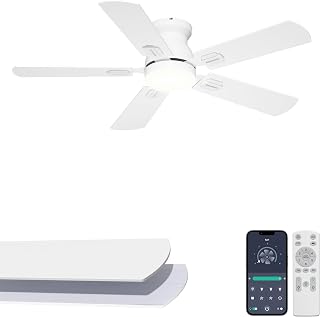
At 42 inches this covers a living room or larger bedroom that smaller fandeliers cannot move air through, while still keeping a low-profile mount. The quiet DC motor and 3CCT dimming are the standouts here, letting you shift from cool daytime light to a soft evening tone without swapping bulbs.
ZMISHIBO 19.7″ Black Low Profile Fandelier
The black finish is a deliberate choice rather than a default, and it works best against a white ceiling where you want a defined anchor point above a table or kitchen island. Tunable 3000K to 6000K output, reversible airflow, and a timer cover the practical side.
Frequently Asked Questions
How much clearance does a low ceiling fan need?
Most codes and manufacturers recommend keeping the lowest moving part at least seven feet above the floor. Flush-mount and hugger fans typically add four to eight inches of drop, which works comfortably in an eight-foot room.
Do bladeless fandeliers actually move air?
Enclosed models move less air than an exposed-blade fan of the same diameter, but they circulate enough for bedrooms and small living spaces. Choose one if safety and a clean ceiling matter more than maximum airflow.
Is a small fan enough for a whole room?
A 19 to 20 inch fan suits rooms up to roughly 120 square feet. Beyond that, step up to 42 inches or add a second unit rather than running one small fan at maximum speed.
What color temperature works best overhead?
Around 2700K to 3000K for bedrooms and lounges, 4000K or higher for kitchens and task areas. Tunable fixtures let one fan cover both without compromise.
Final Thoughts
For most eight-foot rooms, the Depuley 19″ bladeless fandelier is the cleanest solution, offering a fully enclosed housing and soft diffused output that disappears into the ceiling. Larger spaces are better served by the 42″ white flush mount with its quiet DC motor and 3CCT dimming, while the CHAREADA foldable model is the smartest pick for bedrooms where you want the fan to vanish when it is not running.