Key takeaways
- Count the contact points: Squeaks are born where two rigid parts meet and rub. Frames with welded sections, sleeved joints, or interlocking grooves have fewer opportunities to complain than frames held together by long bolts through open brackets.
- Check slat spacing and seating: Slats should sit in a channel or on a rubber-buffered ledge, not loose on a rail. Narrow gaps of roughly 3 inches keep foam mattresses supported and stop the slow shifting that turns into nightly rattle.
- Look for rubber at the floor: Capped feet do double duty — they stop hard steel from tapping a floorboard, and they keep the frame from drifting when someone sits down. On hardwood or tile, this is the single cheapest quietness upgrade.
- Match deck height to your lighting plan: A 7-inch platform keeps sightlines low and lets wall light wash across the bed; a 12 to 14-inch frame opens usable shadow underneath, which is a gift if you want a hidden strip light or storage baskets tucked away.
- Consider surface and sheen: Matte black steel absorbs lamp glare instead of throwing hotspots. Velvet has a directional nap that shifts tone as light moves across it. Raw pine warms up beautifully under low-Kelvin bulbs. All three are quiet choices visually as well as acoustically.
What's inside
As someone who spends their working life shaping how a bedroom feels after sundown, I’ve learned that ambience is not only visual. You can dial a room down to a warm 2200K glow, layer a bedside sconce against a picture light, get the shadows falling exactly where you want them — and a single metallic creak at 2 a.m. undoes the whole composition. Noise is the leak in an otherwise sealed atmosphere. It pulls a sleeper out of the low-light calm you built and back into the mechanical world.
This guide looks at bed frames through that lens: which ones stay silent under real movement, and which ones also behave well as objects in low light. I’ve weighted joint design, slat systems, and floor contact for quietness, then considered finish, deck height, and headboard texture for how each frame reads under lamplight. Below are the models worth your attention in 2026.
As an Amazon Associate we earn from qualifying purchases.



How to Choose a Quiet Bed Frame (2026)
- Count the contact points: Squeaks are born where two rigid parts meet and rub. Frames with welded sections, sleeved joints, or interlocking grooves have fewer opportunities to complain than frames held together by long bolts through open brackets.
- Check slat spacing and seating: Slats should sit in a channel or on a rubber-buffered ledge, not loose on a rail. Narrow gaps of roughly 3 inches keep foam mattresses supported and stop the slow shifting that turns into nightly rattle.
- Look for rubber at the floor: Capped feet do double duty — they stop hard steel from tapping a floorboard, and they keep the frame from drifting when someone sits down. On hardwood or tile, this is the single cheapest quietness upgrade.
- Match deck height to your lighting plan: A 7-inch platform keeps sightlines low and lets wall light wash across the bed; a 12 to 14-inch frame opens usable shadow underneath, which is a gift if you want a hidden strip light or storage baskets tucked away.
- Consider surface and sheen: Matte black steel absorbs lamp glare instead of throwing hotspots. Velvet has a directional nap that shifts tone as light moves across it. Raw pine warms up beautifully under low-Kelvin bulbs. All three are quiet choices visually as well as acoustically.
The Best Quiet Bed Frames of 2026, Reviewed
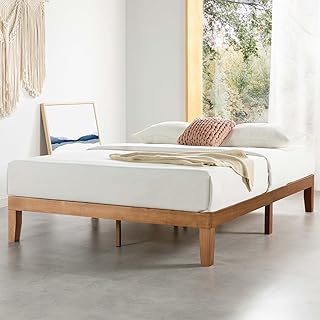
Mellow Naturalista Classic 12-Inch Solid Wood Platform
Solid pine is inherently forgiving — wood-on-wood joints dampen rather than ring, which makes this one of the most naturally silent constructions here. The untreated grain also drinks in warm light rather than reflecting it, so the frame reads as soft mass at the edge of a dim room instead of a hard outline.
Fluest Queen Platform with Velvet Upholstered Headboard
The steel understructure is braced enough to stay mute while the padded headboard handles the room’s soft-furnishing duty, catching and diffusing light from a bedside lamp instead of bouncing it back at you. Beige velvet is a genuinely useful tone to design around, sitting comfortably under both cool morning daylight and evening amber.
ROIL 7-Inch Low Profile with Rounded Corners
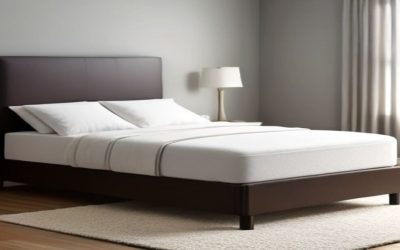
A 3,500-pound capacity and rubber-padded feet make this the quietest option for anyone on a suspended or upstairs floor, and the rounded corner baffles spare your shins during those unlit walks to the bathroom. At 7 inches, it keeps the mattress low and lets a wall wash graze across the bedding — an elegant effect that taller frames block.
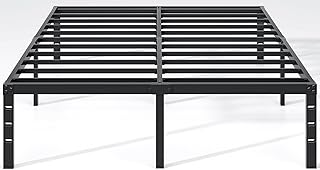
12-Inch Metal Frame with U-Shaped Groove and Six Baffles
The U-shaped grooves seat each slat in its own channel, which is the structural detail that separates genuinely squeak-free steel frames from the merely tolerable. Twelve inches of clearance and a matte black finish give you a clean, glare-free shadow line beneath the bed, ideal for concealed under-bed lighting.
JETO 14-Inch Metal Frame with Storage Space
Heavy-gauge steel and a tall 14-inch deck deliver both a rigid, silent platform and the most generous storage void of this group. If you want a functional, invisible zone under the bed, this is the frame that gives you the room to build it.
Frequently Asked Questions
Why do bed frames start squeaking after a few months?
Bolts loosen as wood and steel settle and expand. Re-tightening every hardware point twice a year, and adding felt or rubber washers at metal-to-metal joints, resolves the vast majority of new noises.
Are metal frames noisier than wood ones?
Not inherently. Modern designs with grooved slat channels, sleeved legs, and rubber caps are often quieter than a cheaply jointed wooden frame. Construction detail matters far more than material.
Do any of these need a box spring?
None of them require one. The GRUSIGN platform is the flexible option here, with adjustable height and slat support that accepts either a mattress alone or a mattress on a box spring.
Does an upholstered headboard actually reduce noise?
It won’t silence a frame, but padded fabric absorbs some high-frequency reflection in a hard-surfaced room and softens the acoustic feel near your head. Its bigger contribution is optical: fabric diffuses lamplight instead of glaring.
Final Thoughts
For quiet, warmth, and the most flattering behaviour under low light, the Mellow Naturalista Classic is my first recommendation. If you want steel reliability with a designed presence, the Fluest velvet-headboard platform is the strongest all-rounder, while the ROIL 7-inch is the pick for low sightlines and absolute floor-level silence.