Key takeaways
- Mounting Type and Angle Compatibility: Look for fans rated for sloped ceilings or sold with long downrod kits; angled-ball mounts typically handle pitches up to 30–45°, while some budget models max out around 15°. Confirm the exact degree rating before purchase.
- Blade Span Relative to Room Size: Rooms over 300 square feet with vaulted ceilings benefit from 72-inch fans that can push air across the expanded volume. Smaller vaulted bedrooms or nooks may work well with 52- to 65-inch spans that still deliver strong circulation without overwhelming the sightline.
- Motor Type and Noise Floor: DC motors run cooler, consume less power, and stay whisper-quiet — a critical factor when a fan is the visual centerpiece overhead and any hum becomes amplified in a tall, reverberant space.
- Light Output and Color Temperature Control: A fan that doubles as ambient lighting should offer tunable CCT (warm to cool) so you can match the warm glow of evening lamps or the crisp tone of task lighting. Dimmability and LED wattage determine whether the fixture supplements or replaces recessed cans.
- Blade Finish and Material Versatility: Dual-finish reversible blades let you pivot between a warm wood tone and a cool matte surface without buying a second fan — especially useful when a vaulted room connects to an adjacent space with a different material palette.
What's inside
When a ceiling rises to a sharp peak or angles away from level, most standard fans wobble, rattle, or simply fail to circulate air where it matters most. Vaulted and sloped ceilings demand fans engineered for off-center mounting, steeper downrod configurations, and blade spans wide enough to move air across a larger cubic volume — all without sacrificing the visual coherence that makes an open, angled room feel intentional rather than unfinished.
This guide distills the criteria an ambience designer actually weighs when specifying ceiling fans for vaulted spaces: motor architecture, light quality and color temperature flexibility, blade count and finish versatility, and how each unit interacts with a room’s natural light layers. Below you will find five standout fans for 2026, followed by a concise selection framework and answers to the questions buyers ask most.
As an Amazon Associate we earn from qualifying purchases.



How to Choose a Ceiling Fan For Vaulted Ceilings (2026)
- Mounting Type and Angle Compatibility: Look for fans rated for sloped ceilings or sold with long downrod kits; angled-ball mounts typically handle pitches up to 30–45°, while some budget models max out around 15°. Confirm the exact degree rating before purchase.
- Blade Span Relative to Room Size: Rooms over 300 square feet with vaulted ceilings benefit from 72-inch fans that can push air across the expanded volume. Smaller vaulted bedrooms or nooks may work well with 52- to 65-inch spans that still deliver strong circulation without overwhelming the sightline.
- Motor Type and Noise Floor: DC motors run cooler, consume less power, and stay whisper-quiet — a critical factor when a fan is the visual centerpiece overhead and any hum becomes amplified in a tall, reverberant space.
- Light Output and Color Temperature Control: A fan that doubles as ambient lighting should offer tunable CCT (warm to cool) so you can match the warm glow of evening lamps or the crisp tone of task lighting. Dimmability and LED wattage determine whether the fixture supplements or replaces recessed cans.
- Blade Finish and Material Versatility: Dual-finish reversible blades let you pivot between a warm wood tone and a cool matte surface without buying a second fan — especially useful when a vaulted room connects to an adjacent space with a different material palette.
The Best Ceiling Fans For Vaulted Ceilings (2026) Reviewed
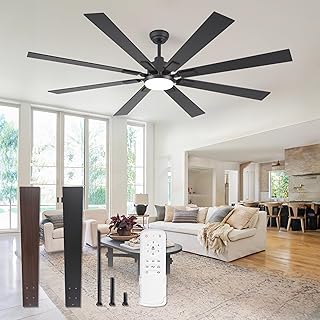
ZMISHIBO 72-Inch Ceiling Fan with Lights
This fan delivers serious CFM output through a quiet DC motor, making it ideal for great rooms where cool air must descend from a peak and settle across open floor plans. The 24W tri-CCT LED module means you can dial in warm amber for evening dining or shift to daylight white for morning coffee, all from the included remote — no smart-home ecosystem required.
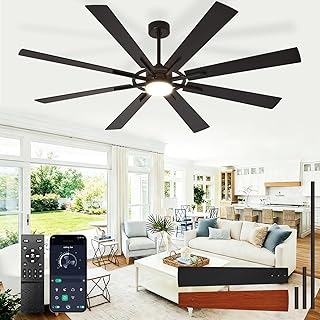
Fanbulous 72-Inch DC Motor Ceiling Fan
What sets this model apart for vaulted installs is the explicit flat-to-sloped ceiling rating paired with app control, giving you fine-tuned speed and light adjustments from the couch instead of fumbling for a handheld remote. The memory function recalls your last settings after a power cycle, which matters in rooms where switching the wall circuit is the only practical on-off method.
52-Inch Sloped Ceiling Fan with Lights
Not every vaulted room demands a 72-inch blade span — this compact unit handles slopes up to 15° with a standard downrod mount, making it a smart pick for vaulted bedrooms or home offices where proportion matters. The white finish blends into a pale ceiling plane, letting the room’s architecture stay the visual focus while the fan quietly does its work overhead.
Amico 72-Inch Ceiling Fan with Lights
Amico pairs a reversible DC motor with six distinct speed settings and a timer function, giving you granular control over airflow in large vaulted living rooms or covered patios. The dimmable 3CCT LED panel produces clean, flicker-free light that works beautifully as the primary ambient layer — especially when you want to avoid the visual clutter of additional pendant fixtures in an open, high-ceilinged room.
Fanbulous 65-Inch 8-Blade Ceiling Fan
The eight-blade configuration on this model moves air with remarkable smoothness, reducing the choppy, pulsating breeze that fewer blades sometimes produce in vaulted spaces. At 24W of LED output with full CCT control, it handles both illumination and circulation in a single, understated fixture — a real asset when you want the ceiling plane to feel clean and uncluttered.
Frequently Asked Questions
Can I install a 72-inch ceiling fan on a vaulted ceiling without a downrod?
Most 72-inch fans require a downrod for proper airflow clearance on vaulted ceilings; flush-mount kits reduce the blade-to-ceiling distance too much, which can actually decrease performance. Always verify that the included downrod or an extended one will place the blades at least 18 inches from the ceiling surface at its lowest point.
How many lumens should a vaulted-ceiling fan light produce?
For a fan serving as the primary ambient light in a large, high-ceilinged room, aim for at least 2,000 lumens — roughly equivalent to four recessed cans. If the fan supplements existing lighting, 1,200 to 1,500 lumens with dimmable CCT control gives you enough range to set the mood without over-illumination.
Do DC motors work better than AC motors for vaulted installations?
DC motors are lighter, quieter, and use roughly half the electricity of AC equivalents, which translates into less vibration transfer through the mounting hardware — an advantage when that hardware is angled and potentially under more lateral stress than a straight vertical mount.
Will dual-finish blades clash with a mixed-material interior?
Not if you choose intentionally. Dual-finish blades typically pair a warm woodgrain with a cool matte or black surface, giving you a built-in option to shift the fan’s visual weight between organic warmth and modern contrast without purchasing a separate set of blades.
Final Thoughts
For maximum airflow in open, steeply vaulted great rooms, the Fanbulous 72-Inch stands out for its slope rating, app control, and reliable memory function. The ZMISHIBO 72-Inch offers a strong alternative when raw CFM output and a no-frills remote experience are priorities. And for smaller vaulted bedrooms where the fan should disappear into the ceiling plane rather than dominate it, the 52-Inch Sloped Ceiling Fan earns its place with quiet operation and clean, proportional design.