Key takeaways
- Downrod length: Aim for blades roughly eight to nine feet off the floor. On a steep vault that often means an 18- to 36-inch rod, and the drop matters as much for glare control as for airflow, since a fixture buried near the ridge throws light at unflattering angles.
- Slope rating: Confirm the canopy’s maximum pitch. Many fans stop at 15 degrees, which suits a gentle cathedral slope but not a sharp A-frame. Steeper vaults need a canopy rated 30 degrees or higher, or an adapter.
- Blade span versus volume: Vaulted rooms hold far more air than their square footage suggests. A 52-inch fan covers a standard bedroom, but open-concept great rooms benefit from 72 inches or more moving air gently rather than a small fan working hard.
- Dimmable, tunable LED: Look for 3CCT switching plus true dimming. Being able to shift from 5000K task light in the afternoon to a warm 3000K glow after dinner is the single biggest ambience upgrade an overhead fixture can offer.
- DC motor and reverse mode: DC motors run quieter at low speeds, which is where you’ll leave a large fan most of the time. Reverse mode in winter pulls trapped warm air off the ceiling and back down the walls without a noticeable draft.
What's inside
Vaulted ceilings do beautiful things for a room’s proportions and terrible things for its air and its light. All that volume above the ridge collects warm air that never comes back down, and the fixtures mounted up there scatter illumination across a sloped plane instead of pooling it where people actually sit. Add a fan sized for an eight-foot ceiling and you get the worst of both: a slow flutter twelve feet overhead, a hard glare spot when you glance up, and blade shadows chopping across the walls every evening.
This guide looks at vaulted-ceiling fans the way a lighting and ambience designer would evaluate them: how far the motor sits below the peak, how wide the sweep is relative to the room’s footprint, whether the integrated LED can be tuned and dimmed to match the hour, and how the whole assembly reads visually from a seated sightline. Below are six fans that handle sloped mounting properly, along with the specs worth checking before you commit.
As an Amazon Associate we earn from qualifying purchases.



How to Choose a Fan for a Vaulted Ceiling (2026)
- Downrod length: Aim for blades roughly eight to nine feet off the floor. On a steep vault that often means an 18- to 36-inch rod, and the drop matters as much for glare control as for airflow, since a fixture buried near the ridge throws light at unflattering angles.
- Slope rating: Confirm the canopy’s maximum pitch. Many fans stop at 15 degrees, which suits a gentle cathedral slope but not a sharp A-frame. Steeper vaults need a canopy rated 30 degrees or higher, or an adapter.
- Blade span versus volume: Vaulted rooms hold far more air than their square footage suggests. A 52-inch fan covers a standard bedroom, but open-concept great rooms benefit from 72 inches or more moving air gently rather than a small fan working hard.
- Dimmable, tunable LED: Look for 3CCT switching plus true dimming. Being able to shift from 5000K task light in the afternoon to a warm 3000K glow after dinner is the single biggest ambience upgrade an overhead fixture can offer.
- DC motor and reverse mode: DC motors run quieter at low speeds, which is where you’ll leave a large fan most of the time. Reverse mode in winter pulls trapped warm air off the ceiling and back down the walls without a noticeable draft.
The Best Fans for Vaulted Ceilings (2026) Reviewed
ZMISHIBO 72″ Ceiling Fan with Light
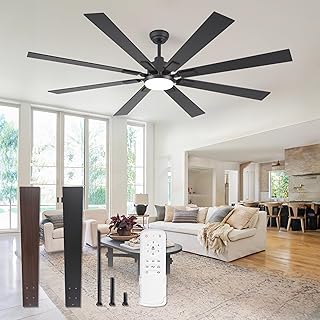
A strong all-rounder for tall living rooms and covered porches, pairing high-CFM output with a quiet DC motor and a 24W 3CCT LED that dims smoothly enough to serve as the room’s only evening source. The dual-finish blades read differently depending on which side you install facing down, which is a genuinely useful tool for matching existing woodwork.
Fanbulous 72 Inch Ceiling Fan with App Control
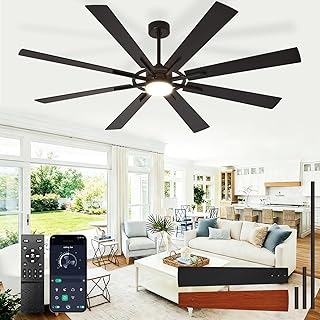
The app and remote combination is the standout here, letting you save a warm dimmed preset and recall it without hunting through settings each night. Reversible blades plus flat and sloped mounting hardware make it flexible across cathedral ceilings and damp-rated patios alike.
ZMISHIBO 96 Inch Industrial Ceiling Fan
Eight aluminum blades and three included downrods make this the right answer for barn conversions, garages, and double-height spaces where a 72-inch fan simply gets lost. There’s no integrated light, which is arguably an advantage: it leaves your lighting scheme entirely to dedicated fixtures rather than compromising with a fan-mounted LED.
52 Inch Ceiling Fan with 3CCT Dimmable LED
Rated for slopes up to 15 degrees and sized for bedrooms or modest vaulted studies, this is the restrained option, with a clean white body that disappears against a light-painted ceiling. The reversible DC motor stays quiet on low, which matters in a sleeping space.
Modern 72 Inch 8 Blade Outdoor Ceiling Fan
Eight blades across a 72-inch sweep produce a notably steady, low-turbulence airflow, so you get movement without papers lifting off the table. Six speeds and app-based dimming give you fine control over both the breeze and the mood in indoor-outdoor rooms.
Frequently Asked Questions
How long should my downrod be?
Measure from the mounting point at the peak down to where you want the blades, targeting eight to nine feet of clearance. In vaulted rooms that commonly lands between 18 and 36 inches; taller peaks may need longer.
Will one fan cool an open-concept vaulted room?
A single 72-inch fan handles most great rooms, but long or L-shaped layouts often circulate better with two smaller fans placed over the distinct seating zones.
Do I still need other lighting?
Yes. Treat a fan’s LED as ambient fill, not a complete scheme. Layer it with lamps or wall sconces so light comes from multiple heights rather than one point overhead.
Can these fans go on a covered patio?
Damp-rated models like the ZMISHIBO 72″ and the Fanbulous 72″ are suitable for covered outdoor areas. Fully exposed locations require a wet-rated fan.
Final Thoughts
For most vaulted living rooms, the ZMISHIBO 72″ Ceiling Fan strikes the best balance of sweep, quiet operation, and tunable light. Choose the Fanbulous 72 Inch if scene presets and app control appeal to you, or step up to the ZMISHIBO 96 Inch for genuinely cavernous spaces where lighting is handled separately.