Key takeaways
- Blade Span and Room Footprint: For vaulted spaces over 300 square feet, look for fans with 72-inch blades or wider. Undersized fans spin fast without delivering the broad, slow air circulation that tall rooms actually need, and they read as visually timid against expansive drywall planes.
- Downrod Length and Mounting Angle: Cathedral ceilings demand a downrod long enough to position the fan blades at least 18 inches below the apex — ideally level with the top of nearby window frames. Fans rated for angled ceilings up to 15 degrees prevent wobble and preserve balanced airflow across an uneven plane.
- Light Temperature and Dimming Range: A good integrated LED module should offer at least three colour temperature settings. In cathedral spaces, warm tones (2700K–3000K) prevent the upper ceiling from feeling cavernous at night, while cooler daylight tones serve task areas during the afternoon.
- Motor Type and Sound Profile: DC motors outperform traditional AC units in energy draw and noise — critical when the fan hangs above a living room where conversation happens. Look for models rated below 35 decibels so the fixture disappears into the ambient soundscape rather than dominating it.
- Finish and Material Cohesion: The fan must relate to existing finishes — matte black hardware, natural wood trim, or brushed metal pendants. In a cathedral room, the fan occupies a high-contrast zone against bright ceiling surfaces, so its finish carries more visual weight than it would at standard height.
What's inside
Cathedral ceilings are architectural showstoppers — they pull your eye upward, expand the perceived volume of a room, and create an opportunity for layered lighting that flat ceilings simply cannot match. But that soaring height introduces a real design problem: standard ceiling fans hang too low, push air ineffectively, or clash with the dramatic geometry overhead. Finding a unit that moves air across a 10-to-12-foot peak without ruining sight lines takes careful attention to blade span, motor class, and mounting compatibility.
This guide approaches the selection from a lighting-and-ambience standpoint — because a ceiling fan is not just airflow hardware, it is a ceiling fixture that sets the visual tone of your upper space. We evaluated the leading 65-to-84-inch fans of 2026 on light quality, finish versatility, acoustic footprint, and how each unit performs when paired with cathedral geometry and high-vault lighting plans.
As an Amazon Associate we earn from qualifying purchases.


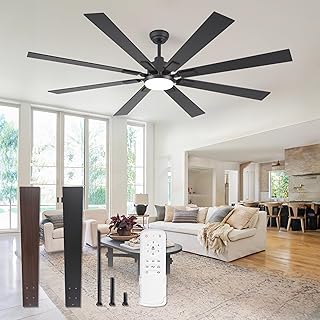

How to Choose a Ceiling Fan For Cathedral Ceiling (2026)
- Blade Span and Room Footprint: For vaulted spaces over 300 square feet, look for fans with 72-inch blades or wider. Undersized fans spin fast without delivering the broad, slow air circulation that tall rooms actually need, and they read as visually timid against expansive drywall planes.
- Downrod Length and Mounting Angle: Cathedral ceilings demand a downrod long enough to position the fan blades at least 18 inches below the apex — ideally level with the top of nearby window frames. Fans rated for angled ceilings up to 15 degrees prevent wobble and preserve balanced airflow across an uneven plane.
- Light Temperature and Dimming Range: A good integrated LED module should offer at least three colour temperature settings. In cathedral spaces, warm tones (2700K–3000K) prevent the upper ceiling from feeling cavernous at night, while cooler daylight tones serve task areas during the afternoon.
- Motor Type and Sound Profile: DC motors outperform traditional AC units in energy draw and noise — critical when the fan hangs above a living room where conversation happens. Look for models rated below 35 decibels so the fixture disappears into the ambient soundscape rather than dominating it.
- Finish and Material Cohesion: The fan must relate to existing finishes — matte black hardware, natural wood trim, or brushed metal pendants. In a cathedral room, the fan occupies a high-contrast zone against bright ceiling surfaces, so its finish carries more visual weight than it would at standard height.
The Best Ceiling Fan For Cathedral Ceiling (2026)s Reviewed
ZMISHIBO 84 Inch Ceiling Fan with Lights
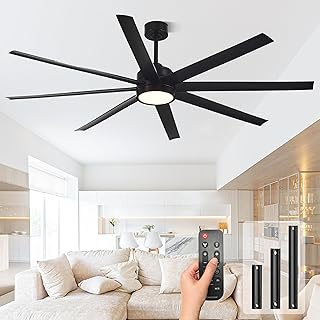
At 84 inches with eight reversible aluminum blades, this unit is built for the kind of volume that cathedral ceilings generate. The industrial-grade quiet DC motor keeps noise below conversational thresholds even on its highest speed, and the three-colour-temperature LED module lets you shift from warm evening glow to crisp daylight without swapping bulbs — a genuine asset when the fan is your primary overhead light source in a vaulted great room.
72 Inch Ceiling Fan with Lights — Modern Farmhouse Style
Six solid-wood blades give this model an organic warmth that pairs naturally with exposed beam ceilings or shiplap vaults. It is damp-rated for covered patios, which means it works equally well inside a cathedral-ceilinged living room or sheltered outdoor seating area. The high-CFM rating moves serious air without the visual bulk of an industrial unit.
72 Inch Ceiling Fan with Light and Remote — 8 Blade Black
The eight-blade configuration and 24-watt six-colour-temperature LED system make this one of the most adaptable fans for mixed-use spaces — a library, café, or large bedroom under a vaulted ceiling. Six speed settings and a reversible motor give you fine-grained control over seasonal airflow direction, and the matte black finish holds its own against dark-painted upper walls.
84 Inch Extra Large Fan — 3 Wood Blades, No Light
This propeller-style fan is a purist’s choice: no integrated light, just three broad walnut-finish blades driven by a quiet DC motor optimized for raw CFM output. In rooms where you have already planned a separate pendant or recessed-light scheme — common in cathedral-ceiling homes — skipping the built-in light eliminates colour-temperature conflicts and keeps the ceiling plan clean.
ZMISHIBO 72 Inch Fan with Lights — Dual-Finish Black
The dual-finish blade design lets you choose between contrasting looks without buying a second fan, and the 24-watt three-CCT LED covers the essentials. Damp-rated and compact enough to avoid overpowering a mid-size vaulted room, this model strikes a balance between performance and subtlety — a strong choice when the ceiling geometry is the star and the fan needs to complement, not compete.
Frequently Asked Questions
What blade span works best for cathedral ceilings?
For rooms between 200 and 400 square feet with vaulted ceilings, aim for 72 to 84 inches. Smaller spans lose effectiveness at height because the air column they move dissipates before reaching floor level.
Can I install a standard ceiling fan on a sloped cathedral ceiling?
Only if the fan is rated for angled mounting — typically up to 12 or 15 degrees of slope. Standard flat-mount fans will wobble, stress the motor, and potentially damage the ceiling junction box over time.
Do cathedral ceiling fans need a light kit?
Not necessarily. If your room has recessed cans, wall sconces, or pendants already positioned to handle ambient and task lighting, a lightless fan like the 84-inch propeller model keeps the ceiling composition uncluttered.
Why are DC motors preferred for high-ceiling installations?
DC motors draw roughly 70 percent less energy than AC equivalents, run quieter, and offer more speed increments. At cathedral heights, the reduced noise floor matters because the fan operates above the listener in an acoustically reflective space.
Final Thoughts
For the most balanced combination of airflow, light quality, and design flexibility in a cathedral-ceiling setting, the ZMISHIBO 84 Inch earns top marks for sheer capacity and the 72 Inch Modern Farmhouse wins on aesthetic warmth. If you have already invested in a separate lighting plan and want a fan that simply moves air with maximum efficiency, the 84 Inch 3-Wood-Blade is the cleanest, most purpose-built option on the list.