Key takeaways
- Vertical mounting surface: A pegboard or upright back panel is the single most useful lighting feature on a bench. It lets you clamp a task lamp at press height and aim light across the case mouth rather than straight down into it, which is what reveals depth and defect.
- Integrated outlets and USB: Reloading gear competes for power with lighting — tumbler, trickler, scale, and two lamps add up fast. Onboard strips with four or more outlets keep cords off the floor and let you position light where the work is instead of where the wall is.
- Surface finish and reflectance: Solid rubberwood and unfinished hardwood diffuse light beautifully at a mid-tone value. Glossy laminate and bare steel create specular hot spots that fatigue your eyes within an hour. If a top is slick, plan on a matte mat.
- Height adjustability: Being able to set a top between roughly 28″ and 39″ changes your eye-to-work distance, and that distance dictates how far your lamp needs to stand off. Seated precision work wants a lower top and a closer, softer source; standing press work wants height and reach.
- Rack-free rigidity: Any lamp mounted to the bench moves with the bench. A frame that flexes under press leverage will make your light shimmer at exactly the moment you are reading a scale, so treat high load ratings as a lighting spec as much as a strength spec.
What's inside
Reloading is a job your eyes do as much as your hands. You are reading a powder charge to a tenth of a grain, checking a primer pocket for a shadow that shouldn’t be there, watching brass for the faintest hairline. Most buyers shop for a reloading bench the way they shop for a shelf — load rating, width, done — and then discover that the press throws a hard shadow directly over the shell holder, that the overhead garage fixture bounces a hot white smear off the die body, and that the only outlet is a twelve-foot run away from where a lamp needs to sit. The bench was never the problem. The light it does or does not support was.
This guide looks at reloading benches through a lighting-and-ambience lens: how much vertical structure you get for mounting task lights, how the top surface handles reflection, whether the frame supports a raking side light without wobble, and where the power actually lives. Rigidity and capacity still matter and we cover both, but the picks below are ranked with an eye toward the workspace you will actually be squinting into at nine on a winter evening.
As an Amazon Associate we earn from qualifying purchases.




How to Choose a/an Workbench For Reloading (2026)
- Vertical mounting surface: A pegboard or upright back panel is the single most useful lighting feature on a bench. It lets you clamp a task lamp at press height and aim light across the case mouth rather than straight down into it, which is what reveals depth and defect.
- Integrated outlets and USB: Reloading gear competes for power with lighting — tumbler, trickler, scale, and two lamps add up fast. Onboard strips with four or more outlets keep cords off the floor and let you position light where the work is instead of where the wall is.
- Surface finish and reflectance: Solid rubberwood and unfinished hardwood diffuse light beautifully at a mid-tone value. Glossy laminate and bare steel create specular hot spots that fatigue your eyes within an hour. If a top is slick, plan on a matte mat.
- Height adjustability: Being able to set a top between roughly 28″ and 39″ changes your eye-to-work distance, and that distance dictates how far your lamp needs to stand off. Seated precision work wants a lower top and a closer, softer source; standing press work wants height and reach.
- Rack-free rigidity: Any lamp mounted to the bench moves with the bench. A frame that flexes under press leverage will make your light shimmer at exactly the moment you are reading a scale, so treat high load ratings as a lighting spec as much as a strength spec.
The Best Workbench For Reloading (2026)s Reviewed
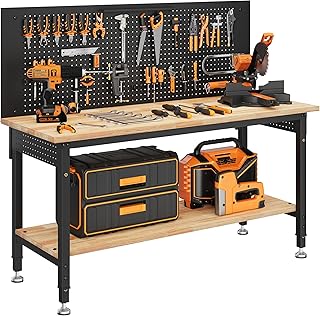
CAMMOO 60″ Work Bench with Storage & Pegboard
The strongest all-round choice here, largely because the pegboard turns the whole back wall into an adjustable lighting rig — hook two clamp lamps at different heights and you get a cross-lit bench with almost no shadow at the die. The onboard power strip and lower shelf keep cords and tumblers off the working plane.
OLBRUS 48″ Adjustable Workbench
A clean, dense hardwood top with a rubber pad and a 2,000 lb frame, which means a bolted single-stage press won’t introduce the micro-tremor that ruins a scale reading. The built-in outlet is well placed for a swing-arm lamp, and the warm wood tone reads far easier under 4000K light than any painted surface.
Frankford Arsenal Platinum Series Reloading Stand
Purpose-built and refreshingly compact, with a wood center panel flanked by steel and storage bins that double as spill-free spots for a puck light. It is the pick if you reload in a corner of a finished room and want a discreet, low-glare station rather than a garage-scale bench.
120″ Adjustable Heavy Duty Workbench
Ten feet of continuous work surface with pegboard and multiple outlets, shipped in two boxes — this is a dedicated reloading room in one purchase. The real advantage is zoning: light the press station bright and cool, keep the case-prep and inspection zone softer and warmer, and never move a lamp again.
47.2″ Heavy Duty Work Bench with Drawer
A tidy small-footprint option with a wood top, metal frame, and a drawer that keeps calipers and primer trays out of the light path. Best suited to a single-press setup where one well-aimed articulating lamp does all the work.
Frequently Asked Questions
What color temperature is best for reloading?
Around 4000K to 5000K with a high color-rendering index. It stays neutral enough to judge brass and powder color honestly without the clinical blue cast that causes eye strain over long sessions.
Do I need more than one light?
Two is the meaningful upgrade. One broad source for general ambience and one aimable task light at a low angle, because raking light is what makes case-neck cracks and high primers visible.
How deep should a reloading bench be?
Twenty to twenty-four inches suits most presses. Deeper tops push work farther from a bench-mounted lamp and force you to lean into your own shadow.
Should the bench be bolted to the wall?
If you run a progressive press, yes. Anchoring stops both the flex and the sympathetic lamp movement that blurs fine visual checks.
Final Thoughts
For most reloaders the CAMMOO 60″ with pegboard is the best balance of structure, power, and mountable lighting surface. Choose the OLBRUS 48″ if you want a denser, quieter hardwood top in a smaller footprint, or the Frankford Arsenal Platinum Series stand if your bench has to look at home in a finished room rather than a garage.